

Indigenous Nigerian food plants show promise in fighting cancer by targeting cell death and inflammation, offering support alongside conventional treatments.
Cancer remains a major global health challenge, and its burden is increasing in Nigeria, where both incidence and mortality rates are on the rise. Common cancers in the region include breast, cervical, prostate, and liver cancers, which contribute significantly to public health concerns.
Despite progress in conventional treatments such as chemotherapy and radiotherapy, there is a critical need for safer, more effective therapeutic options. In this context, indigenous Nigerian food plants have attracted attention for their rich content of bioactive compounds with demonstrated anticancer potential.
A new review examines the underlying mechanisms through which these plants exert their anticancer effects and assesses their potential role as complementary therapies alongside standard cancer treatments.
Indigenous Nigerian Food Plants with Anticancer Properties
Several indigenous plants from Nigeria demonstrate potential anticancer properties, making them valuable candidates for natural cancer therapies. The plants discussed in this review include Spondias mombin, Xanthosoma sagittifolium, Elaeis guineensis, Irvingia gabonensis, Allium cepa, Blighia sapida, Dioscorea dumetorum, Psidium guajava, and Talinum triangulare. These plants contain diverse bioactive compounds, including flavonoids, alkaloids, terpenoids, and phenolic acids, which contribute to their anticancer effects.
Spondias mombin: This plant is rich in carotenoids and flavonoids such as quercetin, which exhibit anticancer activities by inducing apoptosis, inhibiting cell proliferation, and reducing oxidative stress. Quercetin also targets cancer-related signaling pathways, including PI3K/Akt and MAPK, and has anti-inflammatory properties.
Xanthosoma sagittifolium: Known for its anticancer effects against leukemia cells, this plant induces apoptosis, arrests the cell cycle, and inhibits angiogenesis. Its bioactive compounds, including flavonoids and tannins, modulate key cellular pathways, enhancing its potential as a cancer therapeutic.
Elaeis guineensis (Oil Palm): Extracts from oil palm contain tocotrienols, which exhibit potent antioxidant and anticancer properties by reducing oxidative stress and inducing apoptosis in cancer cells. Tocotrienols have shown efficacy in breast cancer models by reducing cell viability and promoting cell cycle arrest.
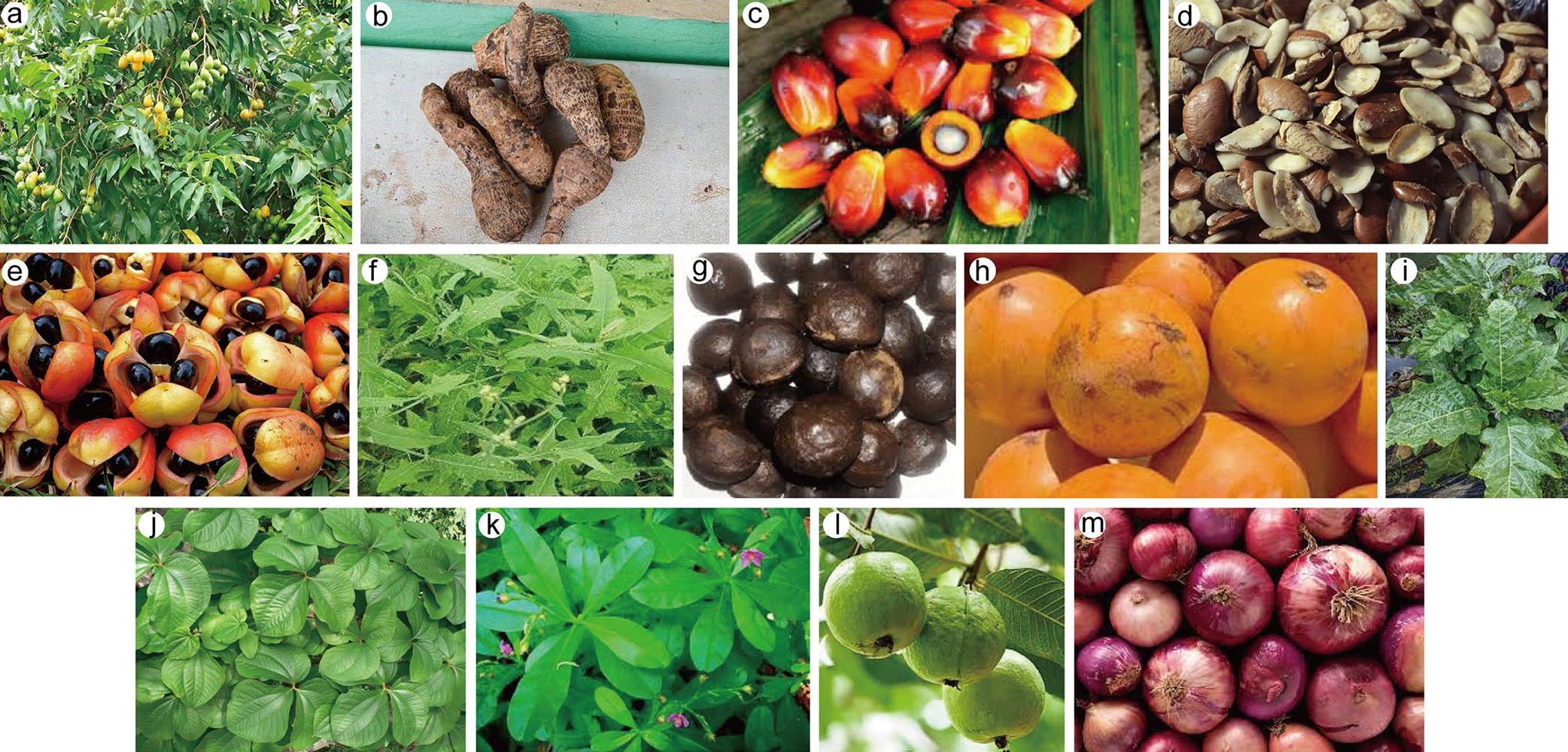
Irvingia gabonensis (African Mango): This plant contains compounds such as flavonoids and tannins, which exhibit antioxidant activity, induce apoptosis, and regulate metabolic pathways involved in cancer progression. Gallotannins found in the seeds also have strong anticancer effects by modulating cellular pathways and enhancing immune responses.
Allium cepa (Onion): Onions are rich in organosulfur compounds, flavonoids, and phenolic acids, which reduce oxidative stress, inhibit cell proliferation, and induce apoptosis. Onions also regulate detoxification enzymes, enhance the immune system, and may help overcome multidrug resistance in cancer cells.
Blighia sapida (Ackee): Ackee contains bioactive compounds like flavonoids and phenolic acids, which inhibit cancer progression through various mechanisms, including the inhibition of the ERK5 signaling pathway in breast cancer and antioxidative activities that prevent DNA damage.
Dioscorea dumetorum (Yam): Diosgenin, a compound in yams, exhibits significant anticancer properties, inhibiting cell proliferation, inducing apoptosis, and modulating signaling pathways like NF-κB and MAPK. Yams also have antioxidant and anti-inflammatory effects that support cancer treatment.
Psidium guajava (Guava): Guava leaves contain tannins, flavonoids, and phenolic acids that induce apoptosis, inhibit cancer cell growth, and prevent DNA damage. Guava also reduces oxidative stress and inflammation, which are key factors in cancer progression.
Talinum triangulare (Waterleaf): This plant is rich in bioactive compounds like quercetin, which induce apoptosis in cancer cells and exhibit antioxidant properties. Its potential anticancer mechanisms include enhancing immune responses and reducing oxidative stress.
Mechanisms of Action
The anticancer effects of these plants are mediated through several mechanisms. These include:
- Induction of Apoptosis: Many of the plants discussed in this review promote programmed cell death in cancer cells. This occurs through the activation of pro-apoptotic proteins and the suppression of anti-apoptotic proteins.
- Cell Cycle Arrest: Several plant extracts induce cell cycle arrest at various checkpoints, such as the G1/S and G2/M phases, by inhibiting cyclin-dependent kinases. This halts tumor cell proliferation and contributes to tumor regression.
- Inhibition of Angiogenesis: By targeting angiogenic factors such as VEGF, these plants prevent the formation of new blood vessels necessary for tumor growth and metastasis.
- Modulation of Inflammatory and Oxidative Stress Pathways: The bioactive compounds in these plants reduce inflammation and oxidative stress, which are crucial factors in cancer initiation and progression.
Future Directions
While the potential of these indigenous food plants in cancer therapy is promising, further research is required to understand their full pharmacological profiles. The current gaps in knowledge include variability in the phytochemical composition of these plants, depending on factors such as soil quality and environmental conditions. There is also a need for more clinical trials to assess the safety and efficacy of these plants in human cancer treatment.
Future studies should focus on standardizing the preparation and dosage of plant extracts, conducting rigorous clinical trials, and integrating traditional knowledge with modern scientific methods. Additionally, public awareness campaigns could educate healthcare professionals and patients about the potential benefits of these plants in complementary cancer therapies.
Conclusion
Indigenous food plants from Nigeria offer a wealth of bioactive compounds with significant anticancer properties. By utilizing their rich phytochemical diversity, these plants present opportunities for complementary cancer therapies that could improve treatment outcomes and reduce side effects.
Integrating these plants into cancer treatment regimens, alongside conventional therapies, could provide more accessible and affordable cancer care, especially in regions with limited medical resources.
Reference: “Anticancer Mechanisms of Indigenous Food Plants in Nigeria” by Adeoye Bayo Olufunso, Adeyemi Funmilayo Elizabeth, Bolade Damilola Comfort, Oyeleke Ibukun Oyebimpe, Oyerinde Ayodeji Michael, Fadeyi Blessing, Olatinwo Goodness Olusayo, Ukangwa Ngozi Angela, Adeshina Halliyah Celine, Onyeyiriuche Chinecherem Chibundo, Aanu-Bakare Grace Olajumoke, Adeoye Ayodeji David, Akano Oyedayo Phillips, Adelakin Lola Adeola, Achor Cornilluis Bangsi, Ajaere Sandra Onyinyechi, Osundina Oluwaseun Babatunde, Olatinwo Mercy Olajoju, Adebayo Barakat Temitope and Olanrewaju Okikiola Olamide, 1 April 2025, Future Integrative Medicine.
DOI: 10.14218/FIM.2024.00042
Never miss a breakthrough: Join the SciTechDaily newsletter.
Follow us on Google and Google News.
1 Comment
I return all the glory to God Almighty for His healing power Through DR MOSES BUBA . I was diagnosed with cancer, and it was one of the most difficult moments of my life. But through faith, prayers, and strength, with the help of DR MOSES BUBA HERBAL MIRACLE MEDICINE God showed up for me. Today, I stand completely healed and cancer-free. What God cannot do does not exist. Thank You, Lord, for giving me a second chance at life. You can also reach for your treatment with his email [email protected]