
Scientists have uncovered a surprising clue about why people with ADHD often struggle to stay focused.
A new study published in JNeurosci examined how brief bursts of sleep-like brain activity in awake adults affect their ability to stay focused during demanding tasks. Elaine Pinggal of Monash University and her colleagues investigated whether this unusual brain activity could help explain attention difficulties commonly seen in people with ADHD.
Comparing Brain Activity in ADHD and Neurotypical Adults
The research team monitored sleep-like brain activity in two groups while they completed a task that required sustained attention. The study included 32 adults with ADHD who were not taking medication and 31 neurotypical adults.
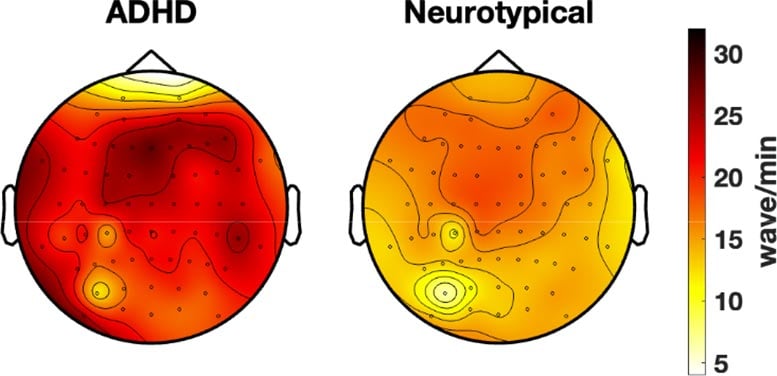
Participants with ADHD showed more episodes of sleep-like brain activity during the task. These moments were linked to increased attention lapses compared with the neurotypical group. Additional analysis suggested that this brain activity may help explain the connection between ADHD and attention-related difficulties such as making mistakes during tasks, responding more slowly, and feeling sleepy.
Why Sleep Like Brain Activity Happens
Pinggal explains that these brief brain events are actually a normal part of how the brain responds to demanding mental work.
“Sleep-like brain activity is a normal phenomenon that happens during demanding tasks. Think of going for a long run and getting tired after a while, which makes you pause to take a break. Everyone experiences these brief moments of sleep-like activity. In people with ADHD, however, this activity occurs more frequently, and our research suggests this increased sleep-like activity may be a key brain mechanism that helps explain why these individuals have more difficulty maintaining consistent attention and performance during tasks.”
Could Sleep-Based Interventions Help?
Previous research in neurotypical populations has shown that certain forms of auditory stimulation during sleep can strengthen slow brain waves. This change may help reduce sleep-like brain activity during the following day while a person is awake.
According to Pinggal, a future step for researchers could be testing whether this same approach might also reduce daytime sleep-like brain activity in people with ADHD. If successful, it could open the door to new strategies aimed at improving attention and performance.
Reference: “Sleep-like Slow Waves During Wakefulness Mediate Attention and Vigilance Difficulties in Adult Attention-Deficit/Hyperactivity Disorder” by Elaine Pinggal, James Jackson, Anikó Kusztor, David Chapman, Jennifer Windt, Sean P.A. Drummond, Tim J. Silk, Mark A. Bellgrove and Thomas Andrillon, 15 March 2026, Journal of Neuroscience.
DOI: 10.1523/JNEUROSCI.1694-25.2025
Never miss a breakthrough: Join the SciTechDaily newsletter.
Follow us on Google and Google News.
22 Comments
I can tell you right now that yes it will. I wasn’t diagnosed with ADHD until I was 23 years old. As a teenager, my mom would get upset with me because I would do my homework with the TV and radio on. She would tell me to turn that stuff off so I could concentrate on doing my homework. I told her that having those both going at the same time actually helps me concentrate so I can do my homework. She made me go without the TV and radio for a while quarter, thinking I was making it up. My grades dropped significantly. She let me go back to using the TV and radio and my grades returned to my normal. She asked me to explain. I told her that the best way I can explain it is that I focused part of my focus on each the TV and radio, giving parts of my brain an activity to keep busy, while I focused on my homework. She said if didn’t make sense to her but if it worked to continue. So I did.
When I was in 2nd grade, the school had my mom take me to get my IQ tested, due to having issues in class. They thought that I perhaps needed special ed. When my IQ came back at 122 at age 7.5 +/-, they knew it wasn’t because I needed special ed classes but didn’t know what my problem was. The Dr that finally diagnosed me, told me that when I was a child, ADHD was considered a boys only problem. It wasn’t until years later that they discovered that girls exhibit the symptoms differently than boys do.
I began taking medications for my ADHD as an adult. I wish I had never started medications for it. I lost a lot of the good abilities I had, multitasking, quick thinking, quick reactions, ability to focus on multiple things at a time and keep up with it all. I miss those things. I’ve stopped taking meds and they didn’t come back fully. I’m many ways, I didn’t feel like myself anymore.
If you had three parts presenting every time you did homework you might find Internal Family Systems theory insightful.
Same here, after taking meds I’m definitely not the same & I wasn’t diagnosed until I was 22 s
Thank you sharing
Everyone has interesting way of describing ADHD. I think there different types of ADHD .I didn’t know until junior high school and yet they didn’t say a particular name for it. I know dropped on my forehead at age 3 playing around. I constant busy body. I had a sound that I couldn’t explain to anyone at the age of 10 yrs old. It was like hearing locust sounds or hizzing buzzing all the time. When it came to retaining what I had read after a day . They ask me class in a normal classroom and suddenly,my mind would go blank and it would make feel strange and out of place. I would reread it and again. Finally had to ask someone to test on questions that we had in class suddenly I would forget. Immediately I get the book read it out loud and I had to pretend to be part of the story or I write notes right after reading a sentence or paragraph. The funny part I myself had to figure out way to keep up with school . Yet I was good in math and spelling by memory . At times I had to write a letter on my fingers with just two letters and I remember the entire question or the answers. I felt I was cheating, reality I wasn’t. Until I started taking a separate class one hour a day and listening 🎧 with earphones and that made me pay attention better and understand as well.unfortunatley .They were not advanced more with the problem and program available. I never gave up on myself or anything. Because I had good pronunciation and I knew how to read out loud very well. I have tinintis Maenires Disease.which contributes more stresanous our inner ear and staying focused. There different types of levels ADHD or something that didn’t develop as a premature born at 7 months. I hope that they continue researching for more about the brain internal. Missing link being born too early or head injuries as young child. Happy to share my thoughts on this. Because I suffer anxiety and depression.
Aniexty is part of ADHD
I have the opposite, music doesn’t help me work, it only makes me be able to sleep, but also I can focus a lot better on tests and reading, basically I’m a “bookworm” because when I have no games to play, I get a book and read.
This explains why I need music to even start my tasks!
My brain shuts down or becomes overwhelmed at just the thought of these tasks.
I believe we are wired for sound! (Thanks cliff)
It can pick up my mood or bring me down!
However I am yet to be able to know when I should turn music on!
I need an ai modulation device that picks the moments my brain is disengaging to start a Metallica song or something.
I relate to not knowing when to turn on music, or even eat, drink water, use the restroom, etc, as I get so involved with my thoughts and the task I am doing I don’t think of necessities. However I am multitasking in my brain while focusing intently on the main task. Time slips away due to being so focused and I am often late due to this. I’m old and have dealt with this my entire life and have always felt different, like an outsider. All of this makes holding a job difficult.
I relate to having time feel like it’s endlessly passing, it happens to me when I read
Thank you Sara, that explains a lot to me about myself
ADHD is created when you can’t stop scrolling on social media apps, tell yourself how long does it take for you to scroll until you get bored? and then fix it because if you don’t, then people won’t respect you when you conversate with them because you’ll be too busy looking at your phone when I’m reality, that doesn’t and shouldn’t matter
My mom has inattentive adhd, as does my daughter, and myself. My mom was born in 52, plus she lived out in the country and played outdoors and all that good stuff – they didn’t have all this technology to “get” adhd. It can be hereditary according to my daughter’s psychiatrist. Most of my whole family on both my dad and my mom’s sides have adhd AND autism, which autism also is now known to run in families, but since it is a spectrum then it can be harder to notice in some people, especially if a person has the combo of audhd – because the two factors can be at odds with each other and sometimes “cancel out” certain aspects that someone with solely with adhd OR autism could be more prominent in. Not only that, but many of us have learned to cope and adjust our lives to fit into the world, and self-medicating/self-soothing, which can include mindlessly scrolling, and also some of us have an aversion to interacting with others, or the other side of it some of us enjoy “parallel play/hang-outs” rather than direct interaction. Regardless of our motivation or lack thereof, it is scientifically proven that both adhd and autistic brains are wired differently than neurotypical brains, they both share the commonality of having executive dysfunction in the prefrontal cortex.
Yo, everybody gather around and listen to this person without ADHD tell us how our brains work
The study seems to have completely missed the aspect of ADHD, which is that it’s an inability to focus or the ability to completely focus on one thing. And it’s always both of these.
So that means the study needs to take into account. Whether or not the focus task is actually either stressful or interesting to the person with ADHD because that means that the person is in a state of hyper focus and that’s where you should be testing when this sleep pattern turns on or off or changes how it shows up. And you also need to check those with ADHD while the task is definitely boring.
Because this information does not specify what the focused task was, just that it was focused. We have no idea if the ADHD individuals in the study found that task boring or interesting, and depending on which one it did, you could see a different result in how those sleepy parts of the brain respond or interact.
Hypothetically speaking, it is entirely possible that a boring focus task shows what the this study is demonstrating, but if you did the exact same study with a focus task that the ADHD individuals found interesting or had a stressful reason to need to do that, those centers might turn off entirely, meaning that that doesn’t fire at all.
Thus, you can explain both the attention deficit and the hyper focus than those with ADHD experience properly.
And if the hypothesis I have is correct, which is that if the focus task is interesting to the ADHD individual, those sleep centers won’t activate at all. Meanwhile, in a normal person they would still activate at their usual rate. Meaning that the actual underlying mechanism for ADHD is that the heightened brain speed and perception lead to more tasks being labeled as boring. Therefore, potentially sleep inducing. And anything that falls outside of those categories. They lack the ability to go to sleep or have those portions go to sleep entirely.
I feel like this study because it didn’t check whether or not the focus task was boring or interesting or stressful. Sort of failed at what it was setting out to do because it didn’t look at those for a condition like ADHD which experiences both a lack of focus and an exceptional amount of focus, not one or the other. But the frequency that a single ADHD individual will have either or of these is different individually.
Sam,
You are spot on. That is the best description I’ve encountered based on my lack ability to focus on anything I’m not interested in/consider boring or mundane…even to the point of falling asleep. I do feel that upbeat music helps to wake me up and give me energy which I use in the morning when my alarm goes off and during tasks like cleaning the house. I haven’t used it for studying but I’m going to try now!
I was thinking the same as you, it would totally change the results.
Bravo
Active sleep that is a good way of naming it. I remember my home model being nonconductive to my homework time untill everyone was finishing bed time routines. I would spend 3pm-5pm jumbling around noises, spaces, lighting, and trying to remember all 6 cases of tasks. Eat and be done with my bed time routines first so I can have enough space to do what I needed. Unfortunately I would have to give up at 12 because after ten I got interrupted every 10 minutes to be reminded of my lagging on finishing. I learned to set my requirements up and said It’s my choice to finish. Unfortunately I would be dead tired by morning. I began to notice I was getting atonomic fact recal but not remember the lecture. I had to sleep, but not look like it. It felt like I would sleep in parts for my brain halves to rest. I figured a dolphin could do it why can’t I.
I’m wondering if ADHD is related to narcolepsy. Like it could be another form of it. I’ve had two sleep studies that said I might have narcolepsy. I do feel like my brain falls asleep during the day while I’m “awake” and I tend to operate “out of habit” and zone out and sometimes have no memory of things I just did. I do have trouble paying attention. I always just thought it was due to fatigue as I have chronic fatigue syndrome and I’m ALWAYS tired during the day.
Other commenters mentioned having music on to help them focus and I’ve been doing that while driving for decades. I just feel like I’m a better driver with music on, when the opposite should be true. I think if I’m singing along with the song, that prevents my mind from thinking in words, so I am preventing myself from being distracted by my own thoughts. That’s my theory.
I have never been diagnosed with either narcolepsy or ADHD but I might have both. I hate doctors and can’t take most Rx drugs so I haven’t bothered to pursue a diagnosis.
I am a 78 year old man who was diagnosed with ADD in my 40’s. I also had an IQ test by the psychologist who we had taken our daughter to who also was diagnosed. I have a high IQ. In high school I had subjects in the 80’s and 90’s and subjects in the 40’s. If interesting I did well. If not interesting not so well. With all that I have been very successful in life. Success in income -with my wife’s support built a thriving business and have retired comfortably. I learned that being bright is good, but that being kind and considerate and treating others well is even better. I refused any meds (ritalin) and we refused my daughter any meds and highly recommend against it. I think medicating people with ADDor ADHD that they call it now (I’ve never been hyperactive) so to me I am ADD.
I am wondering if this study controlled for sleep deprivation. A high percentage of people with ADD/ADHD have chronic sleep issues related to arousal/sensory challenges. This alone could explain the higher frequency of sleep like states in people with adhd. If controlled for, and the difference remains significant …that would be really interesting.
A test dependant on boring or otherwise uninteresting tasks will absolutely lead to a ‘sleep-like’ state in the brain of those of us with ADHD. I’d be interested to see a comparison between someone with ADHD focusing on something interesting or engaging compared to a neurotypical individual. While I can’t speak for everyone, I can say from experience that I myself tend to hyperfocus on tasks I find interesting.. and often forget to eat or drink anything when doing so, sometimes for hours.