

Aditya-L1, a new solar observatory launched in 2023, wasted no time proving its worth. Just a few months after it was launched, the spacecraft observed one of the most violent flare eruptions on the sun – from its origin to its full release.
In February 2024, the Sun unleashed a massive burst of radiation and energy into space. Fortunately, Aditya-L1, India’s newly launched solar probe, was watching. Just months after its launch, the spacecraft recorded the first-ever images of a solar flare in the lowermost layers of the Sun’s atmosphere—a region that other solar observatories cannot see from afar.
This groundbreaking data will provide valuable insights into how solar flares originate and evolve as they move through different layers of the Sun’s atmosphere. By studying these eruptions more closely, scientists hope to better understand their formation, behavior, and potential impacts on Earth.
A Newcomer Among Solar Observatories
Among the many solar probes in space, Aditya-L1 is a recent addition. Launched in September 2023, this Indian solar observatory quickly settled into its position at the L1 Lagrange point, a stable orbit between Earth and the Sun. Equipped with seven scientific instruments, Aditya-L1 did not have to wait long for a significant event.
On February 22, 2024, a massive X6.3-class solar flare erupted from the Sun’s surface, facing Earth. This type of flare is among the most powerful bursts of radiation, capable of disrupting satellites, power grids, and radio communications. Just months later, similarly intense flares triggered spectacular auroras, visible as far south as southern Europe. NASA’s Solar Dynamics Observatory (SDO), ESA’s Solar Orbiter, and several ground-based telescopes also turned their attention to these dramatic solar events.
A Powerful Solar Flare Captured
The Solar Orbiter, which involves the Max Planck Institute for Solar System Research, orbits much closer to the Sun, about 42 million kilometers away, compared to Aditya-L1’s 150 million kilometers. However, Aditya-L1 has a unique advantage: it can observe where solar flares originate.
As a flare erupts, it moves through different layers of the Sun’s atmosphere, starting at the surface, which is around 5,800°C, and reaching the corona, where temperatures soar to over a million degrees Celsius. This extreme heating causes the flare to emit energy in different parts of the electromagnetic spectrum, starting with visible light, shifting to ultraviolet (UV) radiation, and eventually producing X-rays in the corona. Scientists believe the increasing temperature of the plasma as it moves outward is due to the Sun’s constant energy eruptions, which heat the surrounding regions.
Both Solar Orbiter and Aditya-L1 carry advanced instruments to track these changes. Notably, Aditya-L1’s Solar Ultraviolet Imaging Telescope (SUIT) specializes in detecting long-wave UV light (200-400 nanometers), allowing it to observe the lower chromosphere, the region where solar flares originate, with unprecedented detail. Until now, this critical layer of the Sun had been difficult to study at such high resolution.

Unraveling the Mysteries of Solar Heating
“It is a great stroke of luck that Aditya-L1 was able to witness such a strong flare right at the beginning of its research career,” says Sami Solanki, director at MPS and co-author of the current publication. “Together with observations from other probes and telescopes, this for the first time provides a complete picture of the processes that occur in different layers of the solar atmosphere during a flare,” he adds.
The flare on February 22, 2024, originated in a region in the Sun’s northern hemisphere among a group of sunspots. It lasted about 35 minutes and reached its peak at around 22:34 (UTC). In the SUIT images, during this period a bright flashes can be seen at two closely adjacent locations.
Tracking Energy Across Solar Layers
For the current publication, the team also analyzed data from Aditya’s spectrometer, Solar Low Energy X-ray Spectrometer (SoLEXS), as well as data from other space probes and ground-based solar observatories. In this way, the team was able to track how the released energy propagates through the different layers of the solar atmosphere. For example, the analysis shows that the flare in the lower solar atmosphere is directly accompanied by a temperature increase in the outer atmosphere, the corona.
Reference: “Near- and Mid-ultraviolet Observations of X-6.3 Flare on 2024 February 22 Recorded by the Solar Ultraviolet Imaging Telescope on board Aditya-L1” by Soumya Roy, Durgesh Tripathi, Sreejith Padinhatteeri, A. N. Ramaprakash, Abhilash R. Sarwade, Nived V. N., Janmejoy Sarkar, Rahul Gopalakrishnan, Rushikesh Deogaonkar, K. Sankarasubramanian, Sami K. Solanki, Dibyendu Nandy and Dipankar Banerjee, 28 February 2025, The Astrophysical Journal Letters.
DOI: 10.3847/2041-8213/adb0be
About Aditya-L1
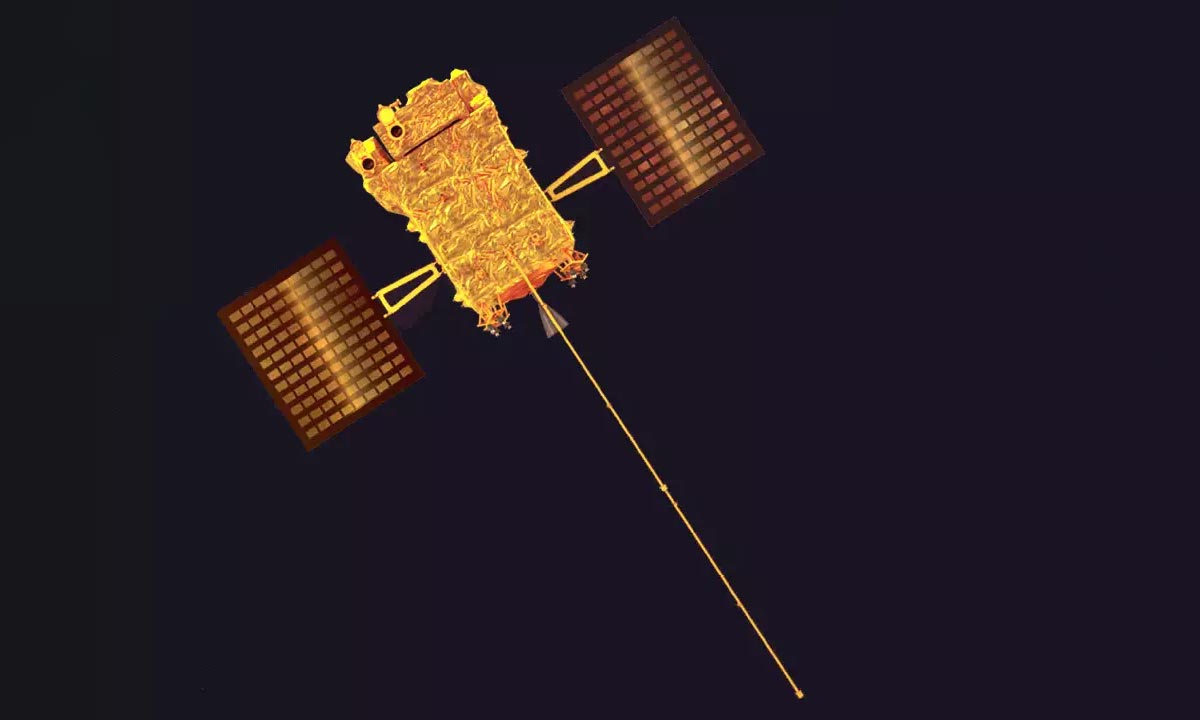
Aditya-L1 is India’s first dedicated solar mission, developed by the Indian Space Research Organization (ISRO). Launched in 2023, the spacecraft is designed to study the Sun from the L1 Lagrange point, providing continuous observations of solar activity.
A key instrument aboard Aditya-L1 is the Solar Ultraviolet Imaging Telescope (SUIT), originally conceptualized by the Max Planck Institute for Solar System Research (MPS). SUIT was designed, developed, and built by the Inter-University Centre for Astronomy and Astrophysics (IUCAA) in Pune, India, which also led the current publication based on Aditya-L1’s observations. Three scientists from MPS are active members of the SUIT team, contributing their expertise to this groundbreaking project.
Aditya-L1 aims to advance our understanding of solar flares, the Sun’s atmosphere, and space weather, providing crucial data that could help protect satellites, power grids, and communication systems on Earth.
Never miss a breakthrough: Join the SciTechDaily newsletter.
Follow us on Google and Google News.