
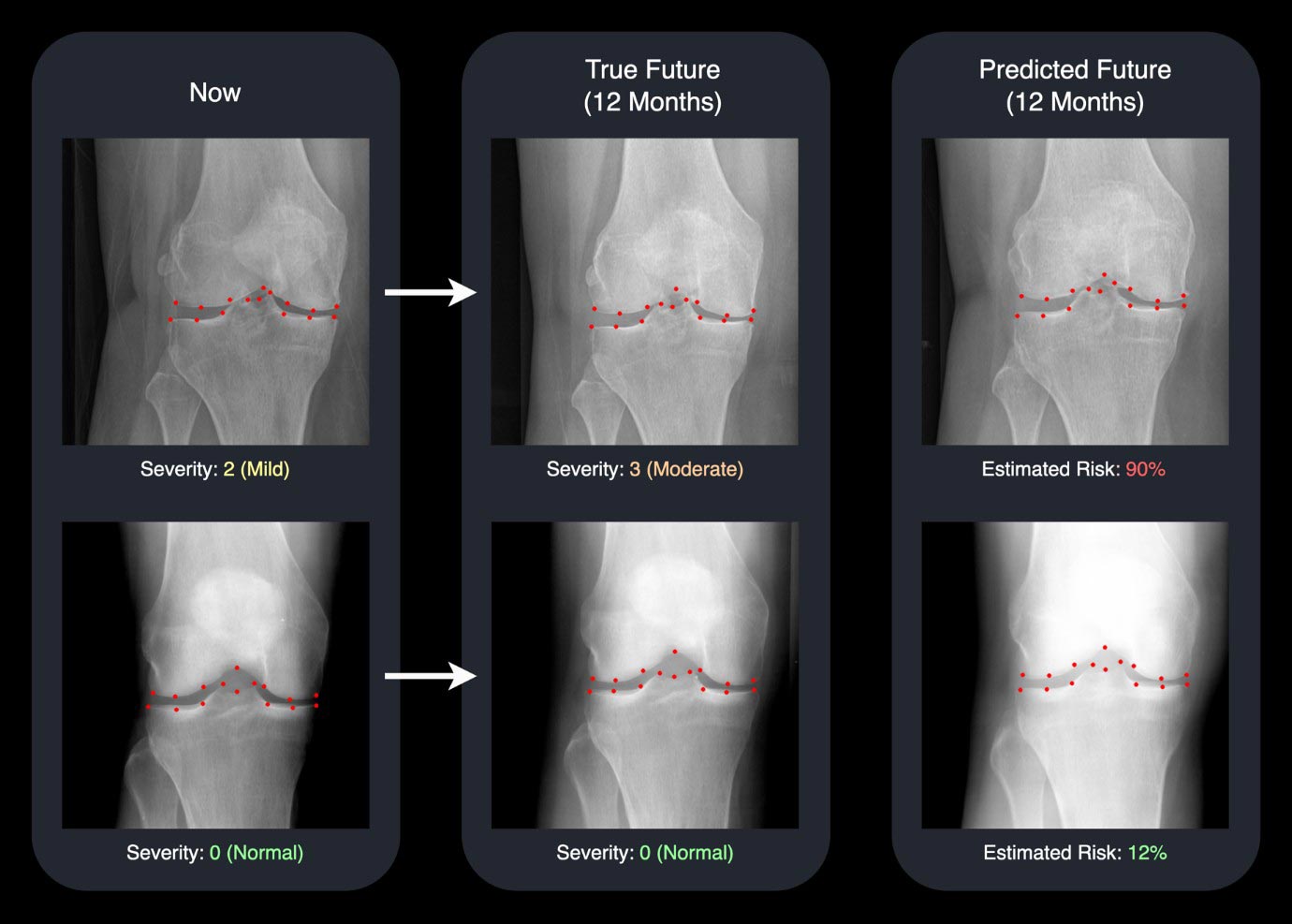
An AI system developed at the University of Surrey can predict future knee X-rays, helping reveal how osteoarthritis may worsen over time. By turning complex predictions into clear images, it gives doctors and patients a better chance to act early.
Researchers at the University of Surrey have created an artificial intelligence system that can estimate what a patient’s knee X-ray may look like one year into the future. The technology could significantly change how people with osteoarthritis understand their condition and make decisions about treatment and lifestyle changes.
Turning Data Into Visual Predictions
The findings were presented at the International Conference on Medical Image Computing and Computer Assisted Intervention (MICCAI 2025). The study explains how the Surrey team uses advanced machine learning to produce a realistic “future” knee X-ray together with a score that estimates how likely the disease is to progress. When viewed together, these results give both doctors and patients a clearer and more visual sense of what may lie ahead.
A Global Condition Meets Large Scale AI
Osteoarthritis is a degenerative joint disease affecting more than 500 million people worldwide and is the leading cause of disability among older adults. The new system was trained on nearly 50,000 knee X-rays from almost 5,000 patients, making it one of the largest osteoarthritis datasets ever used for this purpose.
According to the researchers, the AI predicts disease progression more accurately than similar tools while operating around nine times faster and in a more compact form, which could help it move into everyday clinical use sooner.
Showing Patients What the Numbers Mean
David Butler, the study’s lead author from the University of Surrey’s Centre for Vision, Speech and Signal Processing (CVSSP) and the Institute for People-Centred AI, said:
“We’re used to medical AI tools that give a number or a prediction, but not much explanation. Our system not only predicts the likelihood of your knee getting worse – it actually shows you a realistic image of what that future knee could look like. Seeing the two X-rays side by side – one from today and one for next year – is a powerful motivator. It helps doctors act sooner and gives patients a clearer picture of why sticking to their treatment plan or making lifestyle changes really matters. We think this can be a turning point in how we communicate risk and improve osteoarthritic knee care and other related conditions.”
How the Technology Builds Trust
The system relies on a type of generative AI known as a diffusion model. It creates a projected future knee X-ray and marks 16 key points within the joint. By showing exactly which areas the AI is tracking for change, the system becomes more transparent and easier for clinicians to understand and trust.
Beyond Knees and Osteoarthritis
The researchers believe this approach could eventually be adapted to other long-term health problems. Similar tools might one day help predict lung damage in smokers or monitor the progression of heart disease, giving patients and doctors visual insight that supports earlier action. The team is now looking for partners to help bring the technology into real clinical settings.
A Shift Toward Clearer Medical AI
Gustavo Carneiro, Professor of AI and Machine Learning at Surrey’s Centre for Vision, Speech and Signal Processing (CVSSP), said:
“Earlier AI systems could estimate the risk of osteoarthritis progression, but they were often slow, opaque, and limited to numbers rather than clear images. Our approach takes a big step forward by generating realistic future X-rays quickly and by pinpointing the areas of the joint most likely to change. That extra visibility helps clinicians identify high-risk patients sooner and personalize their care in ways that were not previously practical.”
Reference: “Risk Estimation of Knee Osteoarthritis Progression via Predictive Multi-task Modelling from Efficient Diffusion Model Using X-Ray Images” by David Butler, Adrian Hilton and Gustavo Carneiro, 20 September 2025, Medical Image Computing and Computer Assisted Intervention – MICCAI 2025.
DOI: 10.1007/978-3-032-05185-1_52
Never miss a breakthrough: Join the SciTechDaily newsletter.
Follow us on Google and Google News.
2 Comments
We’ve been reading stories like this about how AI can read imaging and diagnose better than MD’s.
But yet, these systems never seem to get to the market, are not used outside of research labs.
Let’s get this technology out so it can be used in everyday analysis.
thanks for the last information