
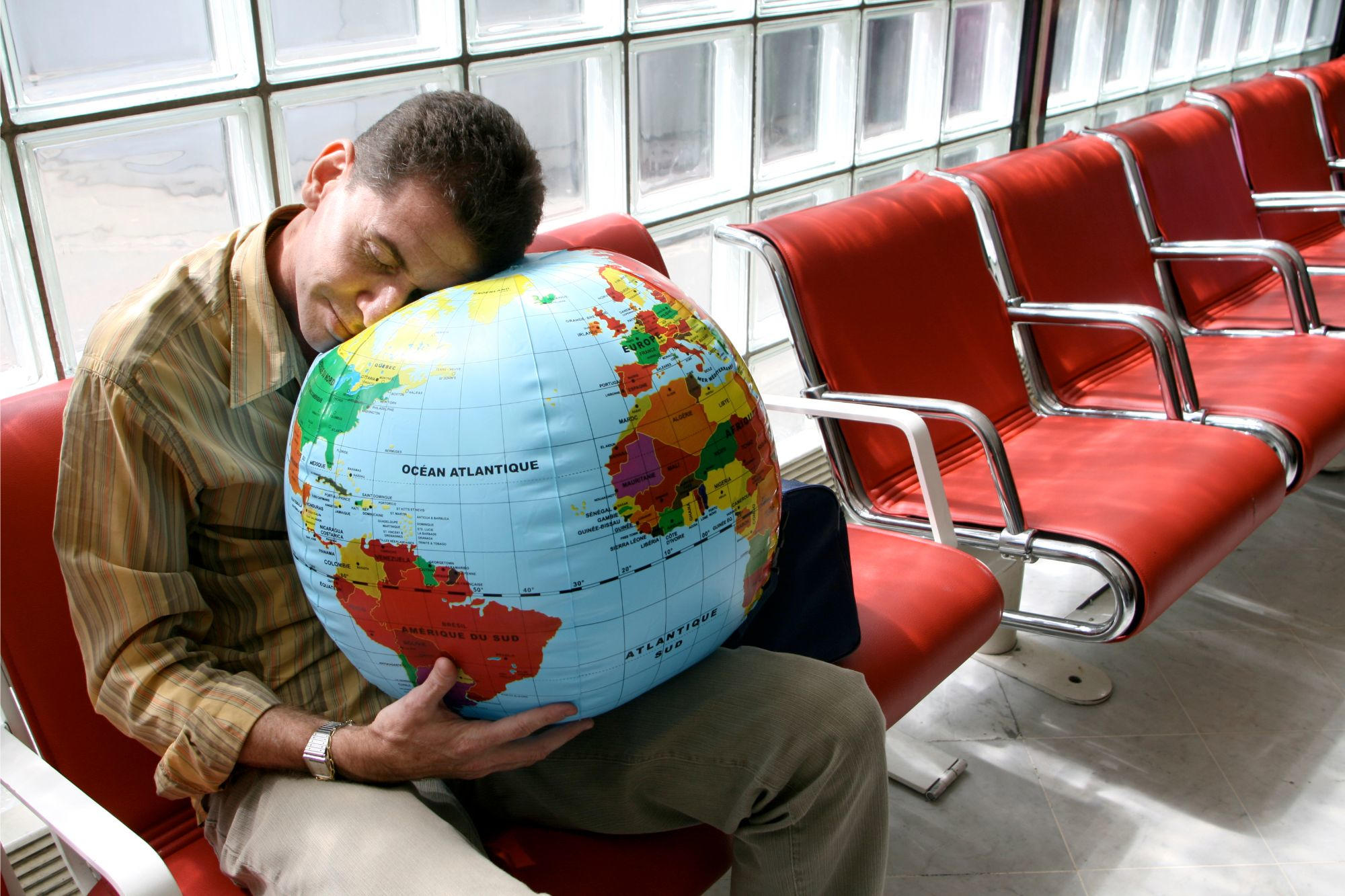
Airports often witness a spectrum of unusual behavior, from harmless quirks to serious disturbances, fueled partly by alcohol.
This setting, which acts as a psychological and environmental threshold, pushes many to behave out of character, driven by a mix of stress, anxiety, and the disorienting effects of being in a liminal space. Exploring both the constraints and liberations of airport environments reveals how they can significantly alter human behavior.
Unruly Behavior in Transit
Many of us have witnessed unusual or even disruptive behavior at airports and on flights. This can range from harmless actions, like passengers sleeping on the floor or practicing yoga near the flight information screens, to more serious incidents, such as heated drunken arguments in the early morning or even attempts to open airplane doors mid-flight.
More severe incidents appear to have become more frequent in recent years, with a rise in air rage cases and flight diversions. In response, there have been increasing calls to limit or ban alcohol sales at airports and on planes. For example, Ryanair has proposed a two-drink limit at airport bars to help curb in-flight disturbances.

Psychological Factors at Airports
But why do airports seem to bring out such unusual behavior? The answer lies in psychology.
For many travelers, the airport marks the exciting start of their vacation, putting them in a different mindset. Eager to embrace relaxation and indulgence, they may behave more freely than usual.
On the other hand, some passengers experience anxiety about flying, which can cause them to act out of character or turn to alcohol for comfort. The overwhelming environment of airports – crowded terminals, loud announcements, and long lines – can intensify stress. Research in environmental psychology shows that people are highly sensitive to their surroundings and can become overwhelmed by excessive noise and congestion, leading to heightened emotions and unpredictable reactions.
Stress and Anxiety in Transit
Stress and anxiety produce irritability, both on a temporary and ongoing basis. People who are generally anxious are more prone to anger. And a temporary anxious mood often triggers angry outbursts.
In my view, we also need to look at the airport from a psychogeographic perspective. Psychogeography studies the effect of places on people’s emotions and behavior, particularly urban environments.
In Celtic cultures, there is a concept of special “thin places” – often sacred groves or forests – where the veil between the material and spiritual world is thin. In thin places, we are between two realms, neither fully in one place nor another.

The Concept of Time and Place at Airports
In the modern technological world, airports can also be seen as “thin places.” They are liminal zones where boundaries fade. On a literal level, national borders dissolve. Once we pass through security, we enter a no man’s land, between countries. The concept of place becomes hazy.
In a similar way, time becomes a hazy concept at airports. About to step on a plane, we are in a liminal space between two time zones, about to leap forward in time, or even head back into the past. Some flights across the US – such as Atlanta to Alabama – land earlier than departure time, as they cross time zones. Being able to manage our time gives us a sense of control over our lives. Losing this may be another source of anxiety.
In another sense, airports are a zone of absence, where the present moment is unwelcome. Everyone’s attention turns towards the future, to their flights and the adventures ahead of them when they arrive at their destination. This intense future focus often brings frustration, especially if flights are delayed.
Social Dynamics in Airports
Personal boundaries also become fluid. As well as anti-social behavior, airports may play host to pro-social behavior, where strangers share their travel and holiday plans, speaking with unusual intimacy. In no man’s land, normal social inhibitions don’t apply. And alcohol can further lubricate this social cohesion.
Due to the haziness of time and place, airports create a sense of disorientation. We define ourselves in terms of time and place. We know who we are in relation to our daily routines and our familiar environments. We also define ourselves in terms of nationality. Without such markers, we may feel adrift. Whether caused by psychological or environmental factors, and even if only temporary, disorientation can have detrimental effects.
The Liberating Effects of Airports
On the plus side, all of this may have a liberating effect for some of us. As I point out in my book Time Expansion Experiences, we normally view time as an enemy that steals the moments of our lives and oppresses us with deadlines. So to step outside time sometimes feels like being let out of prison.
The same applies to identity. A sense of identity is important to our psychological health, but can become constricting. Like actors who are stuck playing the same character in a soap opera week after week, we enjoy the security of our roles but long to test and stretch ourselves with new challenges. So to step outside our normal routines and environments feels invigorating. Ideally, the freedom that begins at the airport continues throughout our foreign adventures.
Freudian Perspective on Airport Behavior
Ultimately, whether we feel anxious or liberated, we may end up acting out of character.
In line with the theories of psychologist Sigmund Freud, this could be interpreted as a shift from our normal civilized ego to the primitive, instinctive part of the psyche, which Freud called the id. According to Freud, the id is the site of our desires and drives, our emotions and aggression, and it demands instant gratification. The id is normally held in check by the ego, but is always liable to break through, especially when our inhibitions are loosened by alcohol or drugs.
Outside normal restraints, some holidaymakers allow their id to express itself as soon as they pass through security. And once they become intoxicated, the id is completely dominant, and liable to cause mayhem.
The Case for Restricting Alcohol
Banning alcohol from airports may sound draconian. But given that there are so many factors that encourage anti-social behavior, it is difficult to think of any other solution. In a situation when boundaries break down, leading to possible chaos, a legal boundary may be the only hope.
Written by Steve Taylor, Senior Lecturer in Psychology, Leeds Beckett University.
Adapted from an article originally published in The Conversation.
Never miss a breakthrough: Join the SciTechDaily newsletter.
Follow us on Google and Google News.
3 Comments
airrorts are not shamanic “thin places” science is grasping
They got nothing on me. I don’t fly. Never have, never will.
Boba just because you weigh 6 tons doesn’t mean you need to gloat about that.