
The Devices Can Be Recharged With Light
University of California San Diego researchers have created soft devices containing algae that, when subjected to mechanical stress, such as being squeezed, stretched, twisted, or bent, glow in the dark. The devices are perfect for creating soft robots that explore the deep sea and other dark areas since they do not need any electronics to light up, according to researchers.
The research was recently published in the journal Nature Communications.
The bioluminescent waves that may sometimes be seen at San Diego’s beaches during red tide events served as the researchers’ inspiration for these gadgets. The senior author of the research, Shengqiang Cai, a professor of mechanical and aerospace engineering at the UC San Diego Jacobs School of Engineering, was intrigued to find out more about what creates this stunning display while watching the glowing blue waves with his family one spring night.
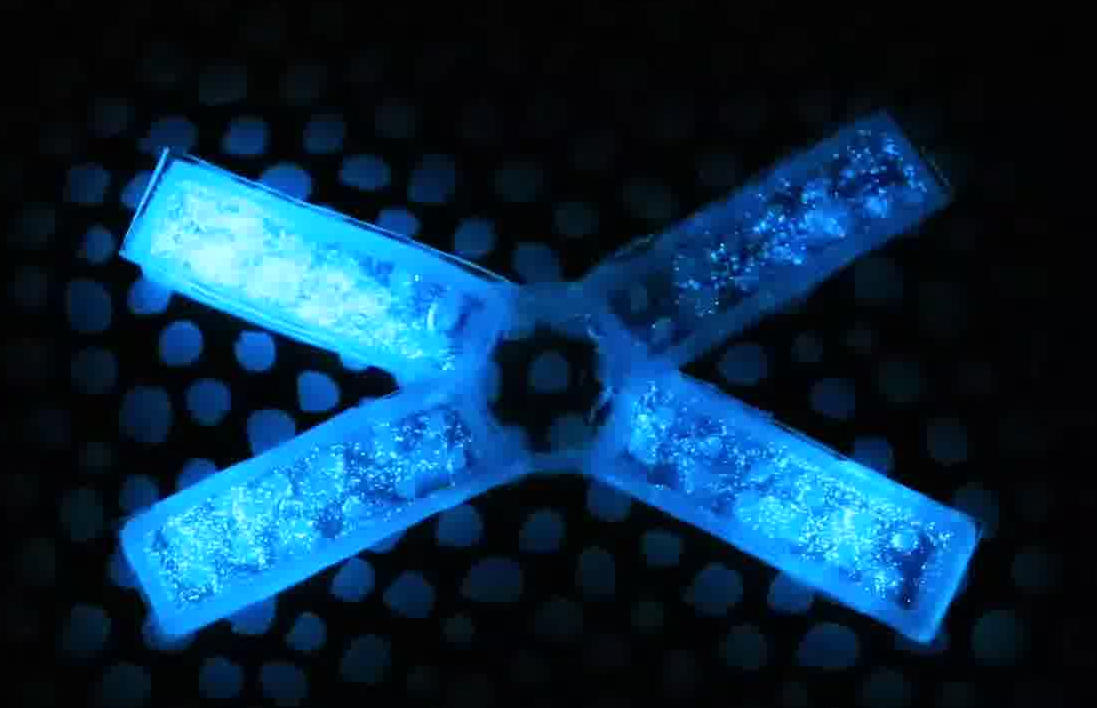
UC San Diego researchers developed soft devices containing algae that glow in the dark when experiencing mechanical stress, such as being squished, stretched, twisted or bent. The devices do not need electronics to produce light, making them ideal for building soft robots for exploring the deep sea and other dark environments. Credit: UC San Diego Jacobs School of Engineering
The source of the glow is a type of single-celled algae called dinoflagellates. But what fascinated Cai, in particular, was learning that dinoflagellates produce light when subjected to mechanical stress, such as the forces from the ocean waves. “This was very interesting to me because my research focuses on the mechanics of materials—anything related to how deformation and stress affect material behavior,” he said.
Cai wanted to harness this natural glow to develop devices for soft robots that can be used in the dark without electricity. He teamed up with Michael Latz, a marine biologist at UC San Diego’s Scripps Institution of Oceanography, who studies bioluminescence in dinoflagellates and how it responds to various water flow conditions. The collaboration was a perfect opportunity to merge Latz’s fundamental research on bioluminescence with Cai’s materials science work for robotics applications.
Developing Stress-Activated Glowing Devices
To make the devices, the researchers inject a culture solution of the dinoflagellate Pyrocystis lunula inside a cavity of a soft, stretchy, transparent material. The material can be any shape—here, the researchers tested a variety of shapes including flat sheets, X-shaped structures, and small pouches.
When the material is pressed, stretched, or deformed in any way, it causes the dinoflagellate solution inside to flow. The mechanical stress from that flow triggers the dinoflagellates to glow. A key feature of the design here is that the inner surface of the material is lined with small pillars to give it a rough inner texture. This disturbs the fluid flow inside the material and makes it stronger. A stronger flow applies more stress to the dinoflagellates, which in turn triggers a brighter glow.
The devices are so sensitive that even a soft tap is enough to make them glow. The researchers also made the devices glow by vibrating them, drawing on their surfaces, and blowing air on them to make them bend and sway—which shows that they could potentially be used to harvest airflow to produce light. The researchers also inserted small magnets inside the devices so that they can be magnetically steered, glowing as they move and contort.
The devices can be recharged with light. The dinoflagellates are photosynthetic, meaning they use sunlight to produce food and energy. Shining light on the devices during the day gives them the juice they need to glow during the night.
Maintenance-Free Living Ecosystem in Soft Devices
The beauty of these devices, noted Cai, is their simplicity. “They are basically maintenance-free. Once we inject culture solution into the materials, that’s it. As long as they get recharged with sunlight, they can be used over and over again for at least a month. We don’t need to change out the solution or anything. Each device is its own little ecosystem—an engineered living material.”
The biggest challenge was figuring out how to keep the dinoflagellates alive and thriving inside the material structures. “When you’re putting living organisms inside a synthetic, enclosed space, you need to think about how to make that space habitable—how it will let air in and out, for example—while still keeping the material properties that you want,” said study first author Chenghai Li, a mechanical and aerospace engineering Ph.D. student in Cai’s lab. The key, noted Li, was to make the elastic polymer that he worked with porous enough for gases like oxygen to pass through without having the culture solution leak out. The dinoflagellates can survive for more than a month inside this material.
The researchers are now creating new glowing materials with the dinoflagellates. In this study, the dinoflagellates simply fill the cavity of an already existing material. In the next stage of their work, the team is using them as an ingredient of the material itself. “This could provide more versatility in the sizes and shapes that we can experiment with moving forward,” said Li.
The team is excited about the possibilities this work could bring to the fields of marine biology and materials science. “This is a neat demonstration of using living organisms for an engineering application,” said Latz. “This work continues to advance our understanding of bioluminescent systems from the basic research side while setting the stage for a variety of applications, ranging from biological force sensors to electronics-free robotics and much more.”
“Highly robust and soft biohybrid mechanoluminescence for optical signaling and illumination” by Chenghai Li, Qiguang He, Yang Wang, Zhijian Wang, Zijun Wang, Raja Annapooranan, Michael I. Latz and Shengqiang Cai, 7 July 2022, Nature Communications.
DOI: 10.1038/s41467-022-31705-6
The study was funded by the Office of Naval Research and the Army Research Office
Never miss a breakthrough: Join the SciTechDaily newsletter.
Follow us on Google and Google News.