

Close Menu
    Facebook X (Twitter) Instagram
    SciTechDaily
    • Biology
    • Chemistry
    • Earth
    • Health
    • Physics
    • Science
    • Space
    • Technology
    Facebook X (Twitter) Pinterest YouTube RSS
    SciTechDaily
    Home»Health»Algae: The Secret to Faster Skin Regeneration and Wound Healing?
    Health

    Algae: The Secret to Faster Skin Regeneration and Wound Healing?

    By WileyMarch 15, 2023No Comments2 Mins Read
    Facebook Twitter Pinterest Telegram LinkedIn WhatsApp Email Reddit
    Share
    Facebook Twitter LinkedIn Pinterest Telegram Email Reddit
    Healthy Skin Beautiful Face Illustration
    A recent study suggests that microvesicles derived from the freshwater single-celled green algae Euglena gracilis may help speed up skin regeneration and wound healing. These microvesicles contain β-glucan, which regulates the immune system, promotes regeneration, and acts as an antioxidant. Laboratory experiments showed that these microvesicles increased collagen synthesis, proliferation-associated proteins, and the proliferation and migration of skin cells, with promising wound healing results.

    Breakthrough in Skin Regeneration from Algae-Derived Microvesicles

    According to a recent study published in the journal Advanced Materials Interfaces, a product derived from the freshwater single-celled green algae Euglena gracilis may accelerate skin regeneration and wound healing.

    Researchers have created a system utilizing microvesicles that originate from the surface of Euglena gracilis cells. These microvesicles contain β-glucan, a carbohydrate with the capability to regulate the immune system, promote regeneration, and exhibit antioxidant properties.

    In laboratory experiments, these microvesicles promoted the proliferation and migration of skin cells, increasing both collagen synthesis and the expression of proliferation-associated proteins. A wound healing test also generated promising results.
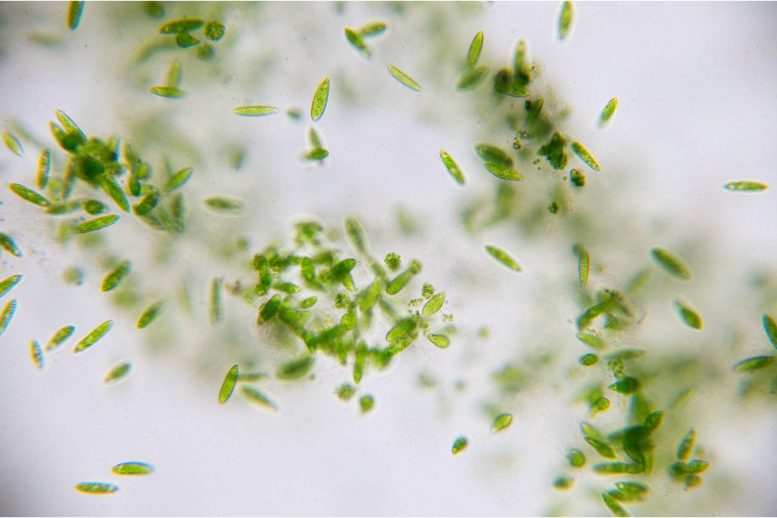
    Euglena Algae
    Euglena gracilis is a single-celled organism belonging to the phylum Euglenophyta. It is a photosynthetic protist and is commonly found in freshwater environments.

    “This technique is expected to be applied to other cells, thereby enabling the design of new types of extracellular vesicles that are applicable for skin treatments and care in the pharmaceutical and cosmetic industries,” the authors wrote.

    Reference: “Nonanimal Euglena gracilis-Derived Extracellular Vesicles Enhance Skin-Regenerative Wound Healing” by Yuri Ko, Hwira Baek, Jee-Hyun Hwang, Youngseok Kim, Kyung-Min Lim, Junoh Kim and Jin Woong Kim, 11 January 2023, Advanced Materials Interfaces.
    DOI: 10.1002/admi.202202255

    Never miss a breakthrough: Join the SciTechDaily newsletter.
    Follow us on Google and Google News.

    Algae Skin Wounds
    Share. Facebook Twitter Pinterest LinkedIn Email Reddit

    Related Articles

    Your Perfume Could Be Destroying Your Body’s Invisible Air Shield

    This Common Fungus Found on Human Skin Wipes Out Deadly Superbug

    Caltech’s Smart Bandage Detects Infection Days in Advance

    “Zombie” Skin Cells Exposed: Three Secret Shapes That Decide If You Age or Heal

    Your Skin Is Breathing – This New Device Finally Knows What It’s Saying

    Scientists Discover a Type of Immune Cell That Produces Defensive “Shields” in the Skin

    How Ebola Hijacks Human Skin for Its Silent Spread

    Beyond the Gross Factor: The Healing Powers of Parasitic Worms

    Genetic Factor Discovery Enables Adult Skin to Regenerate Like a Newborn Baby’s

    Leave A Reply Cancel Reply

    • Facebook
    • Twitter
    • Pinterest
    • YouTube

    Don't Miss a Discovery

    Subscribe for the Latest in Science & Tech!

    Trending News

    New Molecule Restores the Brain’s Natural Defenses Against Alzheimer’s

    Could Creatine Boost More Than Muscles? It May Also Help Depression

    Scientists Discover a Natural Molecule That Could Help Prevent Vision Loss

    Scientists Thought Royal Jelly Made Queen Bees. They Were Wrong

    One Tiny Change May Explain How Viruses Jump From Bats to Humans

    The Secret to Healthy Aging May Be More Protein and More Exercise

    These 567-Million-Year-Old Fossils Are Rewriting the Story of Life on Earth

    The Spider-Like Creatures Helping Scientists Decode the Origins of Fatherhood

    Follow SciTechDaily
    • Facebook
    • Twitter
    • YouTube
    • Pinterest
    • Newsletter
    • RSS
    SciTech News
    • Biology News
    • Chemistry News
    • Earth News
    • Health News
    • Physics News
    • Science News
    • Space News
    • Technology News
    Recent Posts
    • Groundbreaking Study Challenges 40 Years of Beliefs About Mad Cow Disease
    • One Sugar Tells Your Brain You’re Full. Another Barely Does
    • One of Arizona’s Largest Reservoirs Is Less Than 1% Full After Snowpack Collapse
    • Scientists Detect Hundreds of Iceberg Earthquakes at Antarctica’s Crumbling Doomsday Glacier
    • This 400-Year-Old Shark May Hold the Secret to Preserving Human Vision
    Copyright © 1998 - 2026 SciTechDaily. All Rights Reserved.
    • Science News
    • About
    • Contact
    • Editorial Board
    • Privacy Policy
    • Terms of Use

    Type above and press Enter to search. Press Esc to cancel.