
Close Menu
    Facebook X (Twitter) Instagram
    SciTechDaily
    • Biology
    • Chemistry
    • Earth
    • Health
    • Physics
    • Science
    • Space
    • Technology
    Facebook X (Twitter) Pinterest YouTube RSS
    SciTechDaily
    Home»Health»Beyond the Gross Factor: The Healing Powers of Parasitic Worms
    Health

    Beyond the Gross Factor: The Healing Powers of Parasitic Worms

    By Rockefeller University PressAugust 23, 20241 Comment3 Mins Read
    Facebook Twitter Pinterest Telegram LinkedIn WhatsApp Email Reddit
    Share
    Facebook Twitter LinkedIn Pinterest Telegram Email Reddit
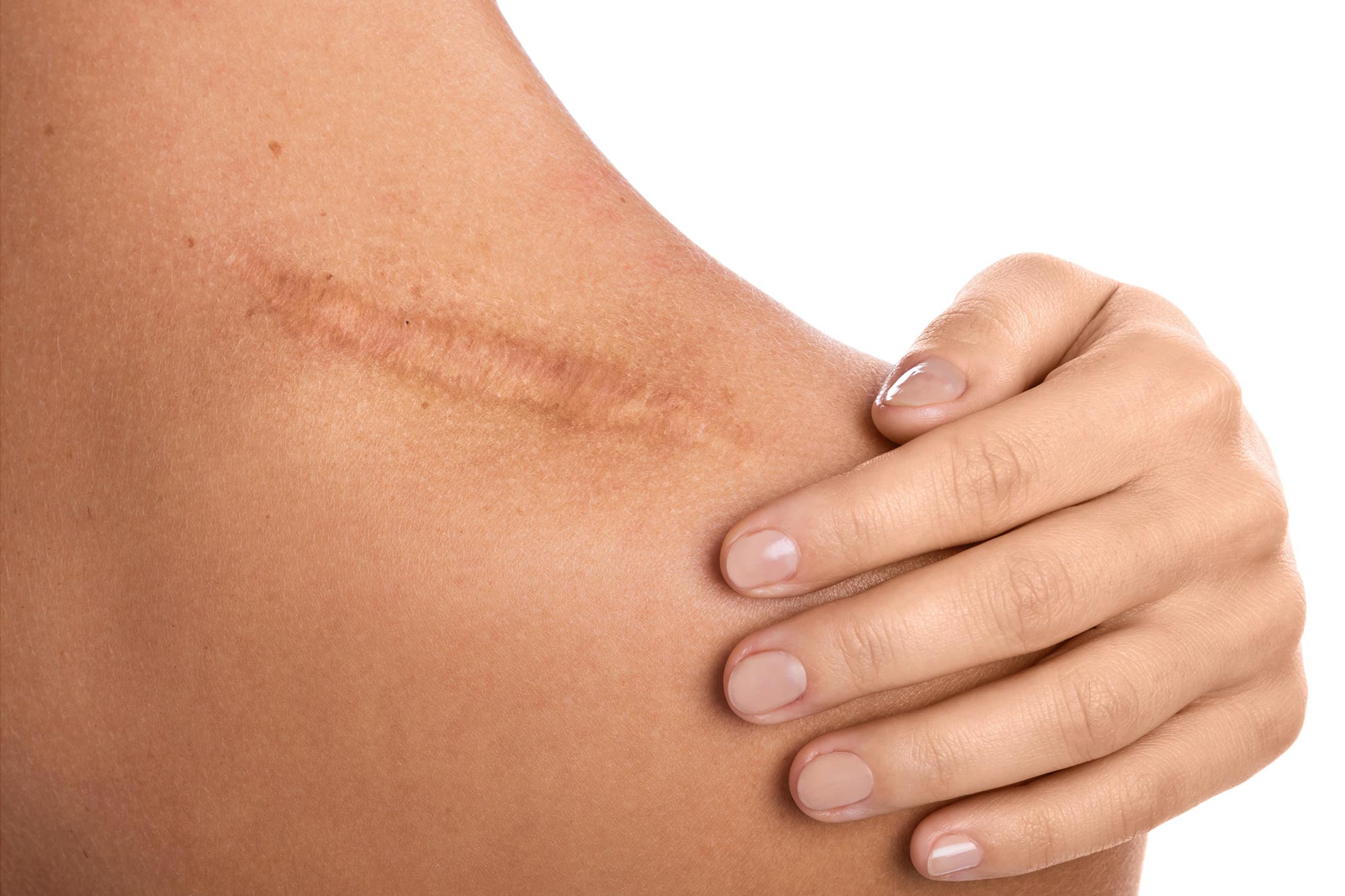
    Woman Shoulder Scar
    A study by Rutgers University reveals that a protein from parasitic worms boosts wound healing and skin regeneration in mice, offering potential for new human treatments that reduce scarring and improve recovery processes.

    Rutgers University researchers have uncovered a protein from gut parasitic worms that accelerates wound healing in mice.

    This protein, when applied to skin wounds, not only quickens healing but also enhances skin regeneration and reduces scarring.

    Groundbreaking Wound Healing Research

    Scientists at Rutgers University in New Jersey have discovered that a protein produced by parasitic worms in the gut enhances wound healing in mice. The study, to be published today (August 23) in the journal Life Science Alliance (LSA), reveals that applying the protein to skin wounds speeds up wound closure, improves skin regeneration, and inhibits the formation of scar tissue. Whether the protein can be harnessed to enhance wound healing in human patients remains to be seen.

    Skin wounds must be rapidly closed in order to prevent infection, but rapid wound closure can favor the development of scar tissue instead of properly regenerated skin. The balance between scarring and successful tissue regeneration is strongly influenced by immune cells recruited to the wound site, and many researchers are interested in finding ways to boost the activity of immune cell types that promote regeneration while inhibiting the activity of immune cells that promote tissue scarring.
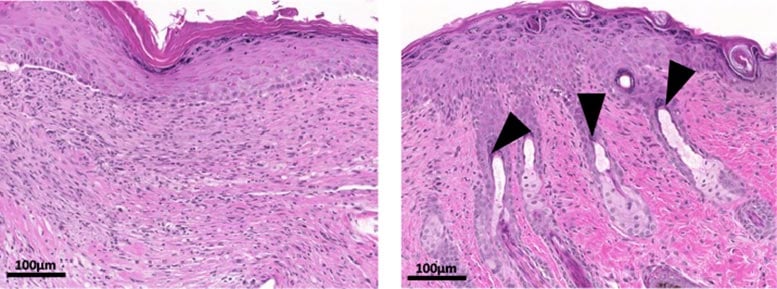
    TGM Promotes Hair Follicle Regeneration After Wounding
    12 days after wounding, untreated skin (left) lacks hair follicles, but TGM treatment (right) promotes the formation of new hair follicles (arrowheads) as the tissue heals and regenerates. Credit: © 2024 Lothstein et al. Originally published in Life Science Alliance. https://doi.org/10.26508/lsa.202302249

    Role of Parasitic Worm Proteins in Regenerative Medicine

    Recent studies have suggested that molecules secreted by parasitic worms might modulate the host’s immune system in ways that promote tissue regeneration. In the new LSA study, a team led by William C. Gause, Director of the Center for Immunity and Inflammation at Rutgers, investigated a protein called TGM that is produced by Heligmosomoides polygyrus, a parasitic roundworm that lives in the intestines of mice and other rodents.

    Gause and colleagues found that daily topical applications of TGM accelerated the closure of skin wounds in mice. Moreover, TGM treatment reduced the formation of scar tissue while enhancing skin regeneration. For example, unlike untreated animals, TGM-treated mice were able to form new hair follicles within the wounded region of the skin.

    Mechanism and Potential of TGM in Wound Therapy

    The researchers determined that TGM works by binding to a signaling protein, called the TGF-b receptor, that is found on the surface of many cell types in mice and humans, including immune cells. TGM treatment appears to stimulate the recruitment of immune cells known as macrophages into wounds and reprograms them to promote tissue regeneration.

    “In this study, we have developed a novel therapy for the treatment of skin wounds that favors regenerative wound healing over tissue fibrosis and scarring,” Gause says. “It provides a significant framework for the potential use of an easy-to-produce parasite protein as a therapy to promote cutaneous wound healing.”

    Reference: “Helminth protein enhances wound healing by inhibiting fibrosis and promoting tissue regeneration” by Katherine E Lothstein, Fei Chen, Pankaj Mishra, Danielle J Smyth, Wenhui Wu, Alexander Lemenze, Yosuke Kumamoto, Rick M Maizels and William C Gause, 23 August 2024, Life Science Alliance.
    DOI: 10.26508/lsa.202302249

    Never miss a breakthrough: Join the SciTechDaily newsletter.
    Follow us on Google and Google News.

    Parasites Regenerative Medicine Skin Wounds
    Share. Facebook Twitter Pinterest LinkedIn Email Reddit

    Related Articles

    This Parasitic Worm Can Turn Off Your Pain and Itch Sensors

    Your Skin Is Breathing – This New Device Finally Knows What It’s Saying

    Breakthrough Drug Reverses Aging in Skin, Speeds Up Healing

    From Corneas to Hearts: Revolutionary Jelly-Like Material Promises To Mend Human Organs

    Transformative Discovery Could Solve Billion-Dollar Problem of Poorly Managed Wound Healing

    The Future of Skin Regeneration: 3D Bioprinting From Fat Tissue

    Algae: The Secret to Faster Skin Regeneration and Wound Healing?

    “Time Jump” by 30 Years: Old Skins Cells Reprogrammed To Regain Youthful Function

    Genetic Factor Discovery Enables Adult Skin to Regenerate Like a Newborn Baby’s

    1 Comment

    1. Sara on February 17, 2026 10:10 am

      EXACTLY what type nematode created her scar?

      I have a peripheral subcutaneous hyper infection creating exactly these patters from throat to breasts, groin to ankles and elbows to fingertips… verdict in is “strongyloidiasis” but that’s as definitive as my Dermatologist will get

      Reply
    Leave A Reply Cancel Reply

    • Facebook
    • Twitter
    • Pinterest
    • YouTube

    Don't Miss a Discovery

    Subscribe for the Latest in Science & Tech!

    Trending News

    Scientists Uncover Potential Brain Risks of Popular Fish Oil Supplements

    Scientists Discover a Surprising Way To Make Bread Healthier and More Nutritious

    After 60 Years, Scientists Uncover Unexpected Brain Effects of Popular Diabetes Drug Metformin

    New Research Uncovers Hidden Side Effects of Popular Weight-Loss Drugs

    Scientists Rethink Extreme Warming After Surprising Ocean Discovery

    Landmark Study Links Never Marrying to Significantly Higher Cancer Risk

    Researchers Discover Unknown Beetle Species Just Steps From Their Lab

    Largest-Ever Study Finds Medicinal Cannabis Ineffective for Anxiety, Depression, PTSD

    Follow SciTechDaily
    • Facebook
    • Twitter
    • YouTube
    • Pinterest
    • Newsletter
    • RSS
    SciTech News
    • Biology News
    • Chemistry News
    • Earth News
    • Health News
    • Physics News
    • Science News
    • Space News
    • Technology News
    Recent Posts
    • Strange 65-Foot Dinosaur Discovered in Argentina
    • Researchers Uncover Source of Strange Deformation in Earth’s Largest Continental Rift
    • Scientists Solve Mystery of Where the Colorado River Vanished Millions of Years Ago
    • Not Just Alzheimer’s: Scientists Uncover Clues to a Second, Overlooked Disorder
    • Scientists Uncover Dangerous Connection Between Serotonin and Heart Valve Disease
    Copyright © 1998 - 2026 SciTechDaily. All Rights Reserved.
    • Science News
    • About
    • Contact
    • Editorial Board
    • Privacy Policy
    • Terms of Use

    Type above and press Enter to search. Press Esc to cancel.