
Close Menu
    Facebook X (Twitter) Instagram
    SciTechDaily
    • Biology
    • Chemistry
    • Earth
    • Health
    • Physics
    • Science
    • Space
    • Technology
    Facebook X (Twitter) Pinterest YouTube RSS
    SciTechDaily
    Home»Technology»Alloy Alchemy: Laser-Crafted Metals Defying the Limits of Strength
    Technology

    Alloy Alchemy: Laser-Crafted Metals Defying the Limits of Strength

    By U.S. Department of EnergyJanuary 10, 20242 Comments4 Mins Read
    Facebook Twitter Pinterest Telegram LinkedIn WhatsApp Email Reddit
    Share
    Facebook Twitter LinkedIn Pinterest Telegram Email Reddit
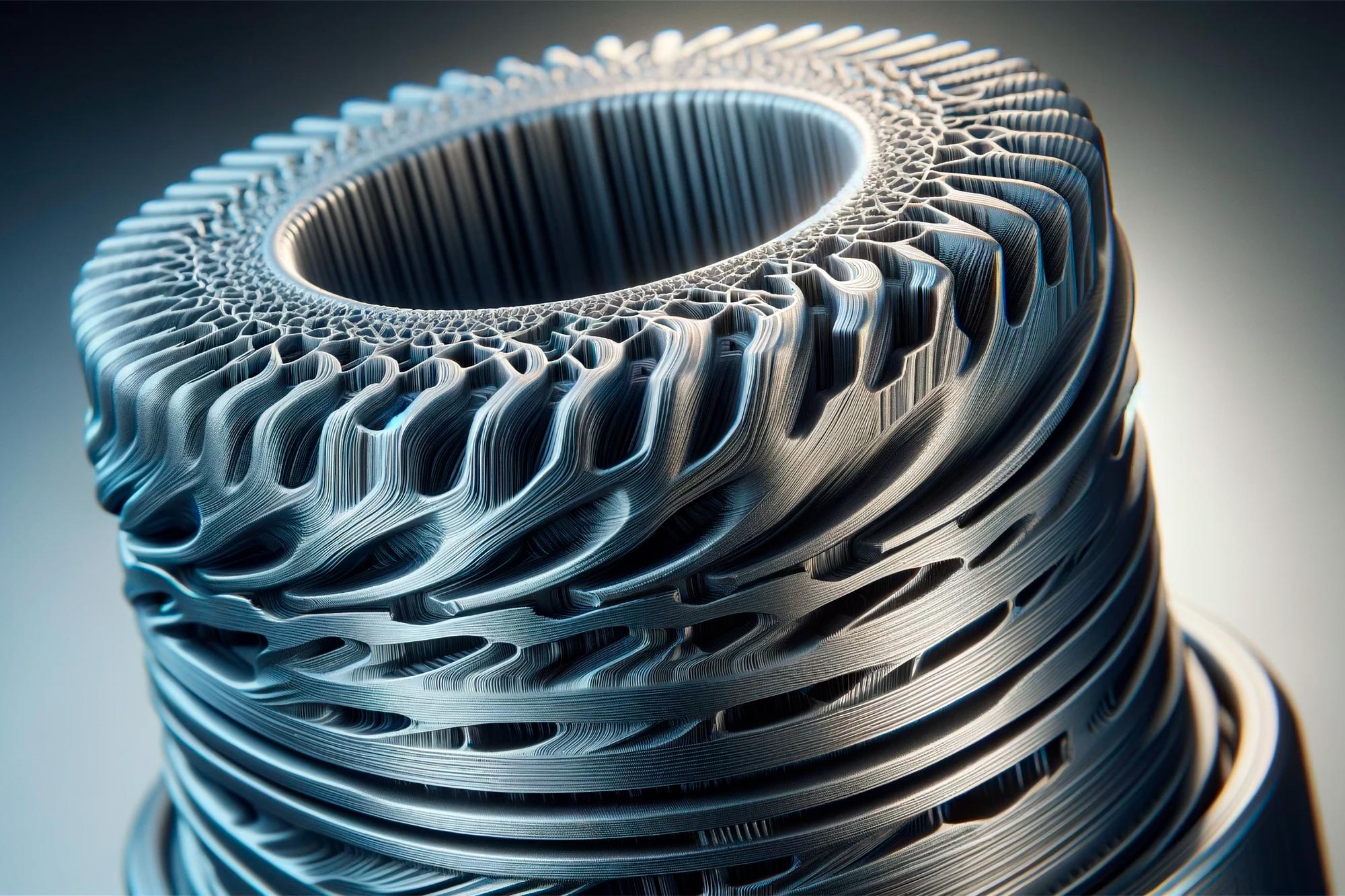
    3D Printed Metal Alloy Art Concept Illustration
    Innovative high-entropy alloys, crafted through laser-based additive manufacturing, offer unprecedented strength and ductility for industrial applications. These new materials, analyzed with advanced techniques, promise enhanced performance in extreme conditions. Credit: SciTechDaily.com

    Laser-based additive manufacturing produces high-entropy alloys that are stronger and less likely to fracture.

    Researchers make a type of material called durable high-entropy alloys (HEAs) by combining several elemental metals. HEAs have potential uses in applications involving severe wear and tear, extreme temperatures, radiation, and high stress.

    They can be made using 3D printing, also known as additive manufacturing (AM), but this usually results in poor ductility. This means 3D-printed HEAs are difficult to shape and do not deform, or stretch, enough under loads to prevent fractures.

    Scientists have now used laser-based AM to form HEAs that are stronger and much more ductile. They used neutron and X-ray scattering and electron microscopy to better understand the mechanisms of these performance improvements.

    Potential Industrial Applications and Energy Efficiency

    Industry could one day use stronger and more easily shaped HEAs in manufacturing. To work in these applications, light and complex HEA parts need improved durability, reliability, and resistance to fracturing.

    This would benefit consumers and industry, for example, by enabling the production of safer and more fuel-efficient vehicles, stronger products, and longer-lasting machinery. In addition, laser-based AM, in which lasers fuse powdered alloys into solid metal shapes, is highly energy efficient. This makes it attractive for producing new types of HEAs.
    Two Crystal Structures Additive Manufacturing
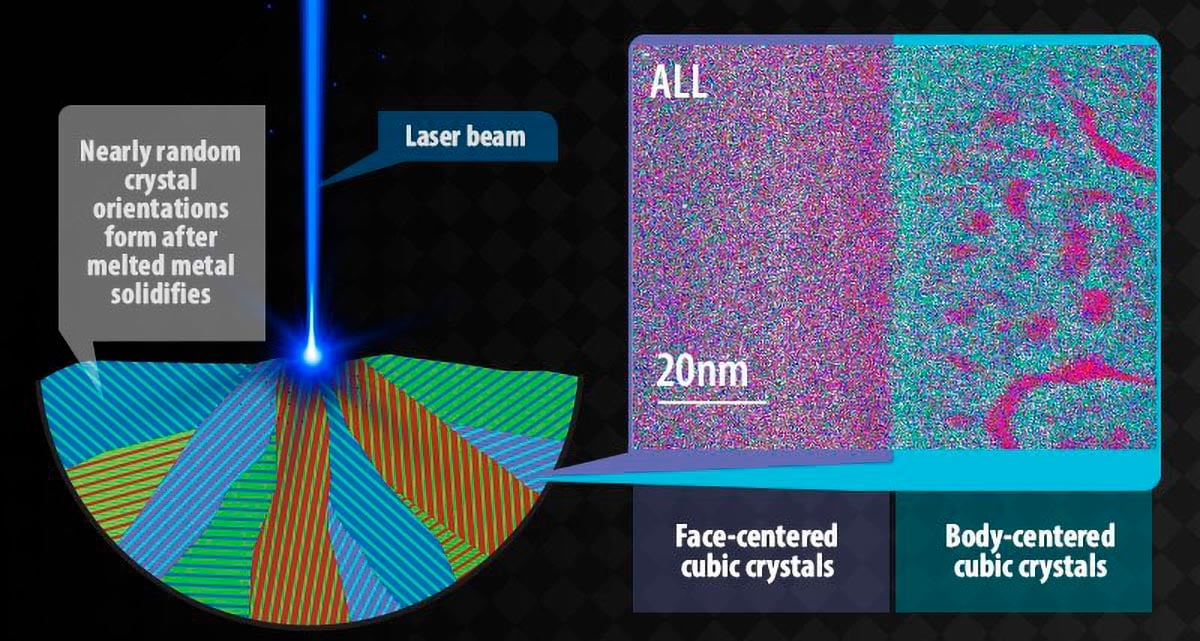
    Images of the two crystal structures (right) found in a high-entropy alloy (left) made by additive manufacturing. Credit: University of Massachusetts Amherst

    Nano-Lamellae Structure and Mechanical Properties

    The laser-based AM process produced nanometer-thick nano-lamellae (thin layers of plates) offering high strength, while the plates’ distinct edges permit a degree of slippage (ductility). The plates consist of alternating layers of face-centered cubic (FCC) crystal structures that average approximately 150 nanometers thick and body-centered cubic (BCC) crystal structures that average approximately 65 nanometers thick.

    The new HEAs exhibited high yield strengths of about 1.3 gigapascals – exceeding the strongest titanium alloys. These HEAs also offer an elongation of about 14%, which is higher than other AM metal alloys given the same yield strength. Elongation is a measure of how much bending a material can withstand without breaking.

    Advanced Research Techniques and Facilities

    Neutron data from the Spallation Neutron Source, a Department of Energy (DOE) Office of Science user facility at Oak Ridge National Laboratory (ORNL), enabled the researchers to examine the interior mechanical load sharing of the HEA samples while under strain.

    The researchers used an atom probe instrument at the Center for Nanophase Materials Sciences, also a DOE user facility at ORNL, to capture detailed 3D images of the compositions and microstructures, consisting of alternating nano-lamellae layers.

    The phases of different annealed samples were studied using X-ray diffraction at the Advanced Photon Source, another DOE Office of Science user facility at Argonne National Laboratory.

    Reference: “Strong yet ductile nanolamellar high-entropy alloys by additive manufacturing” by Jie Ren, Yin Zhang, Dexin Zhao, Yan Chen, Shuai Guan, Yanfang Liu, Liang Liu, Siyuan Peng, Fanyue Kong, Jonathan D. Poplawsky, Guanhui Gao, Thomas Voisin, Ke An, Y. Morris Wang, Kelvin Y. Xie, Ting Zhu and Wen Chen, 3 August 2022, Nature.
    DOI: 10.1038/s41586-022-04914-8

    This research was performed at the Spallation Neutron Source, the Advanced Photon Source, and Center for Nanophase Materials Sciences, all of which are DOE Office of Science user facilities. Funding support for this work included the National Science Foundation, the University of Massachusetts Amherst, and the Laboratory Directed Research and Development program at Lawrence Livermore National Laboratory.

    Never miss a breakthrough: Join the SciTechDaily newsletter.
    Follow us on Google and Google News.

    3D Printing DOE Metal Popular
    Share. Facebook Twitter Pinterest LinkedIn Email Reddit

    Related Articles

    X-Rays and Lasers Forge the Future: Pioneering the 3D Printing of Ultra-Strong Stainless Steel

    Inside the Laser Forge: How 3D-Printed Superalloys Conquer Extreme Environments

    NASA Licenses 3D-Printable High-Temperature Superalloy That Can Last 2,500x Longer

    NASA’s Super Alloy: A Breakthrough in 3D Printing Technology

    Human Bone Structure Key to Stronger 3D-Printed Lightweight Materials [Video]

    MIT Device Cools With No Electricity or Moving Parts – Even Under the Blazing Sun

    Breakthrough Enables Full Recharge of an Electric Vehicle in 10-Minutes

    Scientists Pave the Way for Quantum Computing by Coupling Magnetization to Superconductivity

    ‘Jenga Chemistry’ Creates Superconductivity in a Nickel Oxide Material

    2 Comments

    1. Tom Wiseman on January 10, 2024 9:06 pm

      Looking forword to better made airplanes.

      Reply
    2. Stefan Gradmann on January 14, 2024 6:44 am

      OK

      Reply
    Leave A Reply Cancel Reply

    • Facebook
    • Twitter
    • Pinterest
    • YouTube

    Don't Miss a Discovery

    Subscribe for the Latest in Science & Tech!

    Trending News

    Largest-Ever Study Finds Medicinal Cannabis Ineffective for Anxiety, Depression, PTSD

    250-Million-Year-Old Egg Solves One of Evolution’s Biggest Mysteries

    Living With Roommates Might Be Changing Your Gut Microbiome Without You Knowing

    Century-Old Cleaning Chemical Linked to 500% Increased Risk of Parkinson’s Disease

    What if Your Memories Never Happened? Physicists Take a New Look at the Boltzmann Brain Paradox

    One of the Universe’s Largest Stars May Be Getting Ready To Explode

    Scientists Discover Enzyme That Could Supercharge Ozempic-Like Weight Loss Drugs

    Popular Sweetener Linked to DNA Damage – “It’s Something You Should Not Be Eating”

    Follow SciTechDaily
    • Facebook
    • Twitter
    • YouTube
    • Pinterest
    • Newsletter
    • RSS
    SciTech News
    • Biology News
    • Chemistry News
    • Earth News
    • Health News
    • Physics News
    • Science News
    • Space News
    • Technology News
    Recent Posts
    • Challenging the Narrative: New Study Shows U.S. Life Expectancy Is Rising Across All States
    • Mystery Illness Kills 5 in Burundi As Doctors Scramble for Answers
    • Bone-Strengthening Discovery Could Reverse Osteoporosis
    • The Most Elusive Number in Physics Just Got Even More Mysterious
    • Scientists Uncover Hidden Trigger Behind Stem Cell Aging
    Copyright © 1998 - 2026 SciTechDaily. All Rights Reserved.
    • Science News
    • About
    • Contact
    • Editorial Board
    • Privacy Policy
    • Terms of Use

    Type above and press Enter to search. Press Esc to cancel.