
Close Menu
    Facebook X (Twitter) Instagram
    SciTechDaily
    • Biology
    • Chemistry
    • Earth
    • Health
    • Physics
    • Science
    • Space
    • Technology
    Facebook X (Twitter) Pinterest YouTube RSS
    SciTechDaily
    Home»Space»ALMA Discovers 14-Galaxy Collision in the Distant Universe
    Space

    ALMA Discovers 14-Galaxy Collision in the Distant Universe

    By Jim Shelton, Yale UniversityApril 27, 2018No Comments2 Mins Read
    Facebook Twitter Pinterest Telegram LinkedIn WhatsApp Email Reddit
    Share
    Facebook Twitter LinkedIn Pinterest Telegram Email Reddit
    ALMA Views 14-Galaxy Collision in the Distant Universe
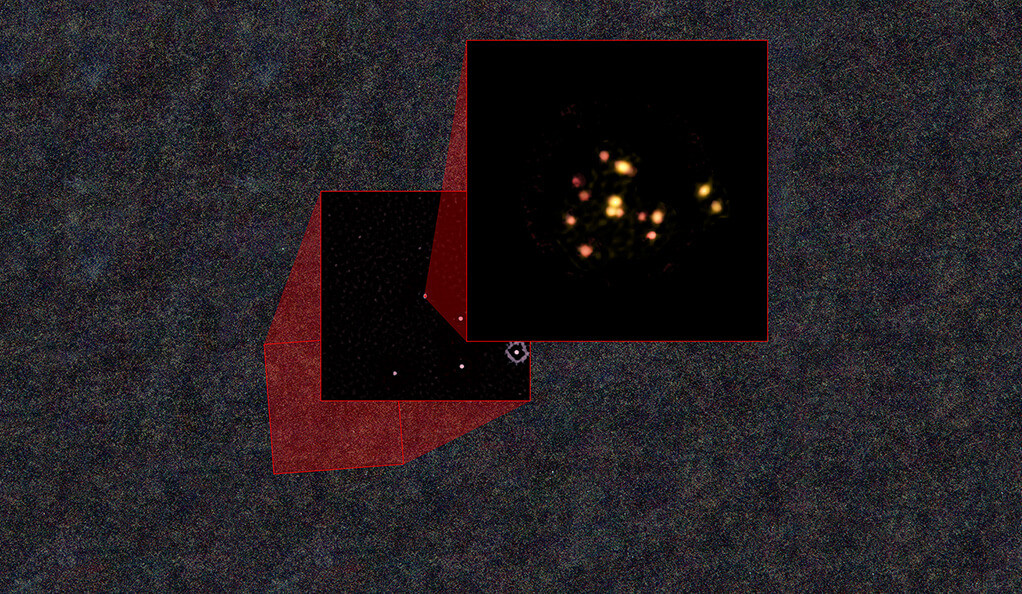
    This figure highlights galaxies discovered by ALMA that are evolving into a galaxy cluster. The outer field is from data taken by the Hershel Space Observatory. The middle image, from a survey by the National Science Foundation’s South Pole Telescope, uncovered the distant galactic source that revealed 14 galaxies.

    Tim Miller, a doctoral candidate in astronomy, is the first author of a new study in the journal Nature about the initial stirrings of a 14-galaxy collision in the distant universe.

    The galactic crash will become a massive galaxy cluster. Scientists know this because the collision is located 12.4 billion light-years from Earth. Its light began traveling to where we could see it when the universe was only 1.4 billion years old, or about a tenth of the universe’s current age.

    Galaxy clusters are the largest objects in the known universe, with as many as 1,000 galaxies. The new study focuses on a protocluster known as SPT2349-56. Using the Atacama Large Millimeter/submillimeter Array (ALMA), an international research team was able to study SPT2349-56 in detail.

    “How this assembly of galaxies got so big so fast is a bit of a mystery. It wasn’t built up gradually over billions of years, as astronomers might expect,” said Miller, who worked on the study while at Dalhousie University in Canada. “This discovery provides an incredible opportunity to study how galaxy clusters and their massive galaxies came together in these extreme environments.”

    Reference: “A massive core for a cluster of galaxies at a redshift of 4.3” by T. B. Miller, S. C. Chapman, M. Aravena, M. L. N. Ashby, C. C. Hayward, J. D. Vieira, A. Weiß, A. Babul, M. Béthermin, C. M. Bradford, M. Brodwin, J. E. Carlstrom, Chian-Chou Chen, D. J. M. Cunningham, C. De Breuck, A. H. Gonzalez, T. R. Greve, J. Harnett, Y. Hezaveh, K. Lacaille, K. C. Litke, J. Ma, M. Malkan, D. P. Marrone, W. Morningstar, E. J. Murphy, D. Narayanan, E. Pass, R. Perry, K. A. Phadke, D. Rennehan, K. M. Rotermund, J. Simpson, J. S. Spilker, J. Sreevani, A. A. Stark, M. L. Strandet and A. L. Strom, 25 April 2018, Nature.
    DOI: 10.1038/s41586-018-0025-2

    Never miss a breakthrough: Join the SciTechDaily newsletter.
    Follow us on Google and Google News.

    ALMA Astronomy Cosmology Yale University
    Share. Facebook Twitter Pinterest LinkedIn Email Reddit

    Related Articles

    Ancient Dusty Galaxies Discovered at the Edge of the Universe Rewrite Cosmic History

    Astronomers Catch a Cosmic Boomerang in Action for the First Time

    ALMA Telescope Reveals Planetary Influences on Young Stellar Disks

    ALMA Views the Episodic Outflow of Protostar CARMA-7

    Evidence of Galaxy Star Birth Regulated by Black Holes

    The Impact of Cosmic Wind on Galaxy Evolution

    ALMA Sees Signs of Windy Weather Around an Infant Solar System

    Early Quasars Got a “Super Boost” from Star Clusters

    ALMA Gets a Close-Up View of Starbirth

    Leave A Reply Cancel Reply

    • Facebook
    • Twitter
    • Pinterest
    • YouTube

    Don't Miss a Discovery

    Subscribe for the Latest in Science & Tech!

    Trending News

    Could Low Vitamin D Be Making Your Pain Worse?

    Scientists Discover Once-Weekly Workout That Melts Belly Fat Surprisingly Effectively

    Scientists Just Tested a Thruster Powerful Enough for Human Missions to Mars

    Doctors Say Your Ice Pack Might Be Making Injuries Worse

    Scientists Discover 43-Foot Sea Reptile Twice the Size of a Great White Shark

    Bees and Birds Are Drinking Alcohol From Flowers

    Scientists Discover How Obesity May Trigger Alzheimer’s Disease

    Scientists Confirm Alcohol Causes Widespread Health Damage

    Follow SciTechDaily
    • Facebook
    • Twitter
    • YouTube
    • Pinterest
    • Newsletter
    • RSS
    SciTech News
    • Biology News
    • Chemistry News
    • Earth News
    • Health News
    • Physics News
    • Science News
    • Space News
    • Technology News
    Recent Posts
    • Scientists Discover Sperm Seem To Bypass a Fundamental Law of Physics
    • The Secret Behind Indigenous Andeans’ “Digestive Superpower” May Be Potatoes
    • Archaeologists Discover Mysterious Artificial Island Older Than Stonehenge in Scotland
    • Magnon Breakthrough Could Shrink Quantum Computers to the Size of a Penny
    • NASA Finds a “Goldilocks” Giant Planet Wrapped in Methane
    Copyright © 1998 - 2026 SciTechDaily. All Rights Reserved.
    • Science News
    • About
    • Contact
    • Editorial Board
    • Privacy Policy
    • Terms of Use

    Type above and press Enter to search. Press Esc to cancel.