

Close Menu
    Facebook X (Twitter) Instagram
    SciTechDaily
    • Biology
    • Chemistry
    • Earth
    • Health
    • Physics
    • Science
    • Space
    • Technology
    Facebook X (Twitter) Pinterest YouTube RSS
    SciTechDaily
    Home»Health»Alzheimer’s Breakthrough: Scientists Identify Key Enzyme That Links Brain Inflammation to Memory Loss
    Health

    Alzheimer’s Breakthrough: Scientists Identify Key Enzyme That Links Brain Inflammation to Memory Loss

    By Institute for Basic ScienceApril 29, 20252 Comments5 Mins Read
    Facebook Twitter Pinterest Telegram LinkedIn WhatsApp Email Reddit
    Share
    Facebook Twitter LinkedIn Pinterest Telegram Email Reddit
    Old Man Alzheimer's Dementia
    Researchers at the Institute for Basic Science (IBS) identified SIRT2 as a key enzyme in astrocytes that drives memory loss in Alzheimer’s disease by promoting excessive GABA production, which impairs brain function. Their findings open new possibilities for selectively inhibiting harmful GABA production without affecting other damaging processes like hydrogen peroxide (H₂O₂) generation.

    SIRT2, an enzyme previously overlooked in astrocytic GABA production, may be crucial for distinguishing the specific effects of degenerative molecules involved in Alzheimer’s disease.

    A research team at the Institute for Basic Science (IBS) has discovered that SIRT2, an enzyme previously unknown in this context, plays a key role in memory loss linked to Alzheimer’s disease. The study, led by Director C. Justin LEE of the IBS Center for Cognition and Sociality, offers important insights into how astrocytes contribute to cognitive decline by producing too much of the inhibitory neurotransmitter GABA.

    Astrocytes, once believed to only provide support for neurons, are now recognized as active participants in brain function. In Alzheimer’s disease, these cells become reactive, changing their behavior in response to the presence of amyloid-beta (Aβ) plaques, a defining feature of the condition. Although astrocytes work to clear these plaques, the process sets off a harmful chain of events.

    They absorb the plaques through autophagy (Kim and Chun, 2024) and break them down via the urea cycle (Ju et al., 2022). This breakdown leads to the excessive production of GABA, which suppresses brain activity and contributes to memory impairment. The same process also produces hydrogen peroxide (H2O2), a toxic byproduct that accelerates neuronal damage and neurodegeneration.
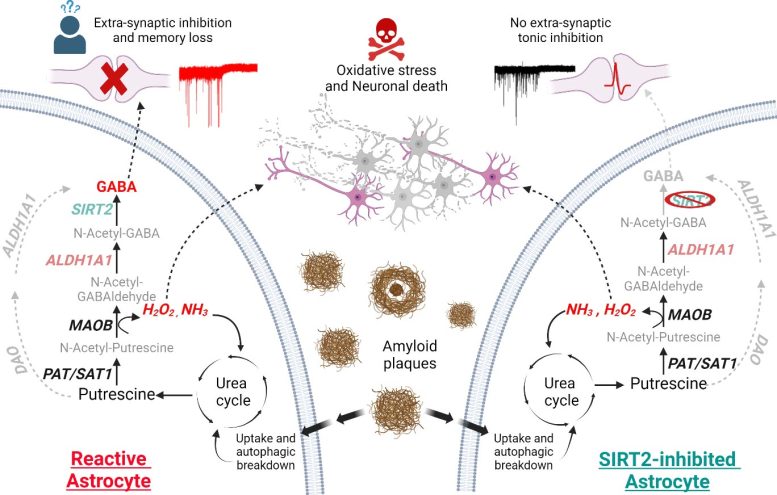
    Diagram of Reactive Astrocytes Break Down Amyloid Plaques and Trigger GABA Overproduction
    Reactive astrocytes in Alzheimer’s Disease uptake and break down amyloid plaques via autophagy, which causes upregulation of the urea cycle and putrescine-to-GABA production. This leads to elevated production of GABA and toxic H2O2, which inhibits neuronal signaling and causes neuronal death (Left). SIRT2 is the last enzyme in the GABA production pathway (Right). Inhibition of SIRT2 reduces GABA, rescuing neuronal inhibition and memory loss, but continues H2O2 production, contributing to neuronal death. Credit: Institute for Basic Science

    Uncovering the enzymes behind GABA overproduction

    To understand what drives this overproduction of GABA, the IBS team aimed to identify the enzymes responsible, with the goal of blocking the negative effects without disrupting other brain functions. Through molecular analysis, microscopic imaging, and electrophysiological techniques, they identified SIRT2 and ALDH1A1 as key enzymes responsible for the elevated GABA levels in astrocytes affected by Alzheimer’s disease.
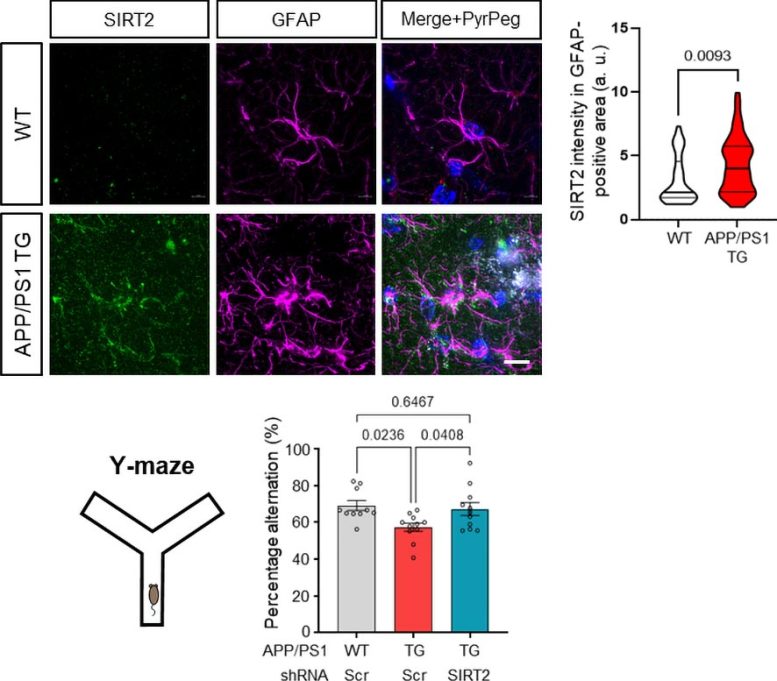
    Graphs Show SIRT2 Levels, Astrocyte Activity, and Memory Performance in Alzheimer’s Mice
    Increased SIRT2 protein (green) in the astrocytes (GFAP; magenta) around Aβ plaques (PyrPeg; white) in AD mouse model APP/PS1 TG (Top). Improved memory in AD mice after SIRT2 knockdown (Bottom). Credit: Institute for Basic Science

    SIRT2 protein was found to be increased in the astrocytes of the commonly used AD mouse model as well as in post-mortem human AD patient brains. “When we inhibited the astrocytic expression of SIRT2 in AD mice, we observed partial recovery of memory and reduced GABA production,” quoted Mridula BHALLA, the lead author of the study and a post-doctoral researcher at IBS. “While we expected reduced GABA release, we found that only short-term working memory (Y-maze) of the mice was recovered, and spatial memory (NPR) was not. This was exciting but also left us with more questions.”

    H2O2 persists despite reduced GABA

    SIRT2 participates in the last step of GABA production, while H2O2 is produced earlier in the process. It is therefore possible that H2O2 is continuously produced and released by the cells even in the absence of SIRT2. “Indeed, we found that inhibition of SIRT2 continued H2O2 production, indicating that neuronal degeneration might continue even though GABA production is reduced,” says Director C Justin LEE.
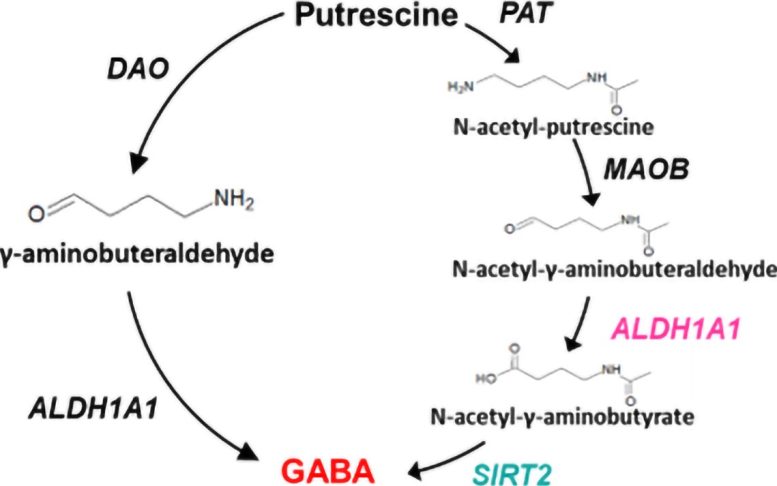
    The Putrescine to GABA Production Pathway
    The putrescine-to-GABA production pathway. Credit: Institute for Basic Science

    By identifying SIRT2 and ALDH1A1 as downstream targets, scientists can now selectively inhibit GABA production without affecting H2O2 levels. This is a critical breakthrough because it allows researchers to separate the effects of GABA and H2O2 and study their individual roles in neurodegeneration.

    Director C. Justin LEE emphasized the importance of these findings, stating:

    “So far, we have been using MAOB inhibitors in AD research, which block the production of H2O2 as well as GABA. By identifying enzymes SIRT2 and ALDH1A1 downstream to MAOB, we can now selectively inhibit GABA production without affecting H2O2, which would allow us to dissect the effects of GABA and H2O2 and study their individual roles in disease progression.”

    While SIRT2 may not be a direct drug target due to its limited effects on neurodegeneration, this research paves the way for more precise therapeutic strategies aimed at controlling astrocytic reactivity in Alzheimer’s disease.

    Reference: “SIRT2 and ALDH1A1 as critical enzymes for astrocytic GABA production in Alzheimer’s disease” by Mridula Bhalla, Jinhyeong Joo, Daeun Kim, Jeong Im Shin, Yongmin Mason Park, Yeon Ha Ju, Uiyeol Park, Seonguk Yoo, Seung Jae Hyeon, Hyunbeom Lee, Junghee Lee, Hoon Ryu and C. Justin Lee, 15 January 2025, Molecular Neurodegeneration.
    DOI: 10.1186/s13024-024-00788-8

    Funding: Institute for Basic Science

    Never miss a breakthrough: Join the SciTechDaily newsletter.
    Follow us on Google and Google News.

    Alzheimer's Disease Brain Enzyme Institute for Basic Science Memory Neurology
    Share. Facebook Twitter Pinterest LinkedIn Email Reddit

    Related Articles

    Rethinking Alzheimer’s: New Evidence Challenges a Long-Held Belief About Memory Loss

    Reviving Brain Circuits: UCLA Scientists Discover Memory-Restoring Molecule for Alzheimer’s Disease

    Mayo Clinic Defines New Memory Loss Syndrome Affecting Older Adults

    A Diabetes Drug Could Protect Against Alzheimer’s

    Secondary Infections Inflame the Brain, Worsening Cognition & Memory in Alzheimer’s Disease

    Neuroscientists Discover Promising Way to Restore Cognitive Function Impaired by Alzheimer’s Disease

    Blocking HDAC2 Enzyme May Reverse Memory Loss Caused by Alzheimer’s Disease

    Test for Alzheimer’s May Be Undermining Drug Trials

    Disrupted Sleep Patterns Linked to Alzheimer’s

    2 Comments

    1. Bill Gates on April 29, 2025 8:02 pm

      great news! wish we could see more of this instead of dumb Trump news

      Reply
    2. Terry Rhee on April 29, 2025 9:49 pm

      exciting news and discovery in Alzheimer. hope for new therapy for Alzheimer patients

      Reply
    Leave A Reply Cancel Reply

    • Facebook
    • Twitter
    • Pinterest
    • YouTube

    Don't Miss a Discovery

    Subscribe for the Latest in Science & Tech!

    Trending News

    The Universe Is Expanding Too Fast and Scientists Can’t Explain Why

    “Like Liquid Metal”: Scientists Create Strange Shape-Shifting Material

    Early Warning Signals of Esophageal Cancer May Be Hiding in Plain Sight

    Common Blood Pressure Drug Shows Surprising Power Against Deadly Antibiotic-Resistant Superbug

    Scientists Uncover Dangerous Connection Between Serotonin and Heart Valve Disease

    Scientists Discover a “Protector” Protein That Could Help Reverse Hair Loss

    Bone-Strengthening Discovery Could Reverse Osteoporosis

    Scientists Uncover Hidden Trigger Behind Stem Cell Aging

    Follow SciTechDaily
    • Facebook
    • Twitter
    • YouTube
    • Pinterest
    • Newsletter
    • RSS
    SciTech News
    • Biology News
    • Chemistry News
    • Earth News
    • Health News
    • Physics News
    • Science News
    • Space News
    • Technology News
    Recent Posts
    • Scientists Overcome Major Quantum Bottleneck, Potentially Transforming Teleportation and Computing
    • Quantum Physics’ Strangest Problem May Hold the Key to Time Itself
    • Scientists Create “Liquid Gears” That Spin Without Touching
    • The Simple Habit That Could Help Prevent Cancer
    • Forgotten Medicinal Plant Shows Promise in Fighting Dangerous Superbugs
    Copyright © 1998 - 2026 SciTechDaily. All Rights Reserved.
    • Science News
    • About
    • Contact
    • Editorial Board
    • Privacy Policy
    • Terms of Use

    Type above and press Enter to search. Press Esc to cancel.