

A new study reveals connections between two widely used models of the disease, with findings that may reshape how scientists approach treatment.
If there is one fact about Alzheimer’s disease that researchers agree on, it is that the condition progressively destroys neurons and the connections between them, ultimately dismantling the neural networks that support memory.
What remains uncertain is the exact mechanism behind this damage. One leading hypothesis suggests that amyloid beta, a protein fragment, accumulates in the brain and harms neurons. Yet other explanations point to factors such as tau proteins, lysosomal dysfunction, neuroinflammation, and the actions of immune cells like microglia, and more.
A unified theory emerges
Researchers now believe they may have found a way to link two of these theories. In a study published September 18 in Proceedings of the National Academy of Sciences, the team presented evidence that amyloid beta and inflammation both act on the same target: a receptor that signals neurons when to dismantle synapses, the junctions where they communicate.

The work brings together two previously separate lines of research. The project was led by Carla Shatz, a Wu Tsai Neurosciences Institute affiliate and Sapp Family Provostial Professor, with Barbara Brott as first author and research scientist in Shatz’s lab. Funding came in part from a Catalyst Award from the Knight Initiative for Brain Resilience, which seeks to reexamine the biological foundations of neurodegenerative diseases such as Alzheimer’s.
The role of LilrB2
One of the two research paths centers on a receptor molecule known as LilrB2, which Shatz has studied extensively. In 2006, she and her colleagues discovered that the mouse version of LilrB2 helps regulate synaptic “pruning,” a normal process in brain development and learning. Later, in 2013, the same team showed that amyloid beta binds to this receptor and activates synapse pruning. Importantly, when the receptor is genetically removed in a mouse model of Alzheimer’s, memory loss is prevented.
The second research path focuses on an immune process called the complement cascade. Normally, this system generates molecules that eliminate viruses, bacteria, and infected cells. However, inflammation is a recognized risk factor for Alzheimer’s, and growing evidence links the complement cascade to excessive synaptic pruning and the progression of neurological disease.
C4d’s unexpected role
That got Shatz wondering whether the complement cascade, like amyloid beta, might also activate the LilrB2 receptor, triggering synaptic pruning.
To find out, the team first ran screens to see if any complement cascade molecules would bind to that receptor. They found one, and only one: C4d, which bound tightly enough to the receptor that the team thought it might contribute to synapse loss.
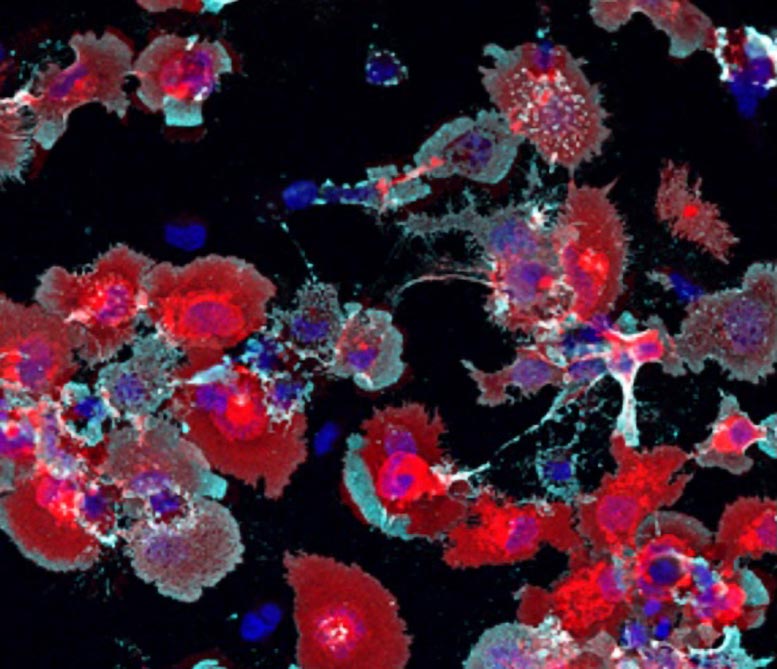
To put that hypothesis to the test, they pumped C4d directly into the brains of ordinary mice. “Lo and behold, it stripped synapses off neurons,” Shatz said—quite a surprise for a molecule researchers had previously thought had no function at all.
Implications for memory and treatment
The upshot of all of this is that amyloid beta and neuroinflammation may contribute to synapse loss through a common mechanism—and that may call for a reevaluation of how Alzheimer’s disease destroys memory.
“There’s an entire set of molecules and pathways that lead from inflammation to synapse loss that may not have received the attention they deserve,” said Shatz, who is also a professor of biology in the School of Humanities and Sciences and of neurobiology in the School of Medicine.
The results also challenge a view held by many in the field that glia—the brain’s immune cells—are principally responsible for synapse loss in Alzheimer’s. “Neurons aren’t innocent bystanders,” Shatz said. “They are active participants.”
And, Shatz said, that observation may have a direct impact on treatment. Right now, the only FDA-approved drugs to treat Alzheimer’s attempt to break up amyloid plaques in the brain. But “busting up amyloid plaques hasn’t worked that well, and there are a lot of side effects,” such as headaches and brain bleeding, Shatz said. “And even if they worked well, you’re only going to solve part of the problem.”
The better solution may be by targeting receptors such as LilrB2 that are directly responsible for synapse loss—and by protecting synapses, Shatz said, we can protect memory as well.
Reference: “C4d, a high-affinity LilrB2 ligand, is elevated in Alzheimer’s disease and mediates synapse pruning” by Barbara K. Brott, Aram J. Raissi, Kristina D. Micheva, Jost Vielmetter, Monique S. Mendes, Caroline J. Baccus, Jolie Huang and Carla J. Shatz, 18 September 2025, Proceedings of the National Academy of Sciences.
DOI: 10.1073/pnas.2519253122
This research was supported by NIH Grants 1R01AG065206, 1R01EY02858, the Sapp Family Foundation, the Champalimaud Foundation, the Harold and Leila Y. Mathers Charitable Foundation, the Ruth K. Broad Biomedical Research Foundation, and the Phil and Penny Knight Initiative for Brain Resilience at the Wu Tsai Neuroscience Institute Stanford University to C.J.S.
Never miss a breakthrough: Join the SciTechDaily newsletter.
Follow us on Google and Google News.