
New study finds that insufficient nutrient supply has not been properly accounted for in ecosystem models.
Agriculture, forestry, and other types of land use account for 23% of human-caused greenhouse gas emissions, yet at the same time natural land processes absorb the equivalent of almost a third of carbon dioxide emissions from fossil fuels and industry, according to the International Panel on Climate Change, which issued the first-ever comprehensive report on land and climate interactions earlier this month. How long will the Amazon rainforest continue to act as an effective carbon sink?
An international team of scientists, including climate scientists from the Department of Energy’s Lawrence Berkeley National Laboratory (Berkeley Lab), investigated this question and found that accounting for phosphorus-deficient soils reduced projected carbon dioxide uptake by an average of 50% in the Amazon, compared to current estimates based on previous climate models that did not take into account phosphorus deficiency. The Amazon Basin is critical to help mitigate climate change due to its trees absorbing around a quarter of the CO2 released each year from the burning of fossil fuels.
The paper, “Amazon forest response to CO2 fertilization dependent on plant phosphorus acquisition,” was published August 5 in the journal Nature Geoscience.
“Most predictions of the Amazon rainforest’s ability to resist climate change are based on models that have outdated assumptions; one of those is that a sufficient supply of nutrients such as phosphorus exist in soils to enable trees to take in additional CO2 as global emissions increase,” said Berkeley Lab research scientist and study co-author Jennifer Holm. “But in reality the ecosystem is millions of years old, highly weathered, and therefore depleted of phosphorus in many parts of the Amazon.
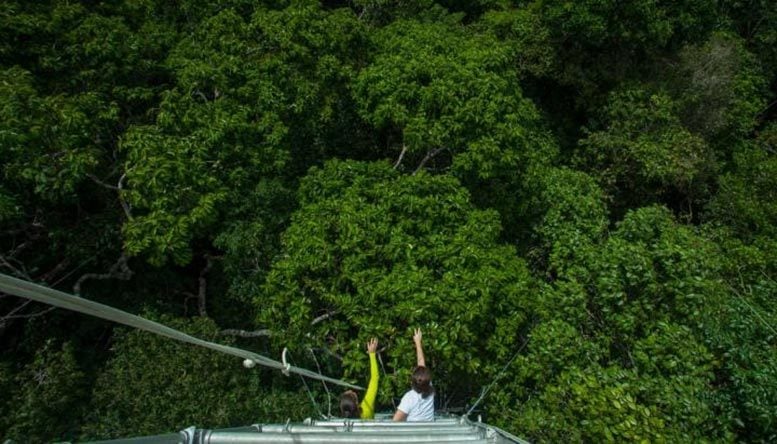
Researchers involved in the AmazonFACE project monitored tree growth and leaf development aboveground, and tracked root growth and activity within soils belowground at a study site north of Manaus, Brazil where ambient CO2 concentration is planned to be artificially elevated to enable a realistic investigation of how future CO2 concentrations will affect the ecosystem.
“Our improved models now take into account these complexities, and could serve to help paint a more realistic portrayal of how the Amazon, and the tropics in general, will be impacted by climate change and the ability of trees to remove greenhouse gases from the atmosphere,” Holm said.
###
The lead author of the study was Katrin Fleischer of the Technical University of Munich (their release here). Holm was supported by DOE’s Next Generation Ecosystem Experiments (NGEE)-Tropics, and Berkeley Lab co-author Qing Zhu was supported by DOE’s Energy Exascale Earth System Model (E3SM) project.
Founded in 1931 on the belief that the biggest scientific challenges are best addressed by teams, Lawrence Berkeley National Laboratory and its scientists have been recognized with 13 Nobel Prizes. Today, Berkeley Lab researchers develop sustainable energy and environmental solutions, create useful new materials, advance the frontiers of computing, and probe the mysteries of life, matter, and the universe. Scientists from around the world rely on the Lab’s facilities for their own discovery science. Berkeley Lab is a multiprogram national laboratory, managed by the University of California for the U.S. Department of Energy’s Office of Science.
DOE’s Office of Science is the single largest supporter of basic research in the physical sciences in the United States, and is working to address some of the most pressing challenges of our time.
Reference: “Amazon forest response to CO2 fertilization dependent on plant phosphorus acquisition” by Katrin Fleischer, Anja Rammig, Martin G. De Kauwe, Anthony P. Walker, Tomas F. Domingues, Lucia Fuchslueger, Sabrina Garcia, Daniel S. Goll, Adriana Grandis, Mingkai Jiang, Vanessa Haverd, Florian Hofhansl, Jennifer A. Holm, Bart Kruijt, Felix Leung, Belinda E. Medlyn, Lina M. Mercado, Richard J. Norby, Bernard Pak, Celso von Randow, Carlos A. Quesada, Karst J. Schaap, Oscar J. Valverde-Barrantes, Ying-Ping Wang, Xiaojuan Yang, Sönke Zaehle, Qing Zhu and David M. Lapola, 5 August 2019, Nature Geoscience.
DOI: 10.1038/s41561-019-0404-9
Never miss a breakthrough: Join the SciTechDaily newsletter.
Follow us on Google and Google News.