
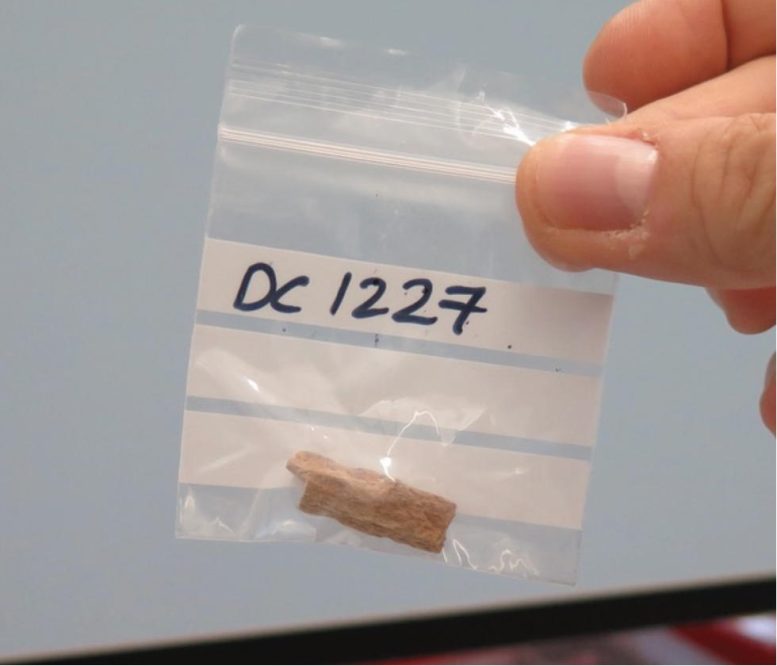
A new study links historical fluctuations in CO₂ levels and climate shifts to periods of interbreeding between Neanderthals and Denisovans.
A new study published in the journal Science by an international team reveals that historical fluctuations in atmospheric CO2 levels and the subsequent alterations in climate and vegetation were significant factors influencing when and where early human species interbred.
Modern-day humans possess a small proportion of DNA in their cells that originated from other hominin species, specifically the Neanderthals and the elusive Denisovans.
Back in 2018, scientists announced to the world the discovery of an individual, later nicknamed Denny, who lived 90,000 years ago and who was identified as a daughter to a Denisovan father and a Neanderthal mother [Slon et al. 2018]. Denny, along with fellow mixed-ancestry individuals found at Denisova cave, testifies that interbreeding was probably common among hominins, and not limited to our own species Homo sapiens.
To unravel when and where human hybridization took place, scientists usually rely on paleo-genomic analysis of extremely rare fossil specimens and their even scarcer ancient DNA content. In the new Science paper, the team of climate experts and paleo-biologists from South Korea and Italy pursued a different approach. Using existing paleo-anthropological evidence, genetic data, and supercomputer simulations of past climate, the team found that Neanderthals and Denisovans had different environmental preferences. More specifically, Denisovans were much more adapted to cold environments, characterized by boreal forests and even tundra, compared to their Neanderthal cousins who preferred temperate forests and grassland.
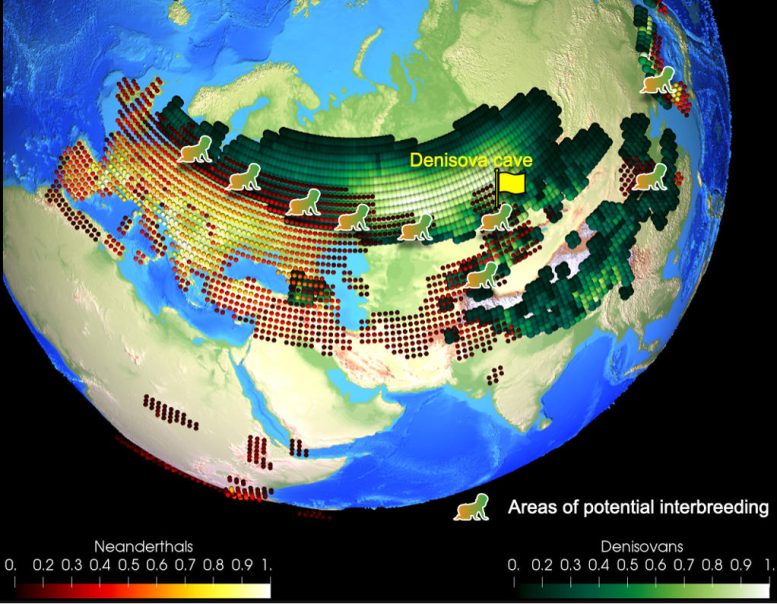
“This means that their habitats of choice were separated geographically, with Neanderthals typically preferring southwestern Eurasia and Denisovans the northeast,” says Dr. Jiaoyang Ruan, a postdoctoral researcher at the IBS Center for Climate Physics (ICCP), South Korea and lead author of the study.
Warm Periods Created Overlapping Habitats
However, according to their realistic computer simulations, the scientists found that in warm interglacial periods, when Earth’s orbit around the Sun was more elliptic and northern hemisphere summer occurred closer to the Sun, the hominin habitats began to overlap geographically. “When Neanderthals and Denisovans shared a common habitat, there were more encounters and interactions among the groups, which would have increased the chance of interbreeding”, adds Prof. Axel Timmermann, corresponding author of the study and director of the ICCP and professor at Pusan National University.
The simulation of past habitat overlaps does not only put the first-generation Neanderthal/Denisovan hybrid Denny into a climatic context, but it also agrees with other known episodes of interbreeding ~78, 120 thousand years ago. Future paleo-genetic reconstructions can be used to test the robustness of the new supercomputer model-based predictions of potential interbreeding intervals around 210 and 320 thousand years ago.
The Role of Vegetation in Shaping Migration Corridors
To further determine the climate drivers of the east-west interbreeding seesaw, the scientists looked more closely at how vegetation patterns changed over Eurasia during the past 400 thousand years. They discovered that elevated atmospheric CO2 concentrations and mild interglacial conditions caused an eastward expansion of temperate forest into central Eurasia which created dispersal corridors for Neanderthals into Denisovan lands. “It is as if glacial-interglacial shifts in the climate created the stage for a unique and long-lasting human love story, whose genetic traces are still visible today”, comments Dr. Ruan.
One of the key challenges the researchers faced in their study was to estimate the preferred climatic conditions for Denisovans. “To deal with the very sparse Denisovan dataset, we had to devise new statistical tools, which could also account for known ancestral relationships amongst human species”, says Prof. Pasquale Raia from the University of Naples, Federico II in Italy, co-author of the study. “This allowed us for the first time to estimate where Denisovans could have lived. To our surprise, we found that, apart from areas in Russia and China, also northern Europe would have been a suitable environment for them,” he adds.
Whether Denisovans ever lived west of the Altai mountains is unknown; but it can be tested using large-sample genetic analyses of Denisovan ancestry in European populations. Such analysis is expected to shed new light on the relationship between early dispersal, habitat encroachment, and human genetic diversification.
Reference: “Climate shifts orchestrated hominin interbreeding events across Eurasia” by Jiaoyang Ruan, Axel Timmermann, Pasquale Raia, Kyung-Sook Yun, Elke Zeller, Alessandro Mondanaro, Mirko Di Febbraro, Danielle Lemmon, Silvia Castiglione and Marina Melchionna, 10 August 2023, Science.
DOI: 10.1126/science.add4459
Never miss a breakthrough: Join the SciTechDaily newsletter.
Follow us on Google and Google News.