
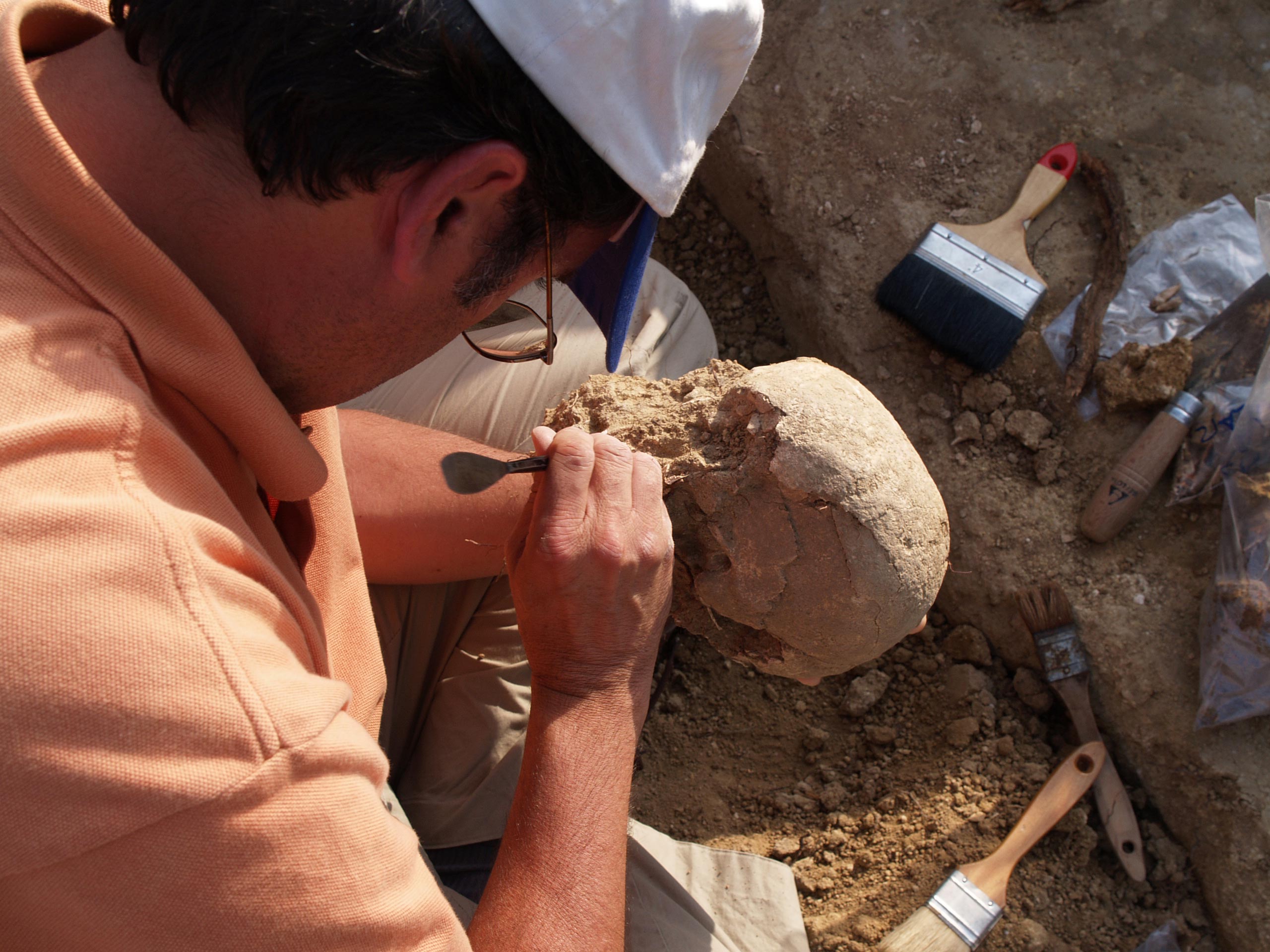
Ancient DNA from a medieval burial inside a Neolithic monument reveals unexpected ancestry links and hnbsints that the site’s significance endured far longer than once believed.
Researchers are using ancient DNA to uncover a surprising new chapter in the history of one of Spain’s most famous prehistoric monuments.
The ATLAS Research Group at the University of Seville (HUM-694) is part of an archaeogenomic study that has uncovered new details about two medieval men buried inside one of Spain’s most famous prehistoric monuments.
Led by researchers from the University of Huddersfield, the University of London (Francis Crick Institute), and Harvard University (USA), the study examined the genetic ancestry of two adult males buried in the atrium of the Menga dolmen (Antequera, Malaga) between the 8th and 11th centuries AD (Andalusian period).
Built about 5,000 years ago, the Menga dolmen is part of the UNESCO World Heritage site at Antequera (Malaga, Spain). The project builds on earlier work by the ATLAS Group, which documented the burial setting, physical anthropology, and radiocarbon dating of the two individuals. That earlier research showed they were buried in a highly formalized way at the entrance of the large Neolithic dolmen, with their heads facing inward.
The study was published in the Journal of Archaeological Science Reports.
DNA Analysis and Preservation Challenges
Researchers analyzed DNA from the two medieval individuals, who were radiocarbon dated to between the 8th and 11th centuries AD and buried in the atrium along the dolmen’s axis of symmetry. The DNA was extremely limited and badly degraded, matching earlier findings from prehistoric and historical sites in Mediterranean Iberia.
Even so, scientists were able to recover the genetic profile of one individual using SNP enrichment, a technique designed to retrieve useful genetic data when DNA is highly degraded or survives only in very small amounts.
That individual showed uniparental lineages commonly found in European populations, but his mitochondrial DNA (mtDNA) lineage is also shared with present-day North African individuals. His autosomal DNA also indicated North African and Levantine ancestry, which fits the broader regional pattern during that period. In his mtDNA lineage, he shared two mutations with a sequence identified in a present-day Mozabite individual in Algeria.
The Mozabites are a Berber group from the M’zab Valley in northern Algeria, with their own language (Mozabite, which is a variant of Berber) and a current population estimated at 150,000 to 300,000 people. According to the researchers, the genomic results highlight the genetic, demographic, and cultural diversity of Andalusian society.
Archaeological Interpretation of the Burials
The study also offers an interpretation of the burials based on archaeological and historical evidence, placing them within the wider pattern of prehistoric monuments being reused during the Middle Ages, a phenomenon widely documented across Iberia. The evidence suggests that when these two men were buried, the Menga dolmen may have been functioning as a hermitage or shrine (marabout).
The Menga dolmen, part of the UNESCO World Heritage Site in Antequera (Malaga, Spain), was built in the fourth millennium BC during the Neolithic period, but its history of use and visitation continued into more recent times. Researchers say it is likely this large dolmen has served continuously as a sacred and/or funerary space since it was constructed between 3800 and 3600 BC.
Reference: “Genetic and historical perspectives on the early medieval inhumations from the Menga dolmen, Antequera (Spain)” by Marina Silva, Leonardo García Sanjuán, Alessandro Fichera, Gonzalo Oteo-García, M.George B. Foody, Luis Efrén Fernández Rodríguez, Verónica Navarrete Pendón, Amira K. Bennison, Maria Pala, Pedro Soares, David Reich, Ceiridwen J. Edwards and Martin B. Richards, 24 December 2025, Journal of Archaeological Science: Reports.
DOI: 10.1016/j.jasrep.2025.105559
Never miss a breakthrough: Join the SciTechDaily newsletter.
Follow us on Google and Google News.