
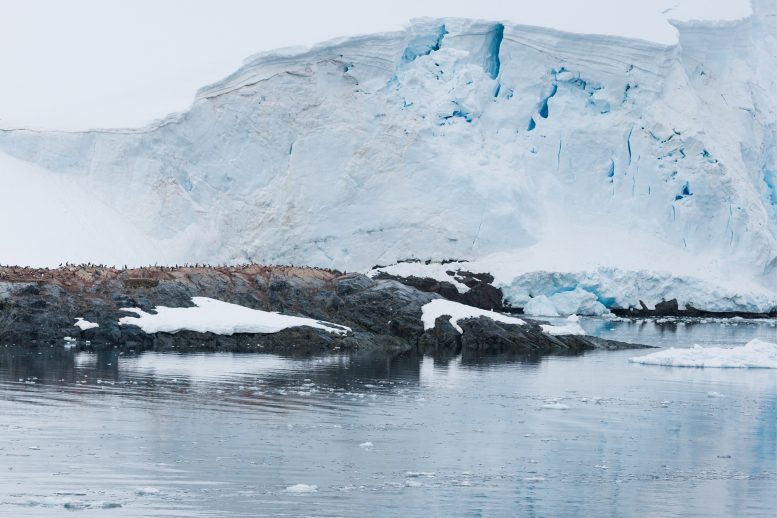
New sediment core data show Antarctic sea ice and climate cycles tightly control algae blooms, impacting food webs and the global carbon cycle.
A 170 m (560 ft) record of marine sediment cores extracted from Adélie Land in Antarctica by the Integrated Ocean Drilling Programme is yielding new insights into the complicated relationship between sea ice and climate change.
In a new study published in Nature Geoscience, researchers at the University of Birmingham, have collaborated in an international project to identify how fluctuations in sea ice levels have interconnected with both algae blooms and weather events linked to El Nino over the past 12,000 years.
They found that Antarctic winds strongly affect the break-out and melting of sea ice, which in turn affects the levels of algae that can grow rapidly in surface waters when sea ice is reduced. Changes in the levels of algae growth in the waters surrounding the Antarctic are important enough to affect the global carbon cycle.
The researchers used techniques such as CT scan (computed tomography) imaging and analysis of microfossils and organic biomarkers, to examine the relationship between sea ice and large algae growth “bloom” events at annual timescales. The findings, produced in partnership with research institutes in New Zealand, Japan, France, Spain, and the USA, span the entire Holocene period and have yielded a highly detailed picture of these relationships that can help predict future sea ice, climate, and biological interactions.
Ross Ice Shelf and the “Sea-Ice Factory”
The researchers found that algal bloom events occurred nearly every year before 4,500 years ago. However, a baseline shift to less frequent algal blooms and the type of algal production after 4.5 thousand years ago, saw bloom events responding to the El Nino Southern Oscillation (ENSO) and other climate cycles as sea-ice levels rapidly increased. Recent work by many of the same team links the expansion of sea ice at this time to glacial retreat and the development of the Ross Ice Shelf, which acts to cool Antarctic surface waters to create a “sea-ice factory.”
Dr. James Bendle, of the University of Birmingham’s School of Geography, Earth and Environmental Science, is a co-author on the paper. He said: “While there’s a clear relationship between temperatures rising in the Arctic over recent decades and sea ice melting, the picture is more complex in the Antarctic. That’s because some areas of the Antarctic are warming, but in some areas, sea ice has been increasing. Since sea ice reflects incoming sunlight, not only is the warming effect slowed down, but algae are unable to photosynthesize as easily. Climate models currently struggle to predict observed changes in sea ice for the Antarctic, and our findings will help climate researchers build more robust and detailed models.”
El Niño, Climate Cycles, and Food Web Implications
He added: “The relationship we have observed with these changing conditions and the ENSO wind fields is particularly significant. We know that El Nino amplifies the effects of climate change in some regions, so any insights linking this with Antarctic sea ice is fascinating and has implications for how future long-term loss of sea ice may affect food webs in Antarctic waters, as well as carbon cycling processes within this globally important region.”
Dr. Katelyn Johnson, of GNS Science, in New Zealand, is the lead author on the paper. She said: “While sea ice that persists from year to year can prevent these large algal blooms from occurring, sea ice that breaks out and melts creates a favorable environment for these algae to grow. These large algae ‘bloom events’ occur around the continent, form the base of the food webs, and act as a carbon sink.”
“Unlike the Arctic where rising temperatures have led to reduced sea ice, the relationship in the Antarctic is less clear, as is the subsequent impact on primary productivity. Our new record provides a longer-term view of how sea ice and climate modes like ENSO impact the frequency of these bloom events, allowing climate modelers to build more robust models.”
Reference: “Sensitivity of Holocene East Antarctic productivity to subdecadal variability set by sea ice” by Katelyn M. Johnson, Robert M. McKay, Johan Etourneau, Francisco J. Jiménez-Espejo, Anya Albot, Christina R. Riesselman, Nancy A. N. Bertler, Huw J. Horgan, Xavier Crosta, James Bendle, Kate E. Ashley, Masako Yamane, Yusuke Yokoyama, Stephen F. Pekar, Carlota Escutia and Robert B. Dunbar, 9 September 2021, Nature Geoscience.
DOI: 10.1038/s41561-021-00816-y
Never miss a breakthrough: Join the SciTechDaily newsletter.
Follow us on Google and Google News.
1 Comment
“Since sea ice reflects incoming sunlight, …”
This statement suggests that the authors are unfamiliar with the geometric relationship between the poles and incoming sunlight, and the specular reflection from water. While ice tends to have a fairly constant diffuse reflectivity, the specular reflectivity of water varies with the angle of incidence. The reflectivity of water reaches 100% at glancing angles; that is, at the limbs. It rises rapidly above 60 degrees. The implication of the quote is that water does not reflect sunlight strongly. That is true for noon over mid-latitudes. However, what these researchers don’t seem to appreciate is that water CAN have a reflectance higher than snow or ice.
https://micro.magnet.fsu.edu/primer/java/reflection/specular/index.html