
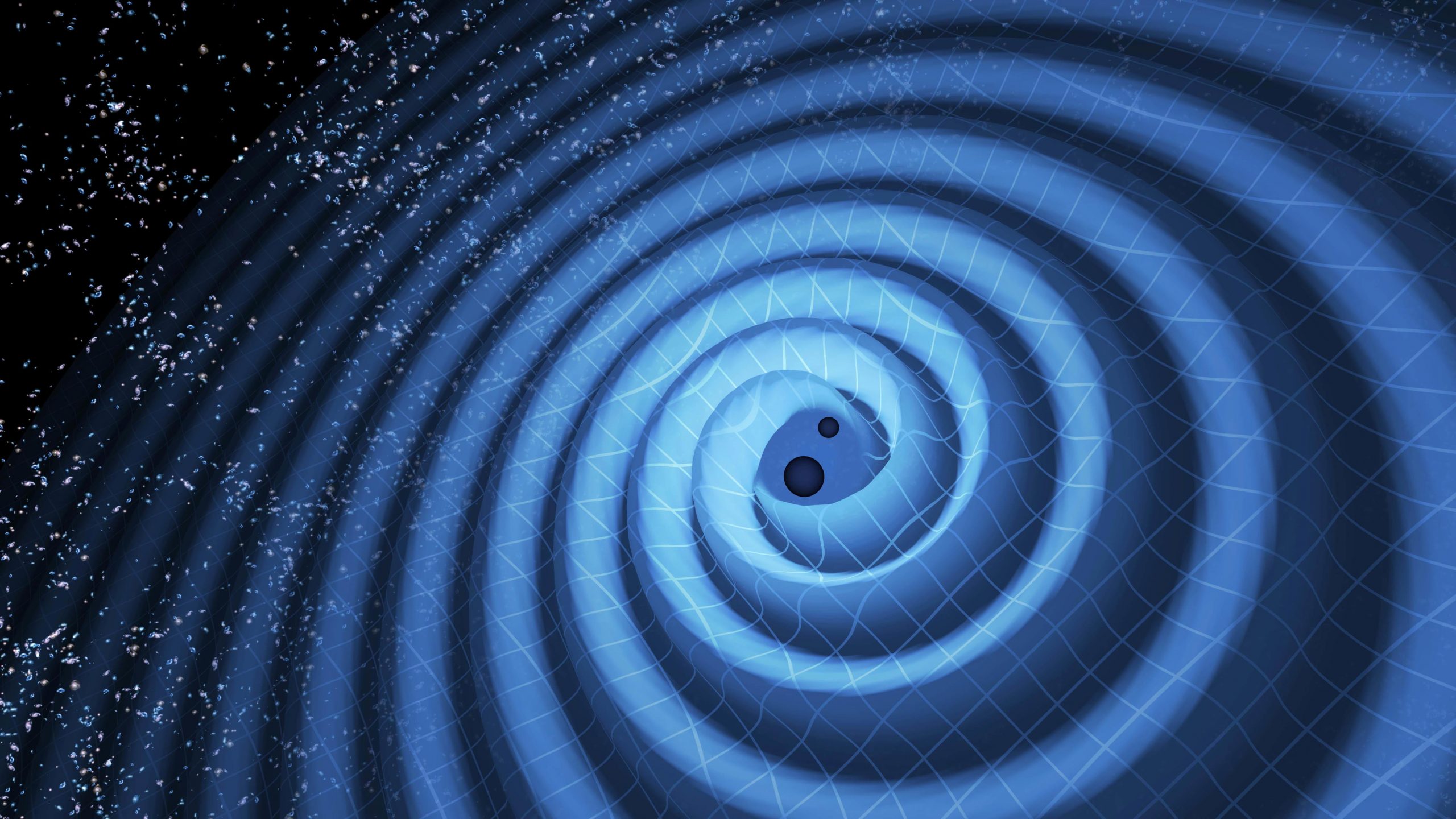
A new quartz detector may have caught the first high-frequency gravitational waves, offering a glimpse into unexplored cosmic phenomena.
A ground-breaking detector that aims to use quartz to capture high-frequency gravitational waves has been built by researchers at the ARC Centre of Excellence for Dark Matter Particle Physics (CDM) and The University of Western Australia.
In its first 153 days of operation, two events were detected that could, in principle, be high-frequency gravitational waves, which have not been recorded by scientists before.
Such high-frequency gravitational waves may have been created by a primordial black hole or a cloud of dark matter particles.
The results were published this month in the American Physical Society APS Physics journal in an article titled “Rare Events Detected with a Bulk Acoustic Wave High Frequency Gravitational Wave Antenna.”
Gravitational waves were originally predicted by Albert Einstein, who theorized that the movement of astronomical objects could cause waves of space-time curvature to be sent rippling through the universe, almost like the waves caused by stones dropped into a flat pond. This prediction was proven in 2015 by the first detection of a gravitational wave signal.
Scientists believe that low-frequency gravitational waves are caused by two black holes spinning and merging into each other or a star disappearing into a black hole.
An Unexplored Frontier
Since then, a new era of gravitational wave research has begun but the current generation of active detectors feature strong sensitivity to only low-frequency signals; the detection of high-frequency gravitational waves has remained an unexplored and extremely challenging front in astronomy.
Despite most attention devoted to low frequency gravitational waves, there is a significant number of theoretical proposals for high-frequency GW sources as well, for example, primordial black holes.
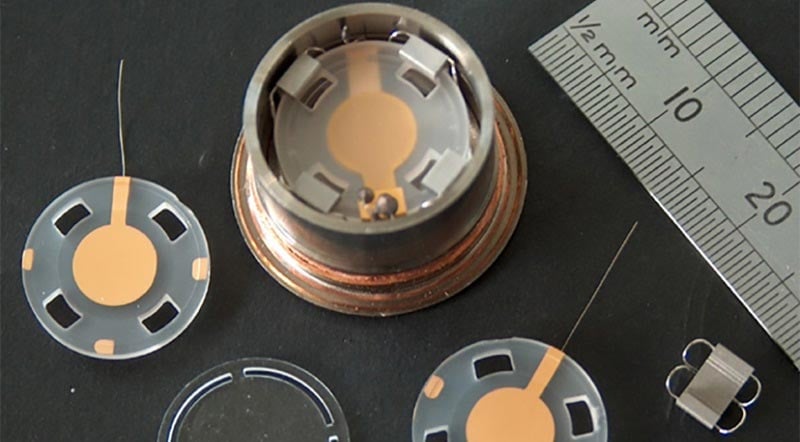
The new detector designed by the research team at the CDM to pick up high-frequency gravitational waves is built around a quartz crystal bulk acoustic wave resonator (BAW). At the heart of this device is a quartz crystal disk that can vibrate at high frequencies due to acoustic waves traveling through its thickness. These waves then induce electric charge across the device, which can be detected by placing conducting plates on the outer surfaces of the quartz disk.
Supercooling and Amplification for Ultra-Sensitive Detection
The BAW device was connected to a superconducting quantum interference device, known as SQUID, which acts as an extremely sensitive amplifier for the low voltage signal from the quartz BAW. This assembly was placed in multiple radiation shields to protect it from stray electromagnetic fields and cooled to a low temperature to allow low energy acoustic vibrations of the quartz crystal to be detected as large voltages with the help of the SQUID amplifier.
The team, which included Dr. Maxim Goryachev, Professor Michael Tobar, William Campbell, Ik Siong Heng, Serge Galliou and Professor Eugene Ivanov will now work to determine the nature of the signal, potentially confirming the detection of high-frequency gravitational waves.
Gravitational Waves or Other Phenomena?
Professor Tobar said a gravitational wave was just one possible candidate that was detected, but other explanations for the result could be the presence of charge particles or mechanical stress build up, a meteor event or an internal atomic process. It might also be due to a very high mass dark matter candidates interacting with the detector.
“It’s exciting that this event has shown that the new detector is sensitive and giving us results, but now we have to determine exactly what those results mean,” Professor Tobar said.
“With this work, we have demonstrated for the first time that these devices can be used as highly sensitive gravitational wave detectors.
“This experiment is one of only two currently active in the world searching for high-frequency gravitational waves at these frequencies and we have plans to extend our reach to even higher frequencies, where no other experiments have looked before.
“The development of this technology could potentially provide the first detection of gravitational waves at these high frequencies, giving us new insight into this area of gravitational wave astronomy.
“The next generation of the experiment will involve building a clone of the detector and a muon detector sensitive to cosmic particles. If two detectors find the presence of gravitational waves, that will be really exciting.”
Reference: “Rare Events Detected with a Bulk Acoustic Wave High Frequency Gravitational Wave Antenna” by Maxim Goryachev, William M. Campbell, Ik Siong Heng, Serge Galliou, Eugene N. Ivanov and Michael E. Tobar, 12 August 2021, APS Physics.
DOI: 10.1103/PhysRevLett.127.071102
Never miss a breakthrough: Join the SciTechDaily newsletter.
Follow us on Google and Google News.
5 Comments
What is the importance of detecting gravitational waves? We can model gravity waves using known gravitational interactions and math.
Ligo and Virgo are a new type of telescope. Detecting gravity waves rather than photons. They help scientists to explore the universe and discover new cosmological phenomena.
High-frequency gravitational waves generate my antigravity propulsion. So, with a sensitive telescope, we can see where traveling intelligent ET.
What frequency is considered “High frequency” in this case?
HFGW’s are where to look for ET. Why? Because HFGW’s are the PERFECT communication medium. Any civilization likely only used electromagnetic radio for that purpose for 100 years or so… just like us 🙂 in 2121 HFGW’s will have replaced every niche in communications tech that normal EM radio occupies now.