
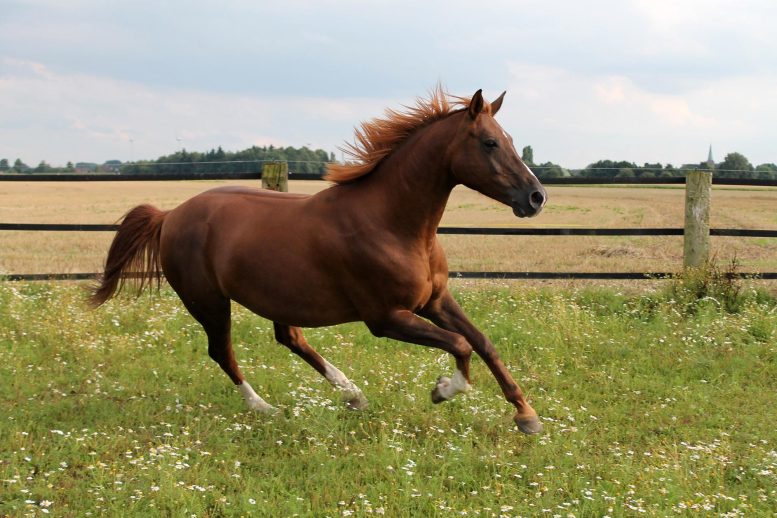
A study suggests that asymmetric gaits, like galloping and bounding, evolved 472 million years ago in ancient fish, long before animals moved onto land.
Few human adults gallop; the equine gait tends to be the preserve of little kids mimicking horses or exercise classes. But for camels, lions, and giraffes, galloping is a key fixture of their repertoire as they shift up through the gears.
However, Eric McElroy, from the College of Charleston, USA, explains that galloping is just one form of movement from a selection of maneuvers known as ‘asymmetric gaits’ – where the timing of foot falls is unevenly spread; including bounds performed by rabbits, crutching – when amphibious fish drag themselves by their fins across land – and punting, when fish push themselves along the sea- or riverbed with their pelvic fins.
The Surprising Evolutionary History of Asymmetric Gaits
Scientists had suggested that the ability to bound and gallop only emerged after mammals first appeared on the planet 210 million years ago. However, it turns out that crocodiles can also gallop at their highest speeds and turtles bound; which made McElroy and Michael Granatosky, from the New York Institute of Technology, USA, wonder whether animals may have evolved the ability to coordinate their limbs independently much earlier than previously thought. They publish their discovery that animals probably evolved the ability to crutch, bound, and possibly even gallop, 472 million years ago, long before life emerged onto land, in Journal of Experimental Biology.
To find out, the duo scoured the scientific literature and constructed a bespoke family tree, including the mammals, marsupials, monotremes, reptiles, frogs, toads, and fish that are currently known to use asymmetric ‘foot falls’ when propelling themselves along surfaces with their feet and fins. “In total, we compiled data from 308 species,” says McElroy, allocating a score of 0 to species that only used evenly timed walks, trots and runs, and a score of 1 to species that showed any sign of moving asymmetrically by bounding, crutching, punting or galloping. Then the duo ran a series of simulations to find out how likely it is that asymmetric gaits appeared earlier or later in the evolutionary tree.
Early Evolution of Asymmetric Gaits
“It took months to work out all the kinks in the analysis,” says McElroy, discovering that it is most likely that the earliest ancestors of almost all modern animals, including fish, 472 million years ago were capable of moving with some kind of proto-asymmetric gait. Whether they were punting, crunching, or bounding along the seabed isn’t known, but the animals were capable of asymmetrically coordinating their limbs to propel themselves. And the duo was surprised to discover that even though our earliest antecedent might have been capable of this alternate form of propulsion, some creatures – such as lizards, salamanders, frogs, and even elephants – have lost the ability to bound and gallop, even though they have ancestors in their family tree that were capable of coordinating asymmetric movements.
So, the ability to bound and gallop isn’t just the preserve of mammals. Almost all animals that are alive today have ancestors that were capable of moving asymmetrically, even though some lost the ability to move asymmetrically somewhere along the line; either because they lost the nerves necessary for coordinating these maneuvers or because they became too large or too slow to become airborne. Either way, mammals are not the sole select group with the ability to coordinate asymmetric movements and it is possible that we inherited the ability from some ancient fishy ancestor that propelled itself along the seabed on its fins long before any species set foot or fin on dry land.
Reference: “The evolution of asymmetrical gaits in gnathostome vertebrates” by Eric J. McElroy and Michael C. Granatosky, 8 March 2022, Journal of Experimental Biology.
DOI: 10.1242/jeb.243235
Never miss a breakthrough: Join the SciTechDaily newsletter.
Follow us on Google and Google News.