
“HemoCD-Twins,” a new antidote for CO and HCN poisoning, shows 85% survival in mice and promises to combat fire-related toxic gas poisoning effectively.
Buildings across the globe are prone to catching fires in unfortunate situations. Other than the flames, the burning materials generate highly toxic carbon monoxide (CO) and hydrogen cyanide (HCN) gases, which can be fatal upon ingestion. Once inhaled, these gases bind strongly to hemoglobin, cytochromes, and iron containing compounds known as “hemes,” and block normal aerobic respiration. It is believed that once an individual is exposed to these life-threatening toxins, it is impossible to effectively remove them from the body. In fact, at present, there is no therapeutic approach available to overcome simultaneous CO and HCN poisoning. This poses a significant challenge in saving the lives of people exposed to toxic gases in building fires.
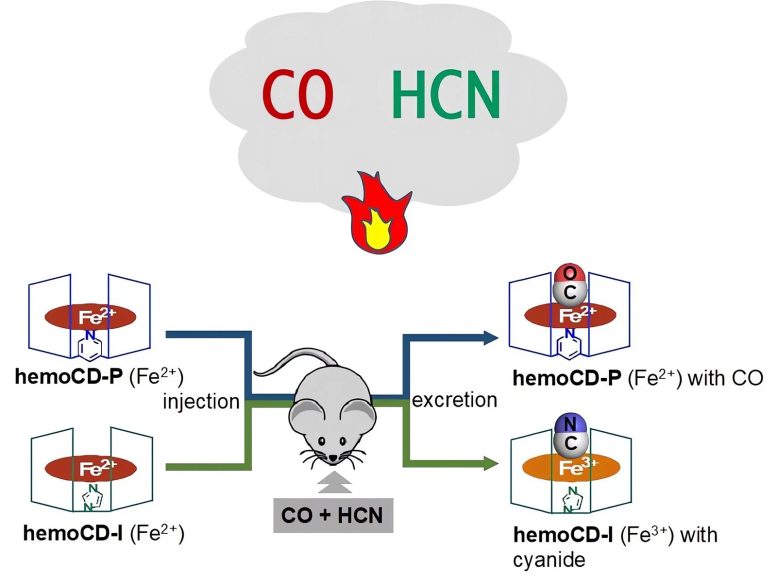
In a recent breakthrough, a team of researchers led by Professor Hiroaki Kitagishi from the Faculty of Science and Engineering, Doshisha University, Japan has developed a synthetic heme-model compound termed “hemoCD-Twins,” that acts as an antidote for CO and HCN poisoning. Prof. Kitagishi and his collaborators—Dr. Qiyue Mao from Doshisha University, Dr. Xuansu Zhao from the Building Research Institute, Japan, Dr. Akiko Kiriyama from Doshisha Women’s College of Liberal Arts, Japan, and Dr. Roberto Motterlini from University Paris Est Creteil, France—have detailed the development of this novel antidote in their recent research article published today (February 20, 2023) in the Proceedings of the National Academy of Sciences (PNAS). In saline solution, hemoCD Twins dissolves into two heme models, of which hemoCD-P captures CO very strongly, and hemoCD-I effectively scavenges CN–.
Motivation Behind the Research
What was the motivation behind the development of this life-saving compound? Prof. Kitagishi recalls, “We have been studying synthetic heme-model compounds (hemoCDs) for over two decades. The series of hemoCDs, which comprises a mixture of synthetic organic compounds—porphyrin and cyclodextrins—has been our original heme-model system that realizes the biological functions of hemes using completely synthetic materials. One fine morning during the course of our research, I embarked on the idea that hemoCDs could be best used as antidotes against simultaneous poisoning by CO and HCN.”
The team has also demonstrated hemoCD-Twins to be a very effective and rapid antidote against CO and HCN simultaneous poisoning in mice models. They found that in mice, this compound resulted in an 85% survival rate and rapid recovery. Moreover, this dual antidote exhibited very low toxicity and rapid elimination via urinary excretion. In addition, hemoCD-Twins had an immediate antidotal effect, a high degree of safety, and storage stability.
How will this antidote impact our lives in the long run? Prof. Kitagishi muses, “This antidote will limit damage from gas poisoning caused by sudden fires and can be tested for the treatment of various symptoms caused by gas poisoning. With the completion of various non-clinical and clinical trials, within 5–10 years, we hope that hemoCD-Twins can be incorporated in ambulances, emergency hospitals, and other facilities. This way, future generations will have no need to fear sudden fire gas poisoning. We will proceed with non-clinical and clinical trials in cooperation with medical doctors in order to implement this compound as a therapeutic agent in the world. For this purpose, we would like to request the cooperation from the general society.” Here’s hoping that we see Prof. Kitagishi’s vision for hemoCD-Twins to be used as a powerful antidote come to life!
Reference: “A synthetic porphyrin as an effective dual antidote against carbon monoxide and cyanide poisoning” by Qiyue Mao, Xuansu Zhao, Akiko Kiriyama, Shigeru Negi, Yasutaka Fukuda, Hideki Yoshioka, Akira T. Kawaguchi, Roberto Motterlini, Roberta Foresti and Hiroaki Kitagishi, 21 February 2023, Proceedings of the National Academy of Sciences.
DOI: 10.1073/pnas.2209924120
About Professor Hiroaki Kitagishi from Doshisha University, Japan
Hiroaki Kitagishi is a Professor at the Faculty of Science and Engineering Department of Molecular Chemistry and Biochemistry, Doshisha University, Japan. His research focuses on Porphyrin, Cyclodextrin, Heme, CO, Supramolecular Chemistry, Bioinorganic Chemistry, Life sciences and Biomaterials. Prior to his extensive research tenure at Doshisha University, he was a post-doctoral fellow at Osaka University in the Graduate School of Engineering Division of Applied Chemistry. He earned his bachelors, masters and Ph.D. from Doshisha University, Nara Institute of Science and Technology, Graduate School of Materials Science, Department of Materials Science and Doshisha University respectively. He has authored over 80 publications and has over 1500 citations to his credit.
Funding information
This work was financially supported by MEXT/JSPS KAKENHI (Grant No. JP20H02871 and JP21K20543), Translational Research Program from Japan Agency for Medical Research and Development (22ym0126814j0001), the Uehara Memorial Foundation, and Takahashi Industrial and Economic Research Foundation.
Never miss a breakthrough: Join the SciTechDaily newsletter.
Follow us on Google and Google News.
1 Comment
That is absolutely fantastic. With normal treatment, a victim is given concentrated oxygen therapy and some hope. Getting the monoxide out takes time, and the patient may not have it. A synthetic way could save many lives that currently firefighters rescue and then have to watch sufficate internally after.
Also, the first sentence, “Buildings across the globe are prone to catching fires in unfortunate situations.” is the most Japanese introductory sentence I’ve ever read in English.