
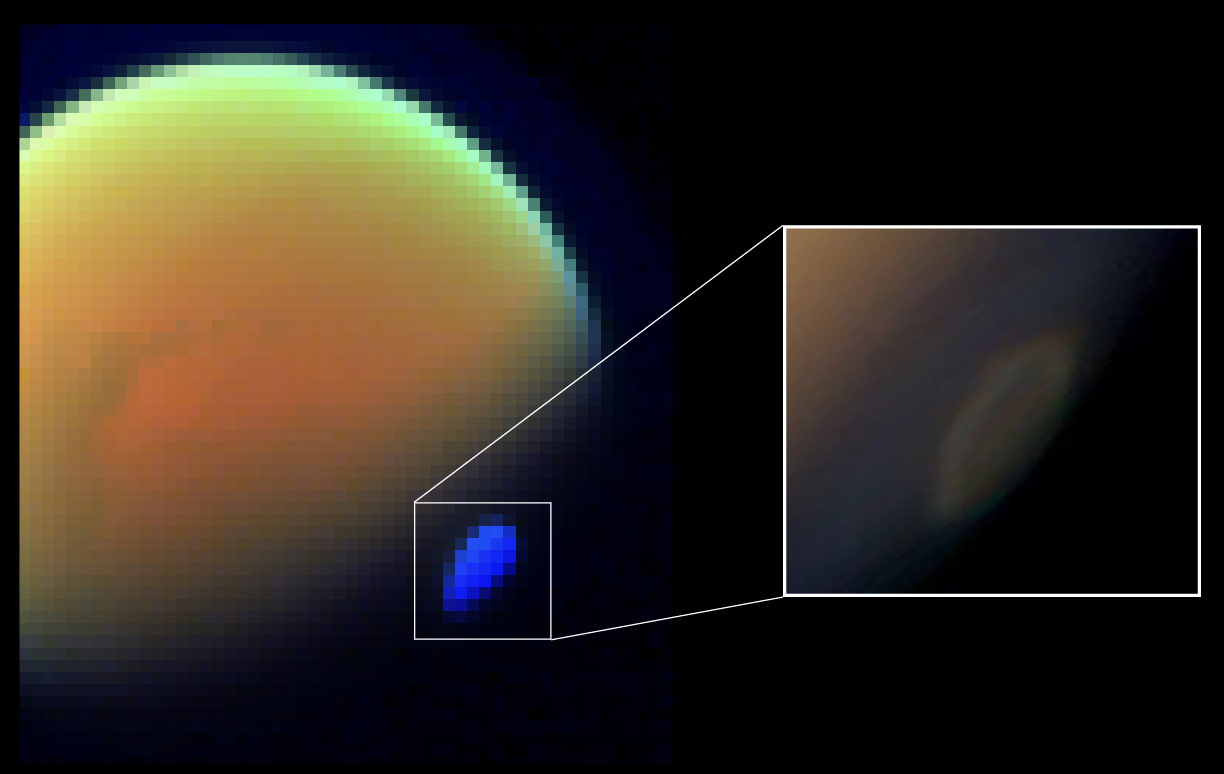
Data from NASA’s Cassini mission reveals that a giant polar vortex hovering over the south pole of Titan contains frozen particles of the toxic compound hydrogen cyanide, or HCN.
“The discovery suggests that the atmosphere of Titan’s southern hemisphere is cooling much faster than we expected,” said Remco de Kok of Leiden Observatory and SRON Netherlands Institute for Space Research, lead author of the study published today in the journal Nature.
Titan is the only moon in the solar system that is cloaked in a dense atmosphere. Like our home planet, Earth, Titan experiences seasons. As it makes its 29-year orbit around the sun along with Saturn, each season lasts about seven Earth years. The most recent seasonal switch occurred in 2009, when winter gave way to spring in the northern hemisphere, and summer transitioned to autumn in the southern hemisphere.
In May 2012, while Titan’s southern hemisphere was experiencing autumn, images from Cassini revealed a huge swirling cloud, several hundred miles across, taking shape above Titan’s south pole. This polar vortex appears to be an effect of the change of season.
A puzzling detail about the swirling cloud is its altitude, some 200 miles (about 300 kilometers) above Titan’s surface, where scientists thought the temperature was too warm for clouds to form. “We really didn’t expect to see such a massive cloud so high in the atmosphere,” said de Kok.
Keen to understand what could give rise to this mysterious cloud, the scientists dove into Cassini’s observations and found an important clue in the spectrum of sunlight reflected by Titan’s atmosphere.
A spectrum splits the light from a celestial body into its constituent colors, revealing signatures of the elements and molecules present. Cassini’s visual and infrared mapping spectrometer (VIMS) maps the distribution of chemical compounds in Titan’s atmosphere and on its surface.
“The light coming from the polar vortex showed a remarkable difference with respect to other portions of Titan’s atmosphere,” says de Kok. “We could clearly see a signature of frozen HCN molecules.”
As a gas, HCN is present in small amounts in the nitrogen-rich atmosphere of Titan. Finding these molecules in the form of ice was surprising, as HCN can condense to form frozen particles only if the atmospheric temperature is as cold as minus 234 degrees Fahrenheit (minus 148 degrees Celsius). This is about 200 degrees Fahrenheit (about 100 degrees Celsius) colder than predictions from current theoretical models of Titan’s upper atmosphere.
To check whether such low temperatures were actually possible, the team looked at observations from Cassini’s composite infrared spectrometer (CIRS), which measures atmospheric temperature at different altitudes. Those data showed that the southern hemisphere of Titan has been cooling rapidly, making it possible to reach the cold temperature needed to form the giant toxic cloud seen on the south pole.
Atmospheric circulation has been drawing large masses of gas towards the south since the change of season in 2009. As HCN gas becomes more concentrated there, its molecules shine brightly at infrared wavelengths, cooling the surrounding air in the process. Another factor contributing to this cooling is the reduced exposure to sunlight in Titan’s southern hemisphere as winter approaches there.
“These fascinating results from a body whose seasons are measured in years rather than months provide yet another example of the longevity of the remarkable Cassini spacecraft and its instruments,” said Earl Maize, Cassini project manager at NASA’s Jet Propulsion Laboratory in Pasadena, California. “We look forward to further revelations as we approach summer solstice for the Saturn system in 2017.”
Reference: “HCN ice in Titan’s high-altitude southern polar cloud” by Remco J. de Kok, Nicholas A. Teanby, Luca Maltagliati, Patrick G. J. Irwin and Sandrine Vinatier, 1 October 2014, Nature.
DOI:10.1038/nature13789
The Cassini-Huygens mission is a cooperative project of NASA, the European Space Agency, and the Italian Space Agency. JPL, a division of the California Institute of Technology, Pasadena, manages the mission for NASA’s Science Mission Directorate in Washington. The VIMS team is based at the University of Arizona in Tucson. The CIRS team is based at NASA’s Goddard Space Flight Center in Greenbelt, Maryland.
Never miss a breakthrough: Join the SciTechDaily newsletter.
Follow us on Google and Google News.