
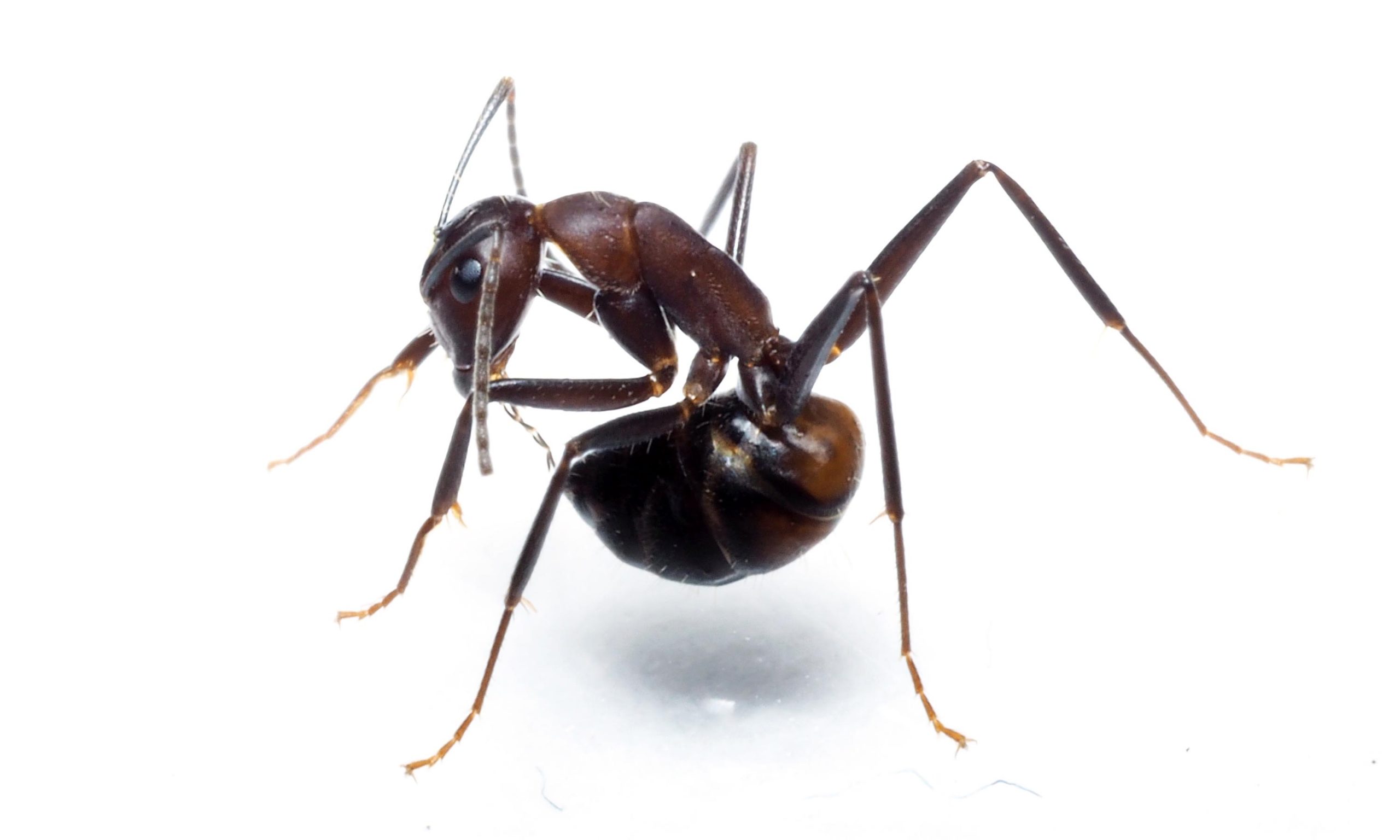
Ants use their own acid to disinfect themselves and their stomachs. A team from Martin Luther University Halle-Wittenberg (MLU) and the University of Bayreuth has found that formic acid kills harmful bacteria in the animal’s food, thereby reducing the risk of disease. At the same time, the acid significantly influences the ant’s intestinal flora. The new study was published in the journal eLife.
Formic acid is one of the simplest organic acids. It is produced in a special gland in the abdomen of numerous species of ants. “There was a long-standing assumption that the acid only served to ward off predators, for example, insects and birds,” says Dr. Simon Tragust from the Institute of Biology at MLU, who co-led the new study alongside Professor Heike Feldhaar from Bayreuth. A couple of years ago he was able to show that ants also use the acid in brood care, for example, to disinfect their brood and prevent the spread of harmful fungi.
The new study was based on an observation of the animals’ behavior. “Whenever ants swallow food or water, they start cleaning their hindquarters afterward,” says Tragust. The researcher wanted to figure out why they do that. “For one thing, the behavior didn’t seem to be linked to digestion, because ants do this even after they have only ingested water,” he adds.
Through several experiments, the team was able to show that ants disinfect themselves on the inside. “When the ants were able to access the acid, their chances of survival increased significantly after eating food enriched with pathogenic bacteria,” explains Tragust. What’s more, the beneficial effect was not limited to an individual animal. Ants pass food from their mouth to the mouths of their nestmates. “This is a major potential source of infection,” says Tragust. If the ant passing on the food has previously ingested the acid, the receiving ant had a lower risk of falling ill. According to Tragust, this behavior might reduce the spread of infection within the ant colony.
The results of the new study also explain why some ants have very few bacteria in their digestive tracts; those that are present are primarily acid-resistant microbes. “Acid swallowing acts as a filter mechanism, structuring the ant’s microbiome,” explains Tragust. Ants are one of just a handful of animals with extremely acidic stomachs. “Otherwise this is only known to occur in humans and a few other vertebrates,” says Tragust. Unlike ants, stomach acid in humans is produced directly in the stomach, but the effects are the same: The acid kills germs in the food and influences the microbiome of the gut.
Incidentally, how formic acid precisely works is still a mystery, but it and other organic acids have long been used as additives in animal feed to kill harmful germs.
Reference: “Formicine ants swallow their highly acidic poison for gut microbial selection and control” by Simon Tragust, Claudia Herrmann, Jane Häfner, Ronja Braasch, Christina Tilgen, Maria Hoock, Margarita Artemis Milidakis, Roy Gross and Heike Feldhaar, 3 November 2020, eLife.
DOI: 10.7554/eLife.60287
Never miss a breakthrough: Join the SciTechDaily newsletter.
Follow us on Google and Google News.
2 Comments
nice topic thanks
Interesting.
Don’t have access to the actual article so difficult to corelate it with humans and mammalian species.
However, these are my comments based on information made available. Extractt and Introduction only.
Even , Ants appear to realize that the foods they eat and the liquids they may contain harmful pathogens, bacteria and Viruses (Dont know if ants perish due to Viruses, they probably do!).
They seem to have the intelligence superior to humans and realize that acid wash of the stomach every time they eat or drink helps in getting to a better and longer life! They appear to be introducing it into the stomach from their Ass! We continue to ignore the fact that many if not all infections and infectious diseaes originate from the food and liquids i.e. we have ingested.
We probably have our heads up our Ass —and there is no need to introduce acid into the stomach and ensure such pathogens, bacteria, and viruses. They can probably thrive in a alkaline environment. Maybe a simle PH test using litmus paper ( along with a PH Scale ) can help determine the acidity / alkalinity of the stomach. May be it as important as the Sodium – Pottasium balane in humans to ensure good health!