
Close Menu
    Facebook X (Twitter) Instagram
    SciTechDaily
    • Biology
    • Chemistry
    • Earth
    • Health
    • Physics
    • Science
    • Space
    • Technology
    Facebook X (Twitter) Pinterest YouTube RSS
    SciTechDaily
    Home»Biology»Archaea, Bacteria, and Eukarya Have More in Common Than Previously Thought
    Biology

    Archaea, Bacteria, and Eukarya Have More in Common Than Previously Thought

    By SEAS Harvard UniversityJanuary 2, 20181 Comment3 Mins Read
    Facebook Twitter Pinterest Telegram LinkedIn WhatsApp Email Reddit
    Share
    Facebook Twitter LinkedIn Pinterest Telegram Email Reddit
    Archaea, Bacteria, and Eukarya May Have More in Common Than Previously Thought
    SEAS researchers have found that these pink-hued archaea — called Halobacterium salinarum — use the same mechanisms to maintain size as bacteria and eukaryotic life, indicating that cellular division strategy may be shared across all domains of life. (Image courtesy of Alexandre Bison/Harvard University)

    The three domains of life — archaea, bacteria, and eukarya — may have more in common than previously thought.

    Over the past several years, Ariel Amir, Assistant Professor in Applied Mathematics at the Harvard John A. Paulson School of Engineering and Applied Sciences (SEAS) has been studying how cells regulate size. In previous research, he and his collaborators found that E. coli (bacteria) and budding yeast (eukaryote) use the same cellular mechanisms to ensure uniform cell sizes within a population.

    Now, with a team of collaborators including Ethan Garner, the John L. Loeb Associate Professor of the Natural Sciences at Harvard, and Amy Schmid, Assistant Professor of biology at Duke University, Amir found that archaea use the very same mechanism.

    “These findings raise really interesting questions about how cellular mechanics evolved independently across all three domains of life,” said Amir. “Our results will serve as a useful foundation for, ultimately, understanding the molecular mechanisms and evolution of cell cycle control.”

    Archaea are single-celled microorganisms that inhabit some of Earth’s most extreme environments, such as volcanic hot springs, oil wells, and salt lakes. They are notoriously difficult to cultivate in a lab and, as such, are relatively understudied.
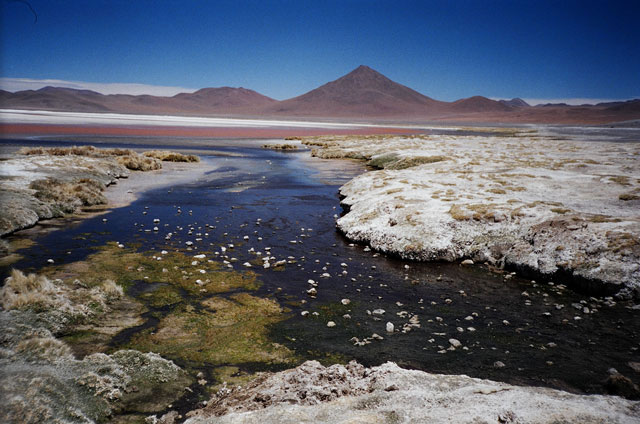
    Cellular Division Strategy Shared Across All Domains of Life
    Archaea inhabit some of Earth’s most extreme environments, such as this salt lake in Bolivia (Image courtesy of Ariel Amir/Havard SEAS)

    “Archaea are unique because they blend a lot of the characteristics of both bacteria and eukaryotes,” said Dr. Yejin Eun, first author of the paper. “Archaea resemble bacterial cells in size and shape but their cell cycle events — such as division and DNA replication — are a hybrid between eukaryotes and bacteria.”

    The researchers studied Halobacterium salinarum, an extremophile that lives in high-salt environments. They found that like bacteria and budding yeast, H. salinarum controls its size by adding a constant volume between two events in the cell cycle. However, the researchers found that H. salinarum are not as precise as E.coli and there was more variability in cell division and growth than in bacterial cells.

    “This research is the first to quantify the cellular mechanics of size regulation in archaea,” said Amir. “This allows us to quantitatively explore how these mechanisms work, and build a model that explains the variability within the data and the correlations between key properties of the cell cycle. Eventually, we hope to understand just what makes this cellular mechanism so popular across all domains of life.”

    This research was also coauthored by Po-Yi Ho, Minjeong Kim, Lars Renner, Salvatore LaRussa, and Lydia Robert.

    This research was supported in part by the National Institute of Health and the National Science Foundation.

    Reference: “Archaeal cells share common size control with bacteria despite noisier growth and division” by Ye-Jin Eun, Po-Yi Ho, Minjeong Kim, Salvatore LaRussa, Lydia Robert, Lars D. Renner, Amy Schmid, Ethan Garner and Ariel Amir, 18 December 2017, Nature Microbiology.
    DOI: 10.1038/s41564-017-0082-6

    Never miss a breakthrough: Join the SciTechDaily newsletter.
    Follow us on Google and Google News.

    Bacteria Duke University Eukaryotes Harvard University Microbiology Yale School of Engineering & Applied Science
    Share. Facebook Twitter Pinterest LinkedIn Email Reddit

    Related Articles

    “Hangry” Bacteria – New Research Sheds Light on Unusual Behavior

    Disgusting Biodiversity: The Surprising Structural Reason Your Kitchen Sponge Is a Bacterial Incubator

    Microbiota in Pregnant Women Looks Like Those of People with Diabetes

    Plants Choose and Make Use of the Bacteria They Allow into Their Roots

    Superoxide Reacts With Manganese to Aid in Environmental Cleanup

    Examining Microbes to Better Understand Their Role in Health and Diet

    Microbial Life Lining Our GI Tracts Has Coevolved With Us

    Stimulating Resolution Programs Limit Consequences of Infection

    Widespread Presence of Antibiotic Resistant Bacteria in Agricultural Soils

    1 Comment

    1. Bruzote on December 5, 2023 11:22 am

      I wonder if the volume regulation mechanism is ultimately regulated by a limit to how many times certain genes are activated to achieve those incremental volume increases.

      Reply
    Leave A Reply Cancel Reply

    • Facebook
    • Twitter
    • Pinterest
    • YouTube

    Don't Miss a Discovery

    Subscribe for the Latest in Science & Tech!

    Trending News

    AI Could Detect Early Signs of Alzheimer’s in Under a Minute – Far Before Traditional Tests

    What if Dark Matter Has Two Forms? Bold New Hypothesis Could Explain a Cosmic Mystery

    This Metal Melts in Your Hand – and Scientists Just Discovered Something Strange

    Beef vs. Chicken: Surprising Results From New Prediabetes Study

    Alzheimer’s Breakthrough: Scientists Discover Key Protein May Prevent Toxic Protein Clumps in the Brain

    Quantum Reality Gets Stranger: Physicists Put a Lump of Metal in Two Places at Once

    Scientists May Have Found the Key to Jupiter and Saturn’s Moon Mystery

    Scientists Uncover Brain Changes That Link Pain to Depression

    Follow SciTechDaily
    • Facebook
    • Twitter
    • YouTube
    • Pinterest
    • Newsletter
    • RSS
    SciTech News
    • Biology News
    • Chemistry News
    • Earth News
    • Health News
    • Physics News
    • Science News
    • Space News
    • Technology News
    Recent Posts
    • Century-Old Cleaning Chemical Linked to 500% Increased Risk of Parkinson’s Disease
    • What if Your Memories Never Happened? Physicists Take a New Look at the Boltzmann Brain Paradox
    • Students Found an Ancient Star That Shouldn’t Be in the Milky Way
    • Astronomers Solve 50-Year Mystery and Reveal Hidden Culprit Behind Strange X-Ray Emissions
    • One of the Universe’s Largest Stars May Be Getting Ready To Explode
    Copyright © 1998 - 2026 SciTechDaily. All Rights Reserved.
    • Science News
    • About
    • Contact
    • Editorial Board
    • Privacy Policy
    • Terms of Use

    Type above and press Enter to search. Press Esc to cancel.