
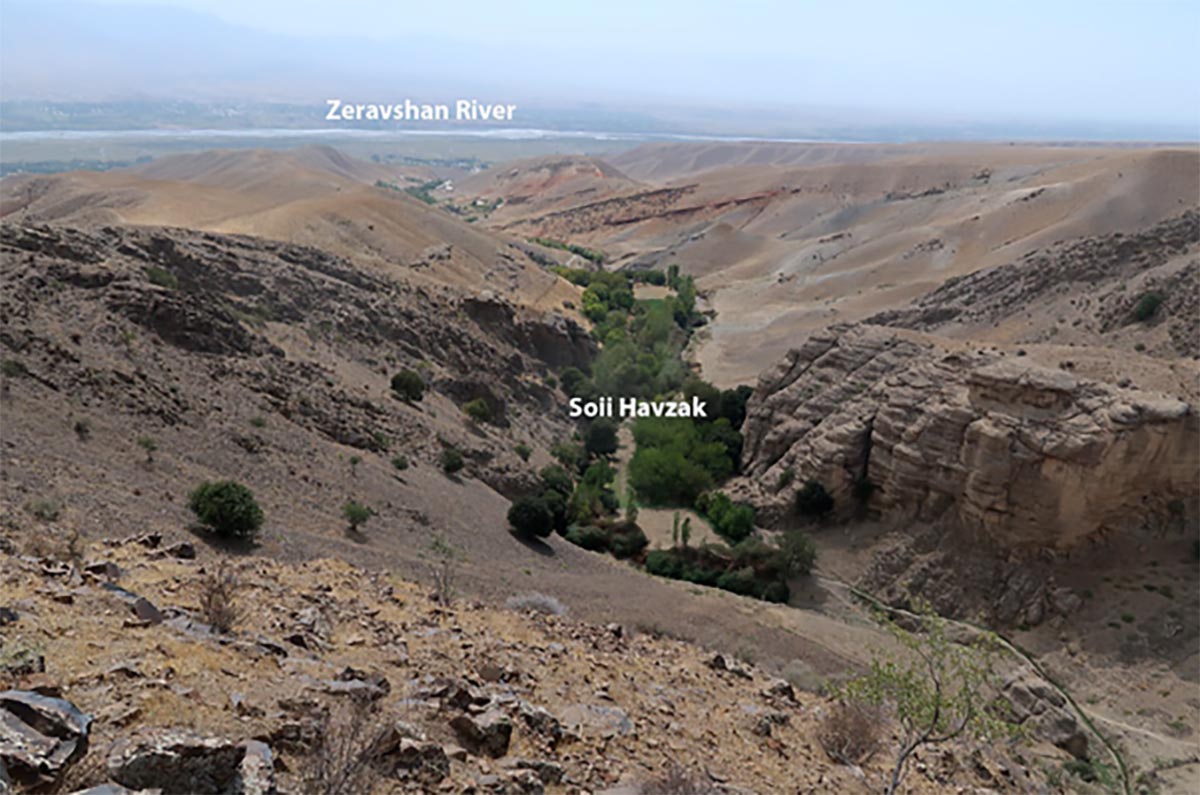
Recent excavations in Tajikistan’s Zeravshan Valley uncovered an archaeological site dating back as far as 150,000 years, offering new insights into early human settlements and migrations in Central Asia.
A team of archaeologists from the Hebrew University of Jerusalem and the National Academy of Sciences of Tajikistan has discovered a multi-layered archaeological site in the Zeravshan Valley, central Tajikistan, offering new insights into early human settlement in the region.
The site, known as Soii Havzak, yielded key evidence of Central Asia’s crucial role in the migration and development of early humans.

Unearthing Ancient Tools and Evidence
The team, led by Prof. Yossi Zaidner of the Institute of Archaeology at Hebrew University and Dr. Sharof Kurbanov from the National Academy of Sciences of Tajikistan, uncovered a vast array of stone tools, animal bones, and ancient vegetation that date back to various periods between 20,000 and 150,000 years ago.

“It turns out that the Zeravshan Valley, known primarily as a Silk Road route in the Middle Ages, was a key route for human expansion long before that—between 20,000 and 150,000 years ago,” explained Prof. Zaidner. “This region may have served as a migration route for several human species, such as modern Homo sapiens, Neanderthals, or Denisovans, which may have coexisted in this area, and our research aims to uncover who were the humans that inhabited these parts of the Central Asia and the nature of their interactions.”
Insights into Ancient Climates and Human Species
In the study, recently published in Antiquity, the archaeological team excavated three areas at Soii Havzak, unearthing layers of human activity. The well-preserved remains offer valuable clues to the ancient climate and environment, as well as the potential for discovering human remains that could identify which human species inhabited the region.

“The preservation of organic materials, such as burnt wood remains, as well as bones, is remarkable. This allows us to reconstruct the region’s ancient climate and provides hope that further excavations might reveal clues about human biology in the region,” said Prof. Zaidner. “This is crucial for understanding the development of human populations and behavior in Central Asia.”
Future Excavations and Research Implications
The research has broader implications for the study of human evolution and migration, particularly in understanding how ancient human groups may have interacted with each other. The team believes that Soii Havzak’s location in the mountainous corridor of Central Asia may have served as a significant transition point for human populations, enabling the spread of early humans across vast regions.

“We hope that ongoing research at this site will reveal new insights into how different human groups—like modern humans, Neanderthals and Denisovans—may have interacted in this region,” said Prof. Zaidner. “This discovery is a significant step toward understanding ancient human history in Central Asia and marks an important collaboration between international scientific teams.”
The excavation at Soii Havzak will continue over the coming years, with further digs planned to explore deeper layers and conduct more in-depth analyses of the findings. The research is expected to deepen our understanding of human development in Central Asia, potentially transforming the historical narrative of human migration and interaction in this critical region.
Reference: “Soii Havzak: a new Palaeolithic sequence in Zeravshan Valley, central Tajikistan” by Yossi Zaidner and Sharof Kurbanov, 4 November 2024, Antiquity.
DOI: 10.15184/aqy.2024.149
Never miss a breakthrough: Join the SciTechDaily newsletter.
Follow us on Google and Google News.
26 Comments
A personal discovery of Scitechdaily commonly presents articles/histories always peak our curiosity with brief infused photo-journalism drawing us into pausing to venture into a corridor to read more with in depth interests. I’m often hooked.
Can’t wait for more information to be found!
Wonderful, fascinating intimations of how and when they plodded westward. Thank you, ladies and gentlemen of all the teams involved.
Great! Who were those humans? What language did they speak? Has any symbols or inscriptions etc been found? If so, have they been deciphered?
We need to correlate all archeological findings and centralise the research in past human history at one accessible centre in globe .Also a book of findings in different fields in the last century chronologically need to be available in big libraries of all countries and universities.
This will give boost to one world, one family without wars like now
I am hooked,! Awesome, more please
Did they produce metal objects?
Please more information. This is incredible! We keep finding older information!
Not sure I’m more worried about the numbers and letters written in the sands.
Sometimes we are gifted to see things none else sees…. Look closely to the letters and numbers all over that picture.
Very interesting Please more
Love this more please
Brilliant!
I love archaeology. Sometimes it goes a long way to actually find and clarify , what has been found. It’s very interesting that we can now , not just see the future but can see (hindsight). In other words what the people ( humans)from thousands of years ago left behind .
Better to wright things properly…Tadjikistan that how it should be …
Write*
Dang 🤣
Got righted, lol..
Can’t wait for more information
I am hooked ! This is incredible!! More Please,..
Incredible
Whats intrigue to me is taking the location in aspects of geology, terrain, proximity to water, elevation… and locate the same features across the globe. If it’s in one location odds say it is in different locations.
These articles appearing in my newsfeed are astonishingly interesting and well written. Keep up the good work. Well done and thank you.
It’s incredible how many people follow ancient walking routes, whether hiking recreationally or using them for hunting or even local commerce, without knowing how long people used these routes for survival and trade. Many were ancient megafauna migration routes, and many sections are now the routes of modern railways and highways.
without the human remains it would seem quite the speculation that neanderthals coexisted with homosapians at the site.
Your occupation is so greatly appreciated. That field of Discovery is beyond to measure. I would have loved to have been an archeologist. Very interesting and rewarding. Keep up the tremendous work and keep educating us. A Great Tribute!
Would love to know the truth about more Finding in the World 🌍 I live in today that we believe anywhere we want to go around the World to live as well, in Peace and Love for each other!!!!
Backing up I meant to say belong not believe anywhere we to go around the World! In My comments