
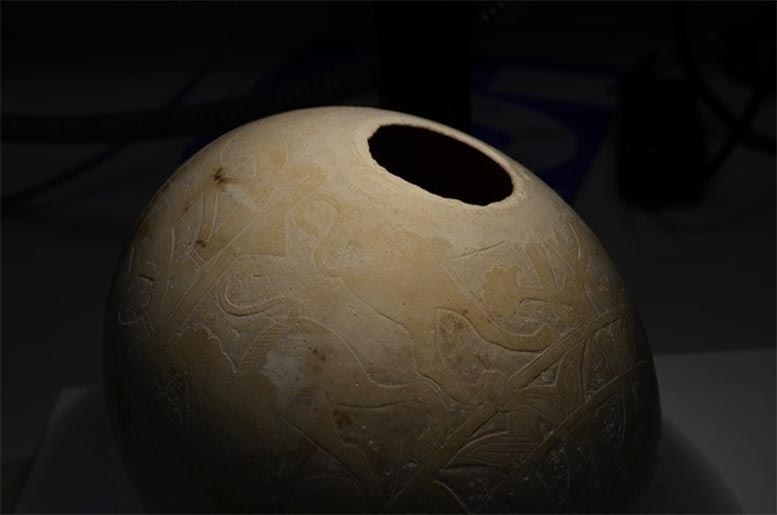
Research reveals surprising complexity of ancient ostrich egg trade.
An international team of specialists, led by the University of Bristol, is closer to cracking a 5,000-year-old mystery surrounding the ancient trade and production of decorated ostrich eggs.
Long before Fabergé, ornate ostrich eggs were highly prized by the elites of Mediterranean civilizations during the Bronze and Iron Ages, but to date little has been known about the complex supply chain behind these luxury goods.
Examining ostrich eggs from the British Museum’s collection, the team, led by Bristol’s Dr. Tamar Hodos, were able to reveal secrets about their origin and how and where they were made. Using state-of-the-art scanning electron microscopy, Dr. Caroline Cartwright, Senior Scientist at the British Museum was able to investigate the eggs’ chemical makeup to pinpoint their origins and study minute marks that reveal how they were made.
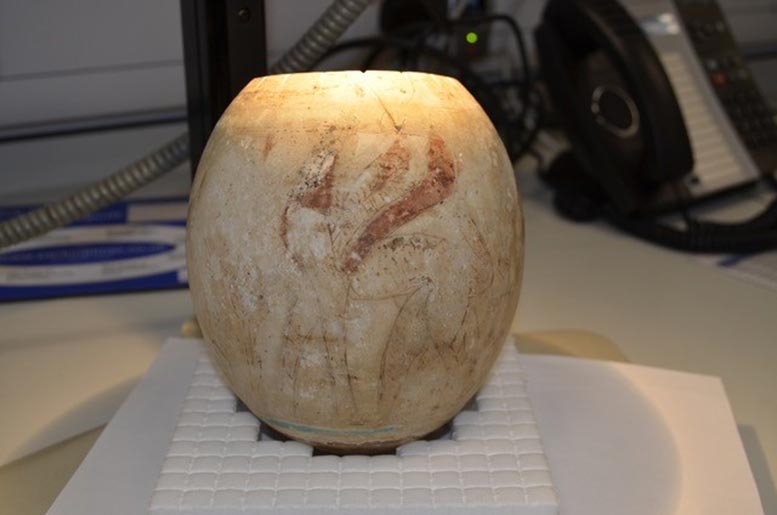
In the study, published today (April 9, 2020) in the journal Antiquity, the researchers describe for the first time the surprisingly complex system behind ostrich egg production. This includes evidence about where the ostrich eggs were sourced, if the ostriches were captive or wild, and how the manufacturing methods can be related to techniques and materials used by artisans in specific areas.
“The entire system of decorated ostrich egg production was much more complicated than we had imagined! We also found evidence to suggest the ancient world was much more interconnected than previously thought,” said Dr. Hodos, Reader in Mediterranean Archaeology in Bristol’s School of Arts.
“Mediterranean ostriches were indigenous to the eastern Mediterranean and North Africa. Using a variety of isotopic indicators, we were able to distinguish eggs laid in different climatic zones (cooler, wetter and hotter, drier). What was most surprising to us was that eggs from both zones were found at sites in the other zone, suggestive of more extensive trade routes.”
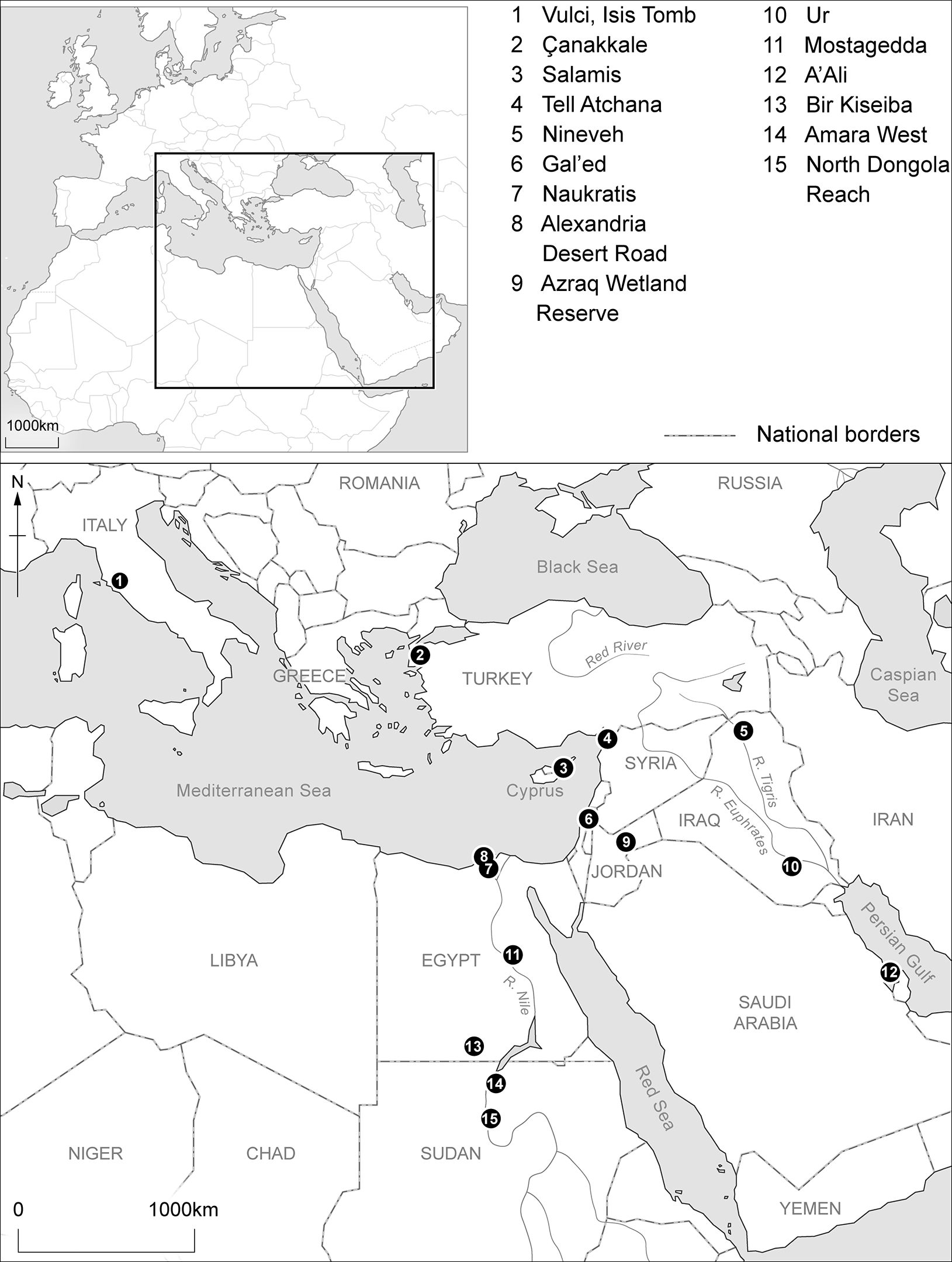
Dr. Hodos and colleagues believe eggs were taken from wild birds’ nests despite evidence of ostriches being kept in captivity during this period. This was no ordinary egg hunt – ostriches can be extremely dangerous so there was a tremendous risk involved in taking eggs from wild birds.
“We also found eggs require time to dry before the shell can be carved and therefore require safe storage. This has economic implications, since storage necessitates a long-term investment and this, combined with the risk involved, would add to an egg’s luxury value,” said Dr. Hodos.
The study is part of an ongoing research project into ancient luxury goods, Globalising Luxuries.
Dr. Hodos explains: “We are assessing not only how ancient luxuries were produced but also how they were used by different peoples. These questions are incredibly important for our own society today, in which the same object may have different social or symbolic meanings for different groups. Such knowledge and understanding help foster tolerance and mutual respect in a multi-cultural society. If we can understand these mechanisms in the past, for which we have long-term outcomes in terms of social development, we can use this knowledge to better inform our own society in a number of ways.”
Dr. Caroline Cartwright, Senior Scientist, Department of Scientific Research, British Museum, said
“The British Museum is delighted to collaborate with colleagues at the universities of Bristol and Durham on this ongoing research. Using state-of-the-art scanning electron microscope facilities in the British Museum’s Department of Scientific Research, our experts were able to study these beautiful objects and cast new light on their significance in history. We look forward to continuing to work with university partners and furthering the knowledge and understanding of the Museum’s collection.”
Reference: “The origins of decorated ostrich eggs in the ancient Mediterranean and Middle East” by Tamar Hodos, Caroline R. Cartwright, Janet Montgomery, Geoff Nowell, Kayla Crowder, Alexandra C. Fletcher and Yvonne Gönster, 9 April 2020, Antiquity.
DOI: 10.15184/aqy.2020.14
Never miss a breakthrough: Join the SciTechDaily newsletter.
Follow us on Google and Google News.
2 Comments
“We also found evidence to suggest the ancient world was much more interconnected than previously thought” Wow i think it is pretty obvious, the evidence is everywhere, conservatives just ignore it to keep the status quo, damn this boomers.
You don’t seem very political and generational interconnected, on the other hand.
But I think any web video aggregator tell us humanity is ever more globally connected, even during a pandemic.