
Close Menu
    Facebook X (Twitter) Instagram
    SciTechDaily
    • Biology
    • Chemistry
    • Earth
    • Health
    • Physics
    • Science
    • Space
    • Technology
    Facebook X (Twitter) Pinterest YouTube RSS
    SciTechDaily
    Home»Space»Architecture of Kepler’s Multi-Transiting Systems
    Space

    Architecture of Kepler’s Multi-Transiting Systems

    By Harvard-Smithsonian Center for AstrophysicsSeptember 30, 2014No Comments3 Mins Read
    Facebook Twitter Pinterest Telegram LinkedIn WhatsApp Email Reddit
    Share
    Facebook Twitter LinkedIn Pinterest Telegram Email Reddit
    Architecture of Keplers Multi-Transiting Systems
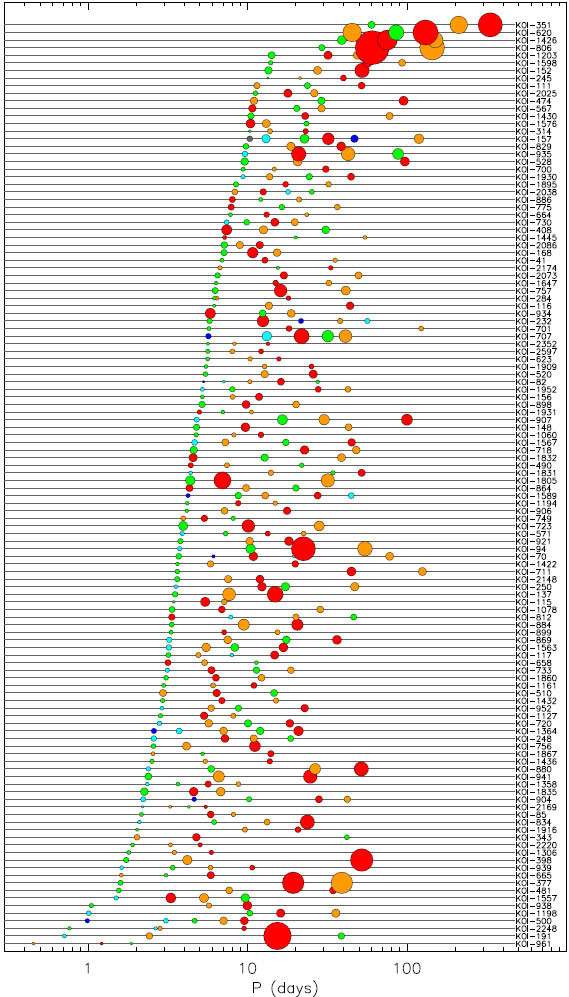
    Astronomers have analyzed the orbits of 365 observed systems of suspected, multiple exoplanets. This figure shows the relative placements and sizes of the planets in systems with three or more planets. The horizontal axis shows the orbital period in days for these systems, in all of which the planets are very to their stars and so complete their annual orbit in under about 100 days (a few suspected planets orbit in under one day!). The planetary radii are colored with the largest in each system being red; most of the planets in this study are between about one and four Earth-radii. Credit: NASA/Kepler; Fabrycky

    A new study details the orbital architectures of Kepler systems having multiple planet candidates, revealing 899 transiting planet candidates in 365 multiple-planet systems and providing a powerful means to study the statistical properties of planetary systems.

    There are 1822 confirmed exoplanets reported so far, and NASA’s Kepler satellite has found evidence for more than two thousand others. Many exoplanets are expected to be in systems with multiple planets; indeed, one Kepler system is thought to contain seven or perhaps even more planets. As astronomers amass data on the characteristics of planets of all kinds, the large number of expected planetary systems allows them to study as well the nature of these systems and the stability of the orbits over time.

    CfA astronomers Darin Ragozzine, John Geary, and Matt Holman, together with their colleagues, have analyzed 899 transiting planet candidates in 365 systems in an effort to understand the statistical properties of planetary systems and the extent to which our solar system might be unusual. The most complex system in their set has six planets. The sample is dominated by planets between about one and four Earth-radii in size and which orbit their stars in about ten days, making the planets hot and not Earth-like.

    The astronomers found one striking feature of these exoplanetary systems: the planets seemed to lie in the same plane, to within an estimated 2.5 degrees (the team also estimates how this value might vary in time). For comparison, the solar system’s planets are coplanar to about 3 degrees, with Mercury being an outlier with its angle of seven degrees; Pluto (not a planet) has an orbital angle of seventeen degrees. The team argues that this exoplanet result suggests that the individual planetary orbits are each nearly circular, a significant conclusion because it means the orbits are not likely to overlap, and hence implies (at least for systems of close-in planets) that they have long-term stability. The new paper marks continuing significant progress in unraveling the picture of planets and planetary systems in the universe.

    Reference: “Architecture of Kepler’s Multi-transiting Systems: II. New investigations with twice as many candidates” by Daniel C. Fabrycky, Jack J. Lissauer, Darin Ragozzine, Jason F. Rowe, Jason H. Steffen, Eric Agol, Thomas Barclay, Natalie Batalha, William Borucki, David R. Ciardi, Eric B. Ford, John C. Geary, Matthew J. Holman, Jon M. Jenkins, Jie Li, Robert C. Morehead, Avi Shporer, Jeffrey C. Smith and Martin Still, 16 July 2014, The Astrophysical Journal.
    DOI: 10.1088/0004-637X/790/2/146
    arXiv: 1202.6328

    Never miss a breakthrough: Join the SciTechDaily newsletter.
    Follow us on Google and Google News.

    Astronomy Astrophysics Exoplanet Harvard-Smithsonian Center for Astrophysics Kepler Space Telescope Planetary Science
    Share. Facebook Twitter Pinterest LinkedIn Email Reddit

    Related Articles

    The Nearest Potentially Habitable Planet is Roughly Nine Light-Years Away

    Kepler Detects A Super-Earth Transiting the Bright K-Dwarf HIP 116454

    Astronomers Discover Transiting Planets in Star Cluster NGC 6811

    Kepler-76b: A Hot Jupiter With Superrotation

    Two New Extrasolar Planets KOI-200b and KOI-889b Detected

    Water Planets in the Habitable Zone: A Closer Look at Kepler 62e and 62f

    Kepler Finds Over 2,300 Candidate Exoplanets

    Earth-like Planets May Have Older and More Evolved Life

    Kepler Data Suggests 17 Billion Earth-Sized Worlds in the Milky Way

    Leave A Reply Cancel Reply

    • Facebook
    • Twitter
    • Pinterest
    • YouTube

    Don't Miss a Discovery

    Subscribe for the Latest in Science & Tech!

    Trending News

    Popular Vitamin B3 Supplements May Help Cancer Cells Survive, Scientists Warn

    Scientists Discover Strange Property of Rice and Turn It Into a Smart Material

    NASA Artemis II Skips Burn As Astronaut Captures Stunning View of Earth

    NASA’s Artemis II: Humans Just Left Earth Orbit for the First Time Since 1972

    What Causes Chronic Pain? Scientists Identify Key Culprit in the Brain

    Semaglutide Shows Surprising Mental Health Benefits in Massive 100,000-Person Study

    This Liquid Snapped Instead of Flowing and Scientists Were Shocked

    Breakthrough Alzheimer’s Drug Rewires the Brain Instead of Just Clearing Plaques

    Follow SciTechDaily
    • Facebook
    • Twitter
    • YouTube
    • Pinterest
    • Newsletter
    • RSS
    SciTech News
    • Biology News
    • Chemistry News
    • Earth News
    • Health News
    • Physics News
    • Science News
    • Space News
    • Technology News
    Recent Posts
    • Stanford Scientists Discover Hidden Brain Circuit That Fuels Chronic Pain
    • Johns Hopkins Scientists Develop Nasal DNA Vaccine for Tuberculosis
    • New Study Reveals Why Ozempic Works Better for Some People Than Others
    • Scientists Uncover the Secret “Glue” That Helps Soil Hold Water
    • Climate Change Is Altering a Key Greenhouse Gas in a Way Scientists Didn’t Expect
    Copyright © 1998 - 2026 SciTechDaily. All Rights Reserved.
    • Science News
    • About
    • Contact
    • Editorial Board
    • Privacy Policy
    • Terms of Use

    Type above and press Enter to search. Press Esc to cancel.