
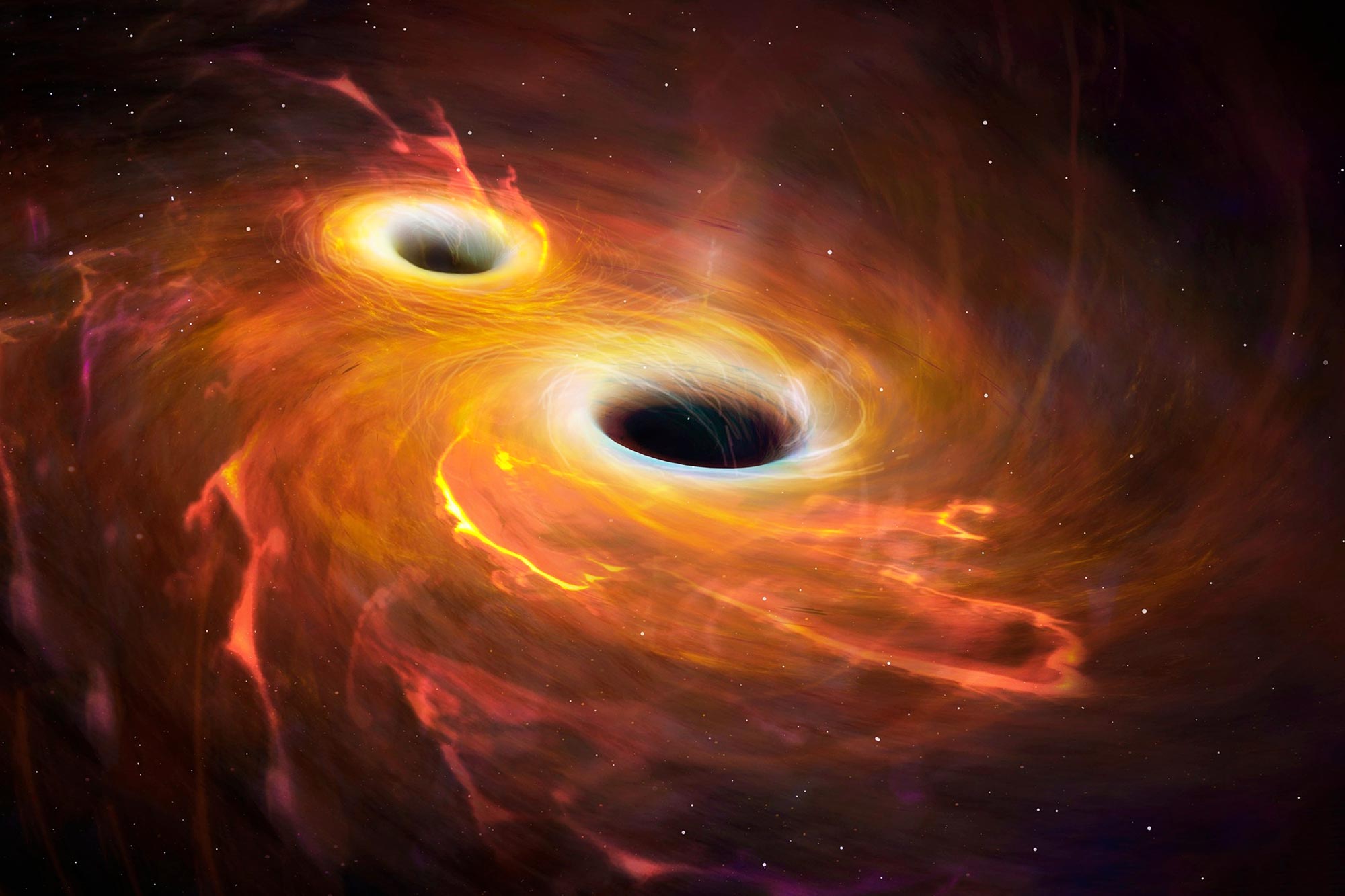
Scientists have developed a more precise method for analyzing gravitational waves, offering a sharper view into the Universe’s most violent and mysterious collisions.
A newly developed technique for analyzing gravitational-wave data could significantly enhance how scientists investigate some of the most powerful events in the Universe, such as collisions between black holes.
Researchers from the University of Portsmouth, University of Southampton, and University College Dublin have introduced a more precise method for interpreting gravitational waves. These waves are subtle distortions in spacetime produced when massive cosmic objects like black holes come together in violent mergers.
Although the study, published in Nature Astronomy, does not reveal new findings about black holes yet, it offers a major improvement in the way gravitational wave data is compared to theoretical models. This advancement provides a solid foundation for future discoveries.
Since gravitational waves were first detected in 2015 (an achievement that earned a Nobel Prize), they have opened up a new frontier in astrophysics. These signals, especially from black hole mergers, have offered rare insight into events that cannot be captured by traditional telescopes, which are often unable to observe such phenomena directly.
The Challenge of Comparing Models
Dr Charlie Hoy, a Research Fellow at the University of Portsmouth’s Institute of Cosmology and Gravitation, and lead author for this work, explained: “When a gravitational wave passes through Earth, we capture a brief signal. To figure out what caused it, we compare the observation against millions of possible theoretical gravitational-wave signals generated with different models. The challenge is that not all models are equally accurate.”
Typically, scientists use a technique known as Bayesian inference to analyse gravitational-wave signals. This technique is often performed multiple times with different models, and the results combined in different ways. The issue with combining results with existing methods is that it can overlook how faithful each model is to Einstein’s theory of general relativity – and risks misleading conclusions.
“I’ve been thinking about how to incorporate model accuracy into gravitational-wave Bayesian inference for years, and it’s very exciting to see our method come to life,” added Dr Hoy.
“Directly computing gravitational waves by solving Einstein’s Field Equations is really hard. Many gravitational-wave models have been developed over the years, but they all have some degree of approximation. With our approach we are able to incorporate this uncertainty into gravitational-wave data analysis methods, and obtain tighter constraints on the fundamental properties of black holes as a consequence.
“Gravitational-wave models are continually being developed and will likely improve in accuracy over the coming years. Our method is designed so that once these models become available, they can be incorporated into our algorithm. All models can then collectively help to obtain together constraints on the mass and spin of black holes.”
Reference: “Incorporation of model accuracy in gravitational wave Bayesian inference” by Charlie Hoy, Sarp Akçay, Jake Mac Uilliam and Jonathan E. Thompson, 15 July 2025, Nature Astronomy.
DOI: 10.1038/s41550-025-02579-7
Never miss a breakthrough: Join the SciTechDaily newsletter.
Follow us on Google and Google News.
2 Comments
Many gravitational-wave models have been developed over the years, but they all have some degree of approximation.
WHY?
To the so-called peer-reviewed publications (including Nature, Science, and the Physical Review series), we demand reflection:
Do phenomena in space originate from the topological evolution of space itself, or are they creations of God, Demons, or Angels?
By what justification do you:
Define the θ and τ mesons – with their manifest differences – as identical?
Assert that two artificially induced, counter-rotating cobalt-60 systems constitute mirror images regardless of their symmetry violation?
Dogmatically proclaim topological vortices and their anti-vortex counterparts as fundamentally distinct spacetime manifolds?
To what end? That we may continue to bear witness to what stands as the most morally corrupt and intellectually bankrupt epoch in the annals of scientific and humanistic inquiry?
Many people do not believe that so-called peer-reviewed publications (such as the Nature, Science, Physical Review series, etc) have been systematically disseminating pseudoscience. If researchers are interested in advances in physics, please visit https://zhuanlan.zhihu.com/p/1927657274920383767, https://zhuanlan.zhihu.com/p/1925124100134790589, https://zhuanlan.zhihu.com/p/1930897490367973024, and https://zhuanlan.zhihu.com/p/1928738508329169149 (If the link is not blocked).
Couldn’t gravitational waves be collapsing the partical field thereby creating reality ie.quantum mechanics?