
Close Menu
    Facebook X (Twitter) Instagram
    SciTechDaily
    • Biology
    • Chemistry
    • Earth
    • Health
    • Physics
    • Science
    • Space
    • Technology
    Facebook X (Twitter) Pinterest YouTube RSS
    SciTechDaily
    Home»Space»Assembling the Cosmos: Hubble Reveals How Dwarf Galaxies Shape the Largest Galaxies
    Space

    Assembling the Cosmos: Hubble Reveals How Dwarf Galaxies Shape the Largest Galaxies

    By ESA/HubbleJuly 15, 2024No Comments3 Mins Read
    Facebook Twitter Pinterest Telegram LinkedIn WhatsApp Email Reddit
    Share
    Facebook Twitter LinkedIn Pinterest Telegram Email Reddit
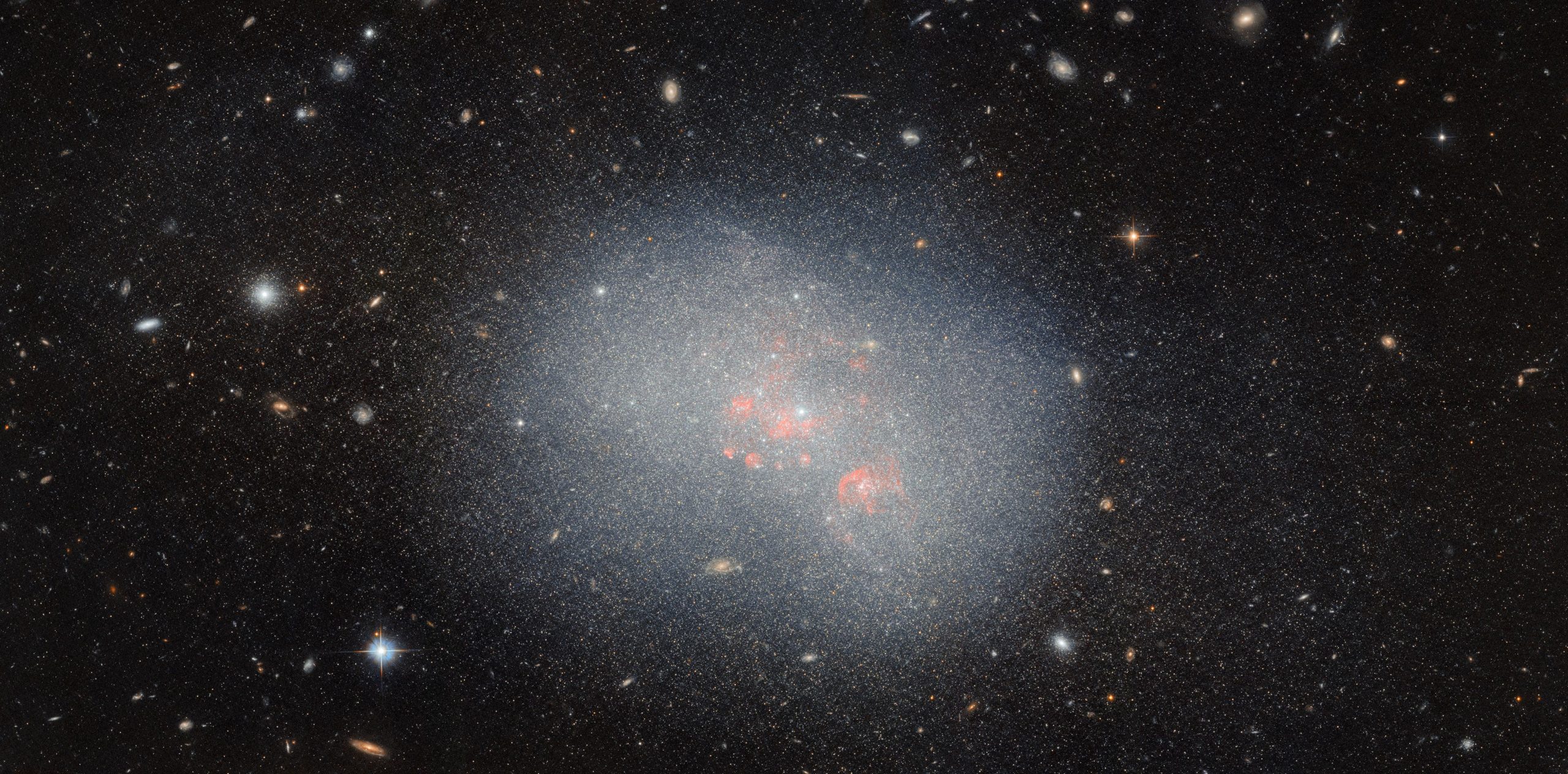
    Dwarf Irregular Galaxy NGC 5238
    This Hubble Space Telescope’s image of NGC 5238, a dwarf galaxy in the constellation Canes Venatici, reveals its complex nature and history of galactic interactions, offering a glimpse into galaxy formation theories. Credit: ESA/Hubble & NASA, F. Annibali

    NGC 5238, a dwarf irregular galaxy imaged by the Hubble Space Telescope, displays a complex structure despite its unassuming appearance. Located in the constellation Canes Venatici, it is theorized to have undergone a significant interaction with a satellite galaxy, providing insights into the process of galaxy formation and evolution.

    The galaxy featured in this Hubble Space Telescope image is the dwarf irregular galaxy NGC 5238, located 14.5 million light-years from Earth in the constellation Canes Venatici. Its unexciting, blob-like appearance, resembling more an oversized star cluster than a galaxy, belies a complicated structure that has been the subject of much research by astronomers. Here, the NASA/ESA Hubble Space Telescope is able to pick out the galaxy’s countless stars, as well as its associated globular clusters — the glowing spots both inside and around the galaxy that are swarmed by yet more stars.

    Galactic Encounter Hypothesis

    NGC 5238 is theorized to have recently — here meaning no more than a billion years ago! — had a close encounter with another galaxy. The evidence for this is the tidal distortions of NGC 5238’s shape, the kind produced by two galaxies pulling on each other as they interact. There’s no nearby galaxy that could have caused this disturbance, so the hypothesis is that the culprit is a smaller satellite galaxy that was devoured by NGC 5238.

    Traces of the erstwhile galaxy might be found by closely examining the population of stars in NGC 5238, a task for which the Hubble Space Telescope is an astronomer’s best tool. Two tell-tale signs would be groups of stars with properties that look out of place compared to most of the galaxy’s other stars, indicating that they were originally formed in a separate galaxy, or stars that look to have all formed abruptly at around the same time, which would occur during a galactic merger. The data used to make this image will be put to use in testing these predictions.

    Role in Galaxy Evolution

    Despite their small size and unremarkable appearance, it’s not unusual for dwarf galaxies like NGC 5238 to drive our understanding of galaxy formation and evolution. One main theory of galaxy evolution is that galaxies formed ‘bottom-up’ in a hierarchical fashion: star clusters and small galaxies were the first to form out of gas and dark matter, and they gradually were assembled by gravity into galaxy clusters and superclusters, explaining the shape of the very largest structures in the Universe today.

    A dwarf irregular galaxy like NGC 5238 merging with an even smaller companion is just the type of event that might have begun this process of galaxy assembly in the early Universe. So, it turns out that this tiny galaxy may serve as a test of some of the most fundamental predictions in astrophysics!

    Never miss a breakthrough: Join the SciTechDaily newsletter.
    Follow us on Google and Google News.

    Astronomy European Space Agency Hubble Space Telescope Popular
    Share. Facebook Twitter Pinterest LinkedIn Email Reddit

    Related Articles

    Hubble’s Newest Discovery Isn’t a Star, It’s a Window Into the Dark Universe

    Hubble Views Spiral Galaxy NGC 5793

    Hubble Captures the Best Ever Image of the Antennae Galaxies

    Hubble Captures Face-On Image of Messier 61

    Hubble Views an Ongoing Cosmic Collision

    Hubble Views Newborn Stars in Galaxy IC 5052

    New XDF Image, The Deepest-Ever View of the Universe

    Hubble Zooms in on the Center of M4

    Hubble Image of Peculiar Galaxy Pair Arp 116

    Leave A Reply Cancel Reply

    • Facebook
    • Twitter
    • Pinterest
    • YouTube

    Don't Miss a Discovery

    Subscribe for the Latest in Science & Tech!

    Trending News

    Why Popular Diabetes Drugs Like Ozempic Don’t Work for Everyone: The “Genetic Glitch”

    Scientists Stunned After Finding Plant Thought Extinct for 60 Years

    Scientists Discover Tiny New Spider That Hunts Prey 6x Its Size

    Natural Component From Licorice Shows Promise for Treating Inflammatory Bowel Disease

    Scientists Warn: Popular Sweetener Linked to Dangerous Metabolic Effects

    Monster Storms on Jupiter Unleash Lightning Beyond Anything on Earth

    Scientists Create “Liquid Gears” That Spin Without Touching

    The Simple Habit That Could Help Prevent Cancer

    Follow SciTechDaily
    • Facebook
    • Twitter
    • YouTube
    • Pinterest
    • Newsletter
    • RSS
    SciTech News
    • Biology News
    • Chemistry News
    • Earth News
    • Health News
    • Physics News
    • Science News
    • Space News
    • Technology News
    Recent Posts
    • Hidden Ocean Currents Revealed in Stunning Detail by AI
    • Trees Emit Tiny Lightning Flashes During Storms and Scientists Finally Prove It
    • Forget Chemicals. This Plant Removes Microplastics From Water
    • Breakthrough Crystal Lets Scientists “Write” Nanoscale Patterns With Light
    • Pomegranate Compound Could Help Protect Against Heart Disease
    Copyright © 1998 - 2026 SciTechDaily. All Rights Reserved.
    • Science News
    • About
    • Contact
    • Editorial Board
    • Privacy Policy
    • Terms of Use

    Type above and press Enter to search. Press Esc to cancel.