

NASA has all but ruled out asteroid 2024 YR4 as a danger to Earth, reducing its impact probability to just 0.004% in 2032.
However, a small risk remains for the Moon. Scientists are seizing the moment to study the asteroid further, turning what was once a potential threat into a valuable learning opportunity for planetary defense.
NASA Lowers Impact Risk of Asteroid 2024 YR4
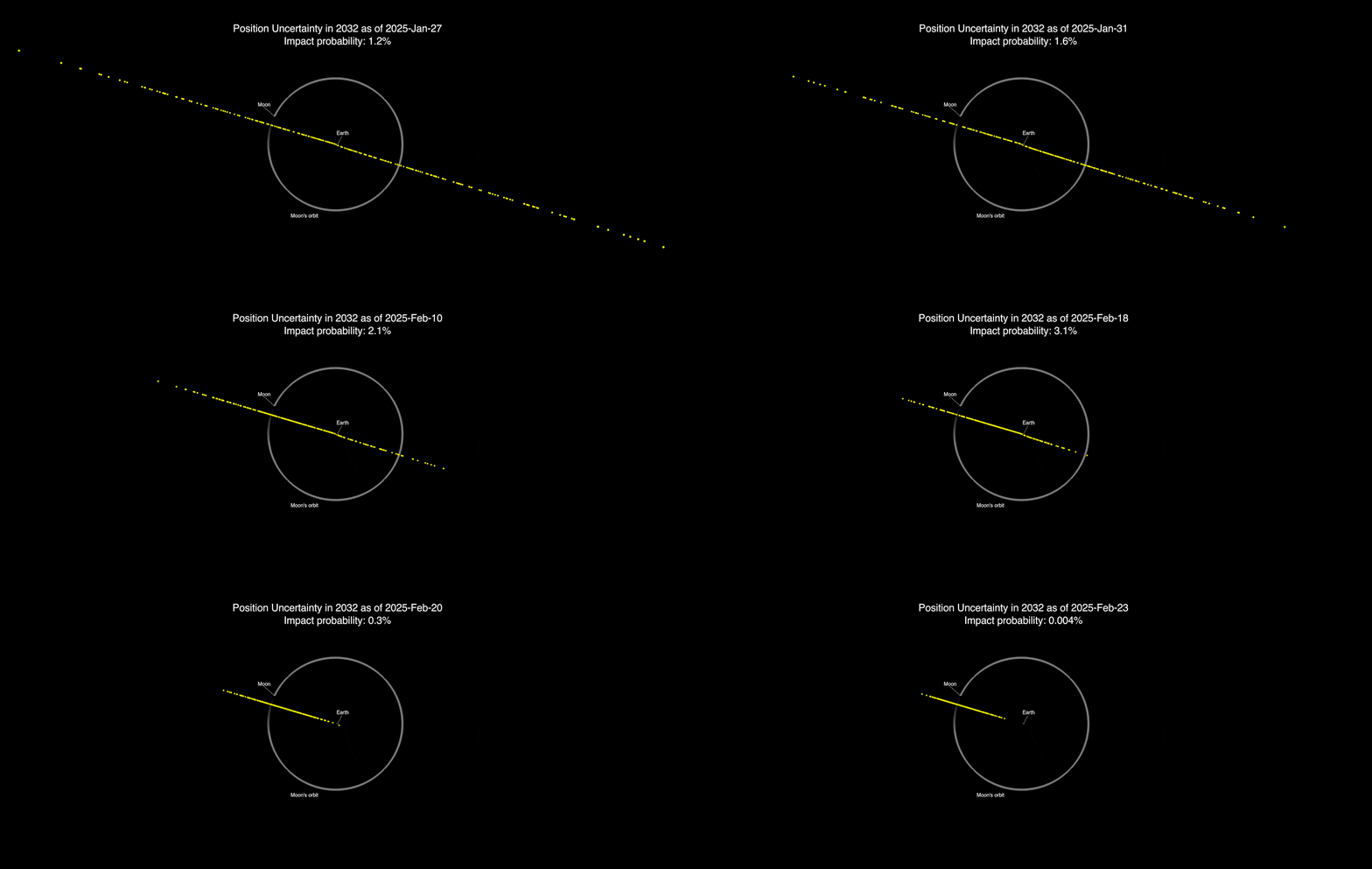
NASA has significantly reduced the risk of asteroid 2024 YR4 impacting Earth in the foreseeable future. When first discovered, the asteroid had a small but noteworthy chance of colliding with our planet in 2032. However, as more observations were submitted to the Minor Planet Center, scientists at NASA’s Jet Propulsion Laboratory (JPL) refined their calculations. Their latest models now estimate the asteroid’s probability of impacting Earth on December 22, 2032, at just 0.004%, confirming there is no significant risk for at least the next century.
Further observations have narrowed uncertainties about the asteroid’s future path, showing that its projected location on December 22, 2032, is now farther from Earth.
Moon Still in the Path?
There still remains a very small chance for asteroid 2024 YR4 to impact the Moon on December 22, 2032. That probability is currently 1.7%.
NASA will continue to observe asteroid 2024 YR4 with observatories funded by its Planetary Defense Coordination Office, and NASA’s James Webb Space Telescope will observe the asteroid in March to further gain insights about its size for scientific purposes.
A Test for Planetary Defense
While this asteroid no longer poses a significant impact hazard to Earth, 2024 YR4 provided an invaluable opportunity for experts at NASA and its partner institutions to test planetary defense science and notification processes. The latest data on all known near-Earth asteroids that could pose an impact hazard to Earth will continue to be available at NASA’s automated Sentry page.
Never miss a breakthrough: Join the SciTechDaily newsletter.
Follow us on Google and Google News.
11 Comments
Looks to me like NASA is trying to eke out a bigger budget.
What is the ‘one small catch’? Is it that the asteroid might hit the moon? If it does, so what?
Think shrapnel
that answer doesn’t compute
most of the shrapnel will fall back on the moon, those chunks that escape moon’s gravity have a truly minuscule chance of getting into the earth’s atmosphere and any that get into the earth’s atmosphere will almost certainly get burned up before hitting the earth
Part of the moon will land in earth
Think of the tides.
Think of the tides buddy.
The collision of the Milky Way with solar bodies is certain. The Milky Way has crossed the Sun dozens of times. This crossing of the arm of the galaxy began since the formation of the solar system, about 4 billion years ago, and during the 4 billion years of the Milky Way galaxy with its stars and very small planets, these two large arms of the galaxy have passed through the solar system more than 60 times, and each time they have passed several star systems through the solar system. About 250 planets from the Milky Way became moons of the Solar System. The passage of the Milky Way galaxy through the solar bodies caused the formation of the Kuiper belt and the outer and inner belts in the solar system. It caused the rapid rotation of gaseous planets around it and the formation of hydrogen gas in the gaseous planets and caused Jupiter to burn and rivers of molten iron to move on the surface of Jupiter. They pass through the solar bodies of the solar system and 100% of many meteorites of the disintegrating planets land on the surface of the earth and the moon after hitting the sun, and the life of the earth is renewed. Because of this, God renewed the word planet on its second letter. The second letter of the planet is the last letter of the Persian alphabet, which is the thirty-second letter. The letter of this letter is very strange. There is a secret in the second letter of the planet, which leads to rebirth and everything
Random barely pseudoscience
I thank the admin and staff for sharing my frequent comments on this site. The collision of meteors in the middle of the galactic year is certain and astronomers should take it seriously. I’ve been writing a 60-page article on this for about ten years, and sometimes I’m unemployed. Let’s see what the result will be if we give all the details of this incident to a supercomputer, maybe we will get some interesting points. I mean the impact of the stars and small planets of the Milky Way with the objects of the solar system. The stars that are thousands of times lighter than the sun were given to the computer and the objects of the solar system were also given to the computer and the scene of the collision of the big arm of the galaxy with the solar objects was reconstructed. The sun will collide and…
Can you just have a small piece fall on the White House? No warning, please!
Of course, your funding will be cut off way before then. Sad.