
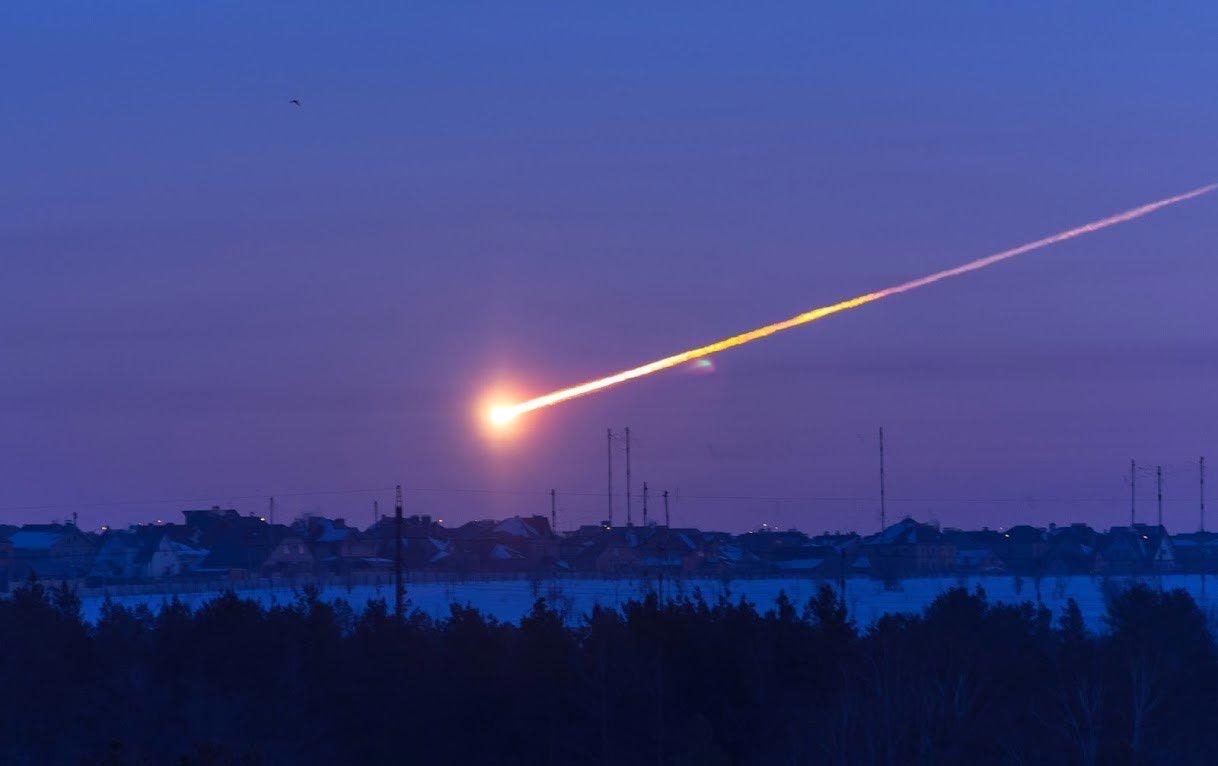
The Chelyabinsk Impact: A Wake-Up Call for Planetary Defense
On February 15, 2013, the people of Chelyabinsk, Russia, experienced a shocking event, and yet it was a small fraction of the devastation an asteroid on a collision course with Earth could yield. As NASA’s Planetary Defense experts reflect on the Chelyabinsk impact 10 years ago, they also look forward to the future and all that the agency has since accomplished in the field of Planetary Defense.
Harmless meteoroids, and sometimes small asteroids, impact our planet’s atmosphere daily. When they do, they disintegrate and create meteors or “shooting stars” and sometimes bright fireballs or bolides. Such was the case on February 12 when a very small asteroid impacted Earth’s atmosphere over Northern France soon after discovery, resulting in a spectacular light show for local onlookers. Much more rarely, a larger asteroid that is still too small to reach the ground intact, yet large enough to release considerable energy when it disintegrates, can do significant damage to the ground.
On February 15, 2013, one such bolide event garnered international attention when a house-sized asteroid impacted Earth’s atmosphere over Chelyabinsk, Russia, at a speed of eleven miles per second and exploded 14 miles above the ground. The explosion was equivalent to 440,000 tons of TNT, and the resulting air blast blew out windows over 200 square miles, damaged buildings, and injured over 1,600 people – mostly due to broken glass. Due to the asteroid’s approach from the daytime sky, it was not detected prior to impact, serving as a reminder that while there are no known asteroid threats to Earth for the next century, an Earth impact by an unknown asteroid could occur at any time.
Finding and Tracking Near-Earth Objects (NEOs)
Coincidentally, negotiations sponsored by the United Nations were finalizing formal recommendations for the establishment of Planetary Defense-related international collaborations – the International Asteroid Warning Network (IAWN) and the Space Missions Planning Advisory Group (SMPAG) – when the Chelyabinsk impact occurred. Since then, NASA established the agency’s Planetary Defense Coordination Office (PDCO) in 2016 to oversee and coordinate the agency’s ongoing mission of Planetary Defense. This includes acting as a national representative at international Planetary Defense-related caucuses and forums, such as IAWN and SMPAG, and playing a leading role in coordinating U.S. government planning for response to an actual asteroid impact threat if one were ever discovered. The PDCO also funds observatories around the world through NASA’s Near-Earth Object (NEO) Observations Program to find and characterize NEOs – asteroids and comets that come within 30 million miles of Earth – with a particular focus on finding asteroids 460 feet (140 meters) and larger that represent the most severe impact risks to Earth. To help accelerate its ability to find potentially hazardous NEOs, NASA is also actively developing the agency’s NEO Surveyor mission, which is designed to finish discovery of 90 percent of asteroids 140 meters in size or larger that can come near Earth within a decade of being launched.
Deflection Technology: The Success of NASA’s DART Mission
In 2022, working together with the Italian Space Agency, NASA’s Double Asteroid Redirection Test (DART) mission successfully demonstrated the world’s first-ever test for deflecting an asteroid’s orbit. Launched in 2021, DART successfully collided with a known asteroid – which posed no impact threat to Earth – demonstrating one method of asteroid deflection technology using a kinetic impactor spacecraft. Since DART’s impact, Planetary Defense experts have been continuing to analyze data returned from the mission to better understand its demonstrated effects on the asteroid, which contributes to the understanding of how a kinetic impactor spacecraft could be used to address an asteroid impact threat in the future if the need ever arose.
The Chelyabinsk impact was a spark that ignited global conversation in Planetary Defense, and much progress in the field has occurred since then. However, there is still more work to be done, and NASA is actively at the forefront. In addition to building NASA’s NEO Surveyor to find the rest of the population of asteroids that could pose a hazard to Earth, the agency is considering a “rapid response reconnaissance” capability to be able to quickly obtain a more detailed characterization of a hazardous asteroid once it is discovered. NASA is also considering sending out a reconnaissance spacecraft to study an asteroid making a close approach to Earth in 2029.
“A collision of a NEO with Earth is the only natural disaster we now know how humanity could completely prevent,” said NASA Planetary Defense Officer Lindley Johnson. “We must keep searching for what we know is still out there, and we must continue to research and test Planetary Defense technologies and capabilities that could one day protect our planet’s inhabitants from a devastating event.”
Never miss a breakthrough: Join the SciTechDaily newsletter.
Follow us on Google and Google News.