
Close Menu
    Facebook X (Twitter) Instagram
    SciTechDaily
    • Biology
    • Chemistry
    • Earth
    • Health
    • Physics
    • Science
    • Space
    • Technology
    Facebook X (Twitter) Pinterest YouTube RSS
    SciTechDaily
    Home»Space»Asteroid Impacts Could Launch Living Microbes From Mars
    Space

    Asteroid Impacts Could Launch Living Microbes From Mars

    By PNAS NexusMarch 3, 20262 Comments3 Mins Read
    Facebook Twitter Pinterest Telegram LinkedIn WhatsApp Email Reddit
    Share
    Facebook Twitter LinkedIn Pinterest Telegram Email Reddit
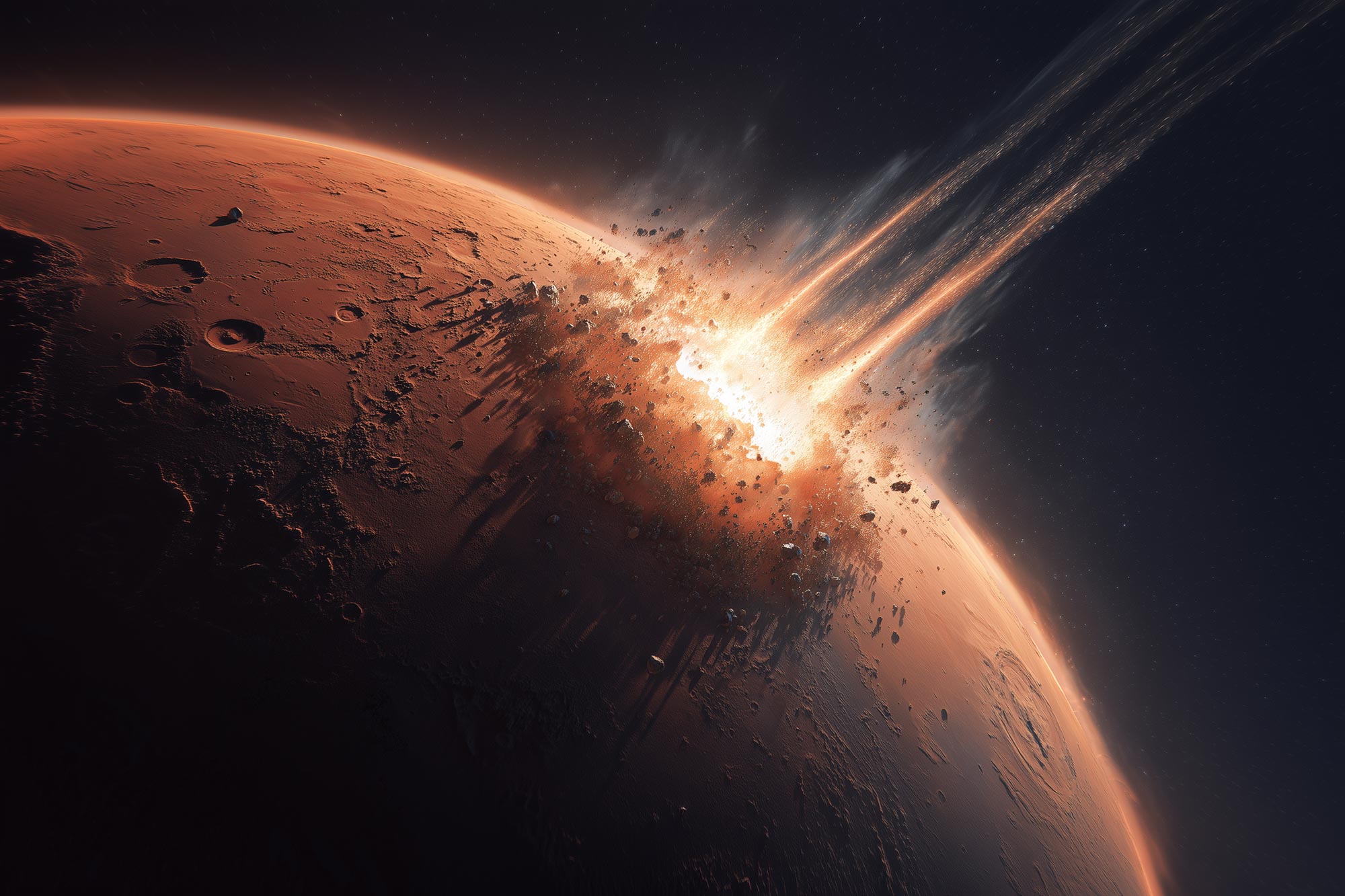
    Mars Asteroid Impact
    By recreating the violent shock of an asteroid impact, scientists found that a famously resilient bacterium can survive the crushing forces that could launch it off Mars. The discovery strengthens the idea that life might hitchhike between planets after major cosmic collisions. Credit: SciTechDaily..com

    A super-tough microbe may be able to survive being blasted from Mars into space—opening the door to interplanetary life transfer.

    A remarkably tough bacterium known as Deinococcus radiodurans may be able to endure the intense forces created when an asteroid slams into Mars and blasts material into space. The battered surfaces of the Moon and Mars, marked by countless craters, reveal how often planets and moons are struck by space rocks. These violent collisions have shaped planetary history and may also play a role in moving material, and possibly life, between worlds.

    To test this idea, researchers led by Lily Zhao and K. T. Ramesh recreated the crushing shock a microbe would experience during such an event. They placed Deinococcus radiodurans between two steel plates and then struck the setup with a third plate, generating pressures as high as 3 GPa (30,000 times atmospheric pressure). This setup mimicked the sudden, extreme compression that would occur if rocks were blasted off Mars by a powerful impact.

    Extreme Pressure Tests up to 3 GPa

    Deinococcus radiodurans is already known for surviving harsh conditions, including intense radiation and severe drying, which has made it a leading candidate for surviving space travel. In the new experiments, scientists monitored how the bacteria responded to escalating pressure by examining which genes were activated. This allowed them to measure biological stress and understand how the cells coped with damage.

    At pressures of 2.4 GPa, some cells began to show ruptured membranes. Even so, about 60% of the microbes survived. The researchers suggest that the bacterium’s sturdy cell envelope plays a key role in protecting it under such extreme compression.

    Genetic Clues to Post-Impact Recovery

    Analysis of gene activity revealed that the surviving bacteria quickly shifted into repair mode after the shock. Their transcription profiles indicate that fixing cellular damage became a top priority in the aftermath of the simulated impact.

    The findings suggest that microorganisms can tolerate harsher conditions than previously recognized. If microbes can survive the violent launch caused by a major asteroid strike, then it is possible that life could travel between planets, carried through space inside debris blasted from one world to another.

    Reference: “Extremophile survives the transient pressures associated with impact-induced ejection from Mars” by Lily Zhao, Cesar A Perez-Fernandez, Jocelyne DiRuggiero and K T Ramesh, 3 March 2026, PNAS Nexus.
    DOI: 10.1093/pnasnexus/pgag018

    Never miss a breakthrough: Join the SciTechDaily newsletter.
    Follow us on Google and Google News.

    Astrobiology Mars Microbiology Popular
    Share. Facebook Twitter Pinterest LinkedIn Email Reddit

    Related Articles

    Microbial Life of a Pure Martian Design

    Best Region for Life on Mars Was Miles Below Surface

    Stanford: Promising Signs for Past Martian Life at Jezero Crater, Mars

    New Clues About Potential Life on Mars Revealed by Ancient Meteorite Site on Earth

    Mars’ Water Was Mineral-Rich and Salty – Likely Habitable for Microbial Life

    Photos Show Evidence of Life on Mars: Insect- and Reptile-Like Fossils & Living Creatures

    Mineral That Could Preserve Signs of Past Life Spotted at Future Mars Landing Spot

    Scientists Discover Evidence of Methane in Martian Meteorites

    Martian Meteorite Reveals the Possibility of Life on Mars

    2 Comments

    1. Larry Deavenport on March 3, 2026 11:40 am

      The least of our problems is microbes from Mars. I fear the retalliation of the attack on Iran could be first and the start of World War 3.

      Reply
      • Robert on March 4, 2026 8:41 am

        First Microbes, as such, are DNA life which is earth-bound. Second: The Mullahs have been trying to inflict destruction of western culture in their drive to get Nukes and sneak them into the USA and Israel. The 47 years of raging terror and millions of deaths are ancillary. Every now and then, such bad actors earn what they have sown. It has been so forever. At some point the grotesque is brought down – it is human’s oldest cycle and how peace and grace and beauty attain. You’re watching history.

        Reply
    Leave A Reply Cancel Reply

    • Facebook
    • Twitter
    • Pinterest
    • YouTube

    Don't Miss a Discovery

    Subscribe for the Latest in Science & Tech!

    Trending News

    Scientists Discover Game-Changing New Way To Treat High Cholesterol

    This Small Change to Your Exercise Routine Could Be the Secret to Living Longer

    Scientists Discover 430,000-Year-Old Wooden Tools, Rewriting Human History

    AI Could Detect Early Signs of Alzheimer’s in Under a Minute – Far Before Traditional Tests

    What if Dark Matter Has Two Forms? Bold New Hypothesis Could Explain a Cosmic Mystery

    This Metal Melts in Your Hand – and Scientists Just Discovered Something Strange

    Beef vs. Chicken: Surprising Results From New Prediabetes Study

    Alzheimer’s Breakthrough: Scientists Discover Key Protein May Prevent Toxic Protein Clumps in the Brain

    Follow SciTechDaily
    • Facebook
    • Twitter
    • YouTube
    • Pinterest
    • Newsletter
    • RSS
    SciTech News
    • Biology News
    • Chemistry News
    • Earth News
    • Health News
    • Physics News
    • Science News
    • Space News
    • Technology News
    Recent Posts
    • Milk Nanoparticles Could Revolutionize Treatment for Deadly Bile Duct Cancer
    • Largest-Ever Study Finds Medicinal Cannabis Ineffective for Anxiety, Depression, PTSD
    • Scientists Reveal Why a Common Drug Causes Birth Defects and Autism
    • A Medieval Japanese Diary Just Helped Scientists Detect a Dangerous Solar Event
    • Humans Returned to Britain 500 Years Earlier Than Scientists Thought
    Copyright © 1998 - 2026 SciTechDaily. All Rights Reserved.
    • Science News
    • About
    • Contact
    • Editorial Board
    • Privacy Policy
    • Terms of Use

    Type above and press Enter to search. Press Esc to cancel.