
Close Menu
    Facebook X (Twitter) Instagram
    SciTechDaily
    • Biology
    • Chemistry
    • Earth
    • Health
    • Physics
    • Science
    • Space
    • Technology
    Facebook X (Twitter) Pinterest YouTube RSS
    SciTechDaily
    Home»Space»Mars’ Water Was Mineral-Rich and Salty – Likely Habitable for Microbial Life
    Space

    Mars’ Water Was Mineral-Rich and Salty – Likely Habitable for Microbial Life

    By Tokyo Institute of TechnologyFebruary 2, 2020No Comments4 Mins Read
    Facebook Twitter Pinterest Telegram LinkedIn WhatsApp Email Reddit
    Share
    Facebook Twitter LinkedIn Pinterest Telegram Email Reddit
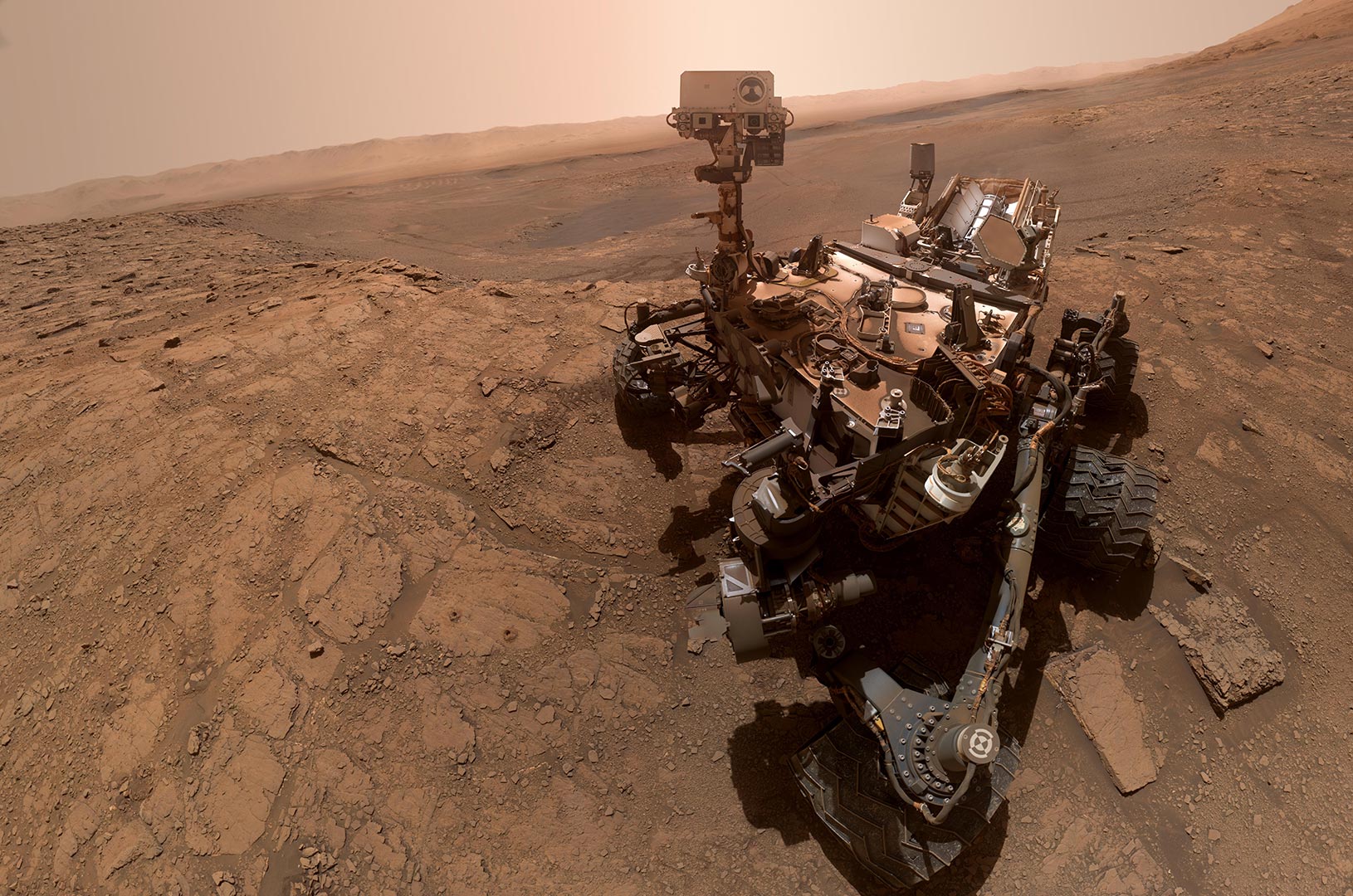
    NASA Curiosity Mars Rover Selfie Crop
    NASA’s Curiosity rover has obtained the mineralogical and chemical data of ancient lake deposits at Gale Crater, Mars. The present study reconstructs water chemistry of the paleolake in Gale based on the Curiosity’s data. NASA’s Curiosity rover took this selfie on October 11, 2019, the 2,553rd Martian day, or sol, of its mission. The rover drilled twice in this location, which is nicknamed “Glen Etive.” Credit: NASA/JPL-Caltech/MSSS

    New study finds surface waters on early Mars may have been habitable for microbial life.

    Presently, Earth is the only known location where life exists in the Universe. This year the Nobel Prize in physics was awarded to three astronomers who proved, almost 20 years ago, that planets are common around stars beyond the solar system. Life comes in various forms, from cell-phone-toting organisms like humans to the ubiquitous micro-organisms that inhabit almost every square inch of the planet Earth, affecting almost everything that happens on it. It will likely be some time before it is possible to measure or detect life beyond the solar system, but the solar system offers a host of sites that might get a handle on how hard it is for life to start.

    Mars is at the top of this list for two reasons. First, it is relatively close to Earth compared to the moons of Saturn and Jupiter (which are also considered good candidates for discovering life beyond Earth in the solar system, and are targeted for exploration in the coming decade). Second, Mars is extremely observable because it lacks a thick atmosphere like Venus, and so far, there is pretty good evidence that Mars’ surface temperature and pressure hovers around the point liquid water — considered essential for life — can exist. Further, there is good evidence in the form of observable river deltas, and more recent measurements made on Mars’ surface, that liquid water did in fact flow on Mars billions of years ago.
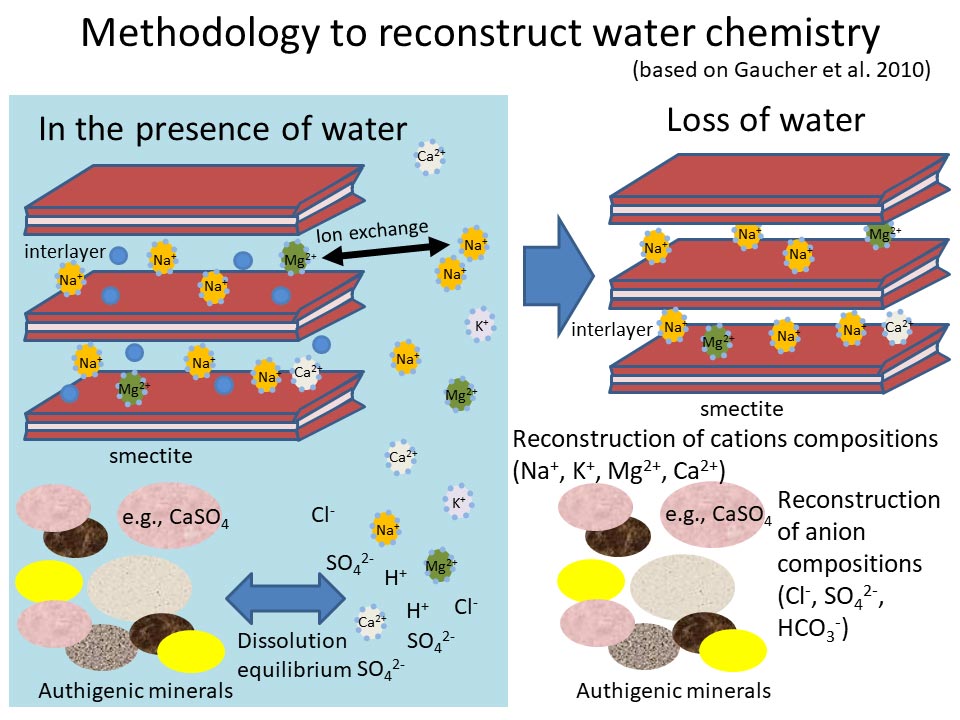
    Methodology to Reconstruct Mars Water Chemistry
    One of the clay minerals, smectite, can trap ions in water through ion exchanges in the presence of water. Even after loss of water, smectite records ion compositions within interlayers of its structure. Credit: Nature Communications

    Scientists are becoming increasingly convinced that Mars was habitable billions of years ago. Whether it was in fact inhabited, or is still inhabited, remains hotly debated. To better constrain these questions, scientists are trying to understand the kinds of water chemistry that could have generated the minerals observed on Mars today, which were produced billions of years ago.

    Salinity (how much salt was present), pH (a measure of how acidic the water was), and redox state (roughly a measure of the abundance of gases such as hydrogen [H2, which are termed reducing environments] or oxygen [O2, which are termed oxidizing environments; the two types are generally mutually incompatible]) are fundamental properties of natural waters. As an example, Earth’s modern atmosphere is highly oxygenated (containing large amounts of O2), but one needs only dig a few inches into the bottom of a beach or lake today on Earth to find environments that are highly reduced.

    Recent remote measurements on Mars suggest its ancient environments may provide clues about Mars’ early habitability. Specifically, the properties of pore water within sediments apparently deposited in lakes in Gale Crater on Mars suggest these sediments formed in the presence of liquid water which was of a pH close to that of Earth’s modern oceans. Earth’s oceans are of course host to myriad forms of life, thus it seems compelling that Mars’ early surface environment was a place contemporary Earth life could have lived, but it remains a mystery as to why evidence of life on Mars is so hard to find.

    Reference: “Semiarid climate and hyposaline lake on early Mars inferred from reconstructed water chemistry at Gale” by Keisuke Fukushi1, Yasuhito Sekine1,2, Hiroshi Sakuma3, Koki Morida4 & Robin Wordsworth5, 25 October 2019, Nature Communications.
    DOI: 10.1038/s41467-019-12871-6

    1 Institute of Nature and Environmental Technology, Kanazawa University, Kanazawa, Ishikawa, Japan.

    2 Earth-Life Science Institute, Tokyo Institute of Technology, Meguro-ku, Tokyo, Japan.

    3 National Institute for Materials Science, Tsukuba, Ibaraki, Japan.

    4 Division of Natural System, Kanazawa University, Kanazawa, Ishikawa, Japan.

    5 Department of Earth and Planetary Sciences, Harvard University, Cambridge, MA, USA.

    Never miss a breakthrough: Join the SciTechDaily newsletter.
    Follow us on Google and Google News.

    Astrobiology Geology Mars Popular Tokyo Institute of Technology Water
    Share. Facebook Twitter Pinterest LinkedIn Email Reddit

    Related Articles

    Mars Mystery Deepens: Curiosity Uncovers a Secret Lattice of Bizarre Ridges in Gale Crater

    NASA’s Mars Streak Mystery Might Finally Be Solved – And It’s Not Great News

    Scientists May Have Found a Massive Ocean of Water Deep Beneath Mars’ Surface

    NASA’s Perseverance Rover Reveals Mars’ Volcanic Past – And Hints of Ancient Life

    Mars’ Lost Ocean? Stunning New Evidence Found Beneath the Surface

    Gulf of Mars: Stunning Rover Data Reveals Hidden Martian Shoreline

    Mars Revealed: NASA’s Curiosity Rover Uncovers the Red Planet’s Shocking Climate Shift

    Could Perseverance’s Mars Samples Hold the Secret to Ancient Life?

    Tracing Water on Mars: From Ice Caps to Hidden Oceans and the Quest for Life

    Leave A Reply Cancel Reply

    • Facebook
    • Twitter
    • Pinterest
    • YouTube

    Don't Miss a Discovery

    Subscribe for the Latest in Science & Tech!

    Trending News

    The Universe Is Expanding Too Fast and Scientists Can’t Explain Why

    “Like Liquid Metal”: Scientists Create Strange Shape-Shifting Material

    Early Warning Signals of Esophageal Cancer May Be Hiding in Plain Sight

    Common Blood Pressure Drug Shows Surprising Power Against Deadly Antibiotic-Resistant Superbug

    Scientists Uncover Dangerous Connection Between Serotonin and Heart Valve Disease

    Scientists Discover a “Protector” Protein That Could Help Reverse Hair Loss

    Bone-Strengthening Discovery Could Reverse Osteoporosis

    Scientists Uncover Hidden Trigger Behind Stem Cell Aging

    Follow SciTechDaily
    • Facebook
    • Twitter
    • YouTube
    • Pinterest
    • Newsletter
    • RSS
    SciTech News
    • Biology News
    • Chemistry News
    • Earth News
    • Health News
    • Physics News
    • Science News
    • Space News
    • Technology News
    Recent Posts
    • Scientists Overcome Major Quantum Bottleneck, Potentially Transforming Teleportation and Computing
    • Quantum Physics’ Strangest Problem May Hold the Key to Time Itself
    • Scientists Create “Liquid Gears” That Spin Without Touching
    • The Simple Habit That Could Help Prevent Cancer
    • Forgotten Medicinal Plant Shows Promise in Fighting Dangerous Superbugs
    Copyright © 1998 - 2026 SciTechDaily. All Rights Reserved.
    • Science News
    • About
    • Contact
    • Editorial Board
    • Privacy Policy
    • Terms of Use

    Type above and press Enter to search. Press Esc to cancel.