
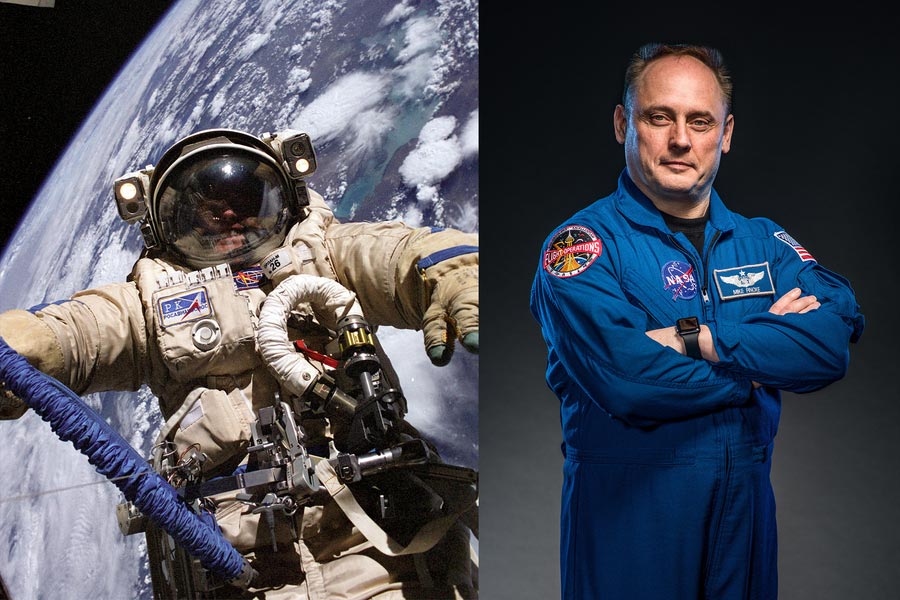
In a virtual event, Fincke discussed his time studying at MIT, learning the Russian language, and flying on both Russian and American spacecraft.
Life was very different in 1989. A trip to the movie theater cost less than $4, Madonna’s “Like a Prayer” was newly released, and the World Wide Web had just been invented.
That year, Michael Fincke, a recent MIT grad who had just completed a BS in aeronautics and astronautics and Earth, atmospheric, and planetary sciences, set foot for the first time in Moscow. It was one of the last summers before the dissolution of the Soviet Union. Fincke had seen a poster written in Russian hanging in a hall on campus. “If you could read it, you know what it said and you could show up at the meeting,” he recalls. The poster advertised a new exchange program at the Moscow Aviation Institute, a program Fincke went on to attend.
Now, more than 30 years later, Fincke is a decorated NASA astronaut, and the American with the greatest number of Russian spacewalks — six. He’s clocked more than a year in orbit on three space flights (and soon, a fourth). He’s earned two NASA distinguished service medals, three NASA spaceflight medals, the International Space Station Leadership Award, and many other recognitions.
In a virtual event (see video embedded below) hosted jointly by the MIT-Russia Program — part of the MIT International Science and Technology Initiatives (MISTI) — and the Department of Aeronautics and Astronautics on April 20, Fincke had a lively conversation with Piper Sigrest ’18 about his time as a student on campus, his experiences in both Russian and American space missions, and his advice for students interested in pursuing a similar career. Sigrest, an aspiring astronaut, is currently pursuing a PhD in aerospace engineering at the University of Michigan.
The event came a week after another MIT-Russia panel, entitled “Soviet and Russian Space Exploration: Celebrity and Propaganda, 1957-Present,” in which historians Andrew Jenks and Victoria Smolkin discussed with Professor Kate Brown how exploration of the cosmos played a symbolic and political role in the USSR.
“April was a banner month for celebrating Russian space efforts and Russian-American cooperation,” Professor Elizabeth Wood, faculty co-director of the MIT-Russia program, says.
In their conversation, Fincke and Sigrest highlighted the integral role of international collaboration in space exploration, and the importance of MIT’s motto “mens et manus,” Latin for “mind and hand.” They shared their excitement about spaceflight and the Russian language as a bridge to better communication.
His First Model Rocket
The United States and the Soviet Union had a long, complicated relationship on the ground and in space. Beginning in 1957 with the Soviet launch of Sputnik, the two nations engaged in an extended “Space Race” that lasted for decades. For the first several years, they launched satellites into orbit and to the moon. Then astronauts entered the scene.
On April 12, 1961, Soviet cosmonaut Yuri Gagarin launched into orbit from the Baikonur Cosmodrome in modern-day Kazakhstan. Only a few weeks later, on May 5, 1961, Alan Shepard became the first American in space. In 1969, the United States landed the first humans on the moon.
When he was about 10 years old, in the mid-1970s, Fincke launched his first model rocket while at summer camp – a model Russian Vostok, an early rocket designed for human spaceflight. “Thirty-something years later, I was in the great big brother of the Vostok: the Soyuz launch craft,” Fincke said.
The Soviet Union’s achievements in space motivated Fincke to study Russian as a foreign language at MIT, and to study in Moscow after his graduation in 1989. In his MIT years, he studied in the Foreign Languages and Literatures section within the School of Humanities, Arts, and Social Sciences. Today, that program is called Global Languages and has a program in Russian language and literature headed by Maria Khotimsky and Wood.
Fincke’s Career Takes Flight
In the early 1990s, the United States and Russia became partners in space, Fincke said.
After his time in Moscow, Fincke went on to earn a master’s degree in aeronautics and astronautics at Stanford University and a master’s in physics from the University of Houston at Clearlake, and to become a top graduate of the U.S. Air Force Test Pilot School. Those experiences, in tandem with his proficiency in the Russian language, made him a strong candidate when he applied and was accepted to NASA in 1996.
“The more you know, the more opportunity you have,” Fincke said. “Because I could speak Russian, and there was an opportunity to go to the Soviet Union and be an exchange student, it opened the door for NASA.”
Fincke was involved in designing and launching the International Space Station (ISS) in the late 1990s and early 2000s –– a feat which required a high level of collaboration between Russian and American astronauts. The ISS has since hosted 243 people from 19 countries. Because he could speak and understand Russian, Fincke next went to Star City near Moscow, where Russian cosmonauts train.
Then, the shocking 2003 Columbia disaster led to a pause in the American space shuttle program. “My friends were on board, my classmates. I still miss them terribly,” Fincke said. “We Americans were without a way to get to space. Our Russian partners stepped up as true partners and they offered us rides on Soyuz.”
In both 2004 and 2009, Fincke rode aboard the Soyuz rockets to get to the ISS. His Russian language skills qualified him to serve as co-pilot.
“When I was growing up and when I was at the Institute, there was no way that Americans and Soviets were ever going to get along and do these things,” Fincke said. “Now we’re great partners in space.”
Infinity and Beyond
Fincke has worked with NASA’s commercial crew program on two spacecraft, the SpaceX Crew Dragon and the Boeing CST-100 Starliner. He will be serving as joint operations commander on the first crewed experimental test flight of the Starliner, scheduled for later this year.
Fincke said his career has taught him the importance of collaboration across barriers.
“It’s all teamwork. This idea of a scientist or engineer working in her laboratory late at night and making all the discoveries is a fallacy,” Fincke said. “Spaceflight is definitely the world’s biggest team sport.”
Never miss a breakthrough: Join the SciTechDaily newsletter.
Follow us on Google and Google News.