
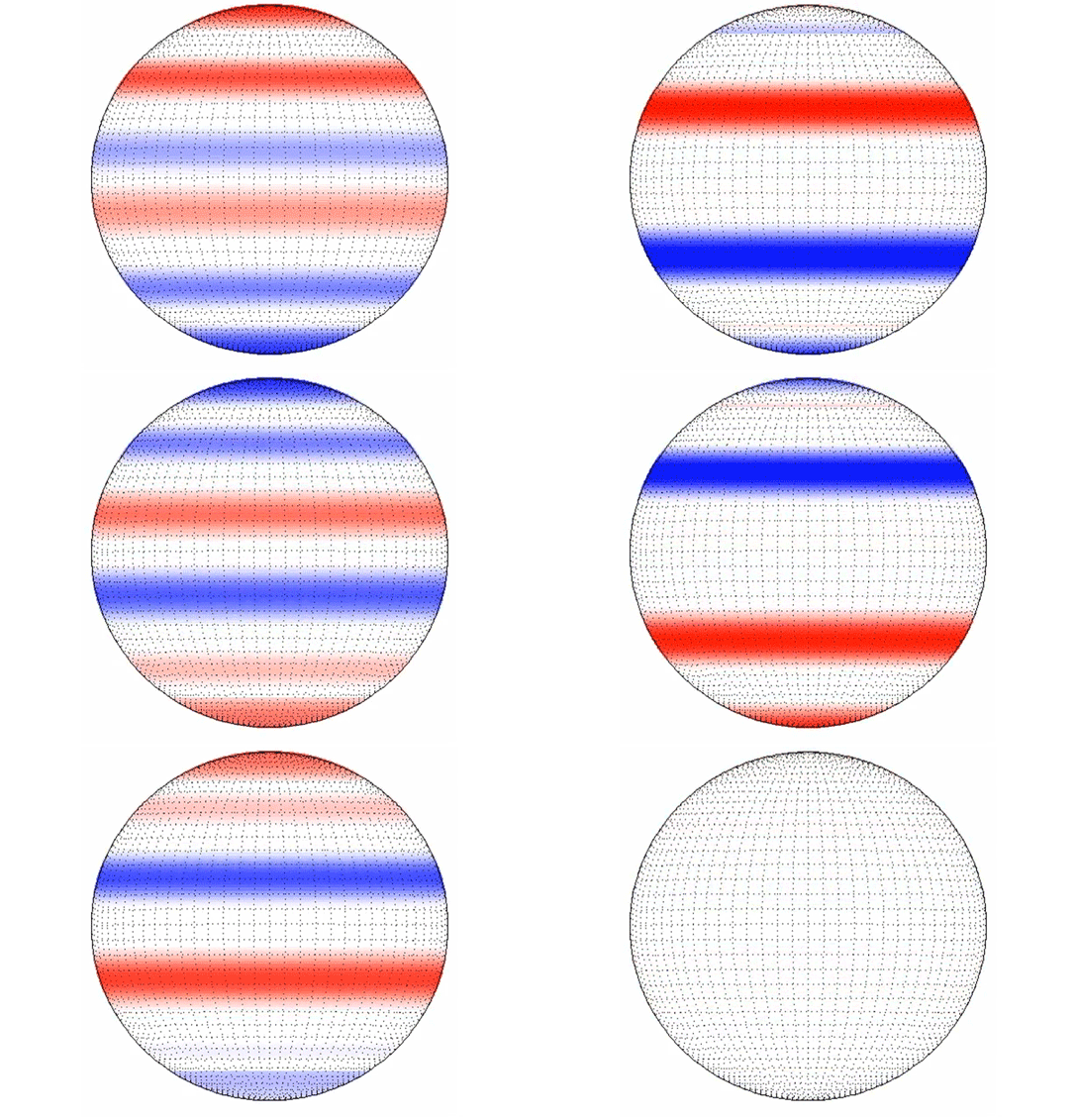
New research examines what creates the magnetic bands on the Sun and how they influence solar cycles, revealing that the changes in the magnetic field in the bands gives rise to a 330-day activity cycle on the sun that is observable but has often been downplayed and overlooked when trying to seek the cause of the sun’s longer, 11-year cycle.
Our sun is constantly changing. It goes through cycles of activity – swinging between times of relative calm and times when frequent explosions on its surface can fling light, particles and energy out into space. This activity cycle peaks approximately every 11 years. New research shows evidence of a shorter time cycle as well, with activity waxing and waning over the course of about 330 days.
Understanding when to expect such bursts of solar activity is crucial to successfully forecasting the sun’s eruptions, which can drive solar storms on Earth. These space weather events can interfere with satellite electronics, GPS navigation, and radio communications. The quasi-annual variations in space weather seem to be driven by changes in bands of strong magnetic field that are present in each solar hemisphere, said researchers in a paper published on April 7, 2015, in Nature Communications.
“What we’re looking at here is a massive driver of solar storms,” said Scott McIntosh, lead author of the paper and director of the High Altitude Observatory of the National Center for Atmospheric Research in Boulder, Colorado. “By better understanding how these activity bands form in the sun and cause these seasonal instabilities, we can greatly improve forecasts of space weather.”
The new study is one of several by the research team to examine what creates the magnetic bands and how they influence solar cycles. McIntosh and his co-authors detected the bands by drawing on a host of NASA satellites and ground-based observatories that observe the sun and its output — from the constant flow of particles in the solar wind to large explosions such as solar flares or giant eruptions of solar material called coronal mass ejections, or CMEs.
Bands of magnetized solar material – with alternating south and north polarity – march toward the sun’s equator. Comparing the evolution of the bands with the sunspot number in each hemisphere over time may change the way we think about what’s driving the sun’s 11-year sunspot cycle. Credit: S. McIntosh
The scientists note that the changes in the magnetic field in the bands gives rise to a 330-day activity cycle on the sun that is observable but has often been downplayed and overlooked when trying to seek the cause of the sun’s longer, 11-year cycle.
“People have not paid much attention to this nearly-annual cycle,” said McIntosh. “But it’s such a driver of space weather that we really do need to focus on it. Cycles over this time frame are observed in all sorts of output from the sun: the sun’s radiance, the solar wind, solar flares, CMEs.”
Magnetic band interaction can also help explain a puzzle first discovered in the 1960s: Why does the number of powerful solar flares and CMEs peak a year or more after the maximum number of sunspots? This lag is known as the Gnevyshev Gap, after the Soviet scientist who first noticed the pattern. The answer appears to also depend on two activity bands. Having one band located in each solar hemisphere provides an opportunity for them to mix — magnetic field from one band effectively leaking into the other — creating more unstable active regions on the sun and leading to more flares and CMEs. In other papers, scientists have shown that this process happens only after the sunspot maximum.
In doing their analysis on band interaction the scientists noticed that the bands themselves undergo strong quasi-annual variations, taking place separately in both the northern and southern hemispheres. Those quasi-annual variations in magnetism could be almost as large in magnitude as those of the more familiar, approximately 11-year solar cycle, giving rise to the appearance of stormy seasons.
“The activity bands on the sun have very slow-moving waves that can expand and warp,” said Robert Leamon, co-author on the paper at Montana State University in Bozeman and NASA Headquarters in Washington. “Sometimes this results in magnetic field leaking from one band to the other. In other cases, the warp drags magnetic field from deep in the solar interior and pushes it toward the surface.”
The surges of magnetic fuel from the sun’s interior can catastrophically destabilize the existing corona, the sun’s outermost atmosphere. They are a driving force behind the most intense solar storms.
Researchers can turn to advanced computer simulations and focused observations to learn more about the influence of these bands on solar activity. McIntosh suggested that this could be assisted by a proposed network of satellites observing the sun, much as the global networks of satellites around Earth has significantly advanced terrestrial weather models since the 1960s.
“If you understand what the patterns of solar activity are telling you, you’ll know whether we’re in a stormy phase or quiet phase in each hemisphere,” McIntosh said. “If we can combine these pieces of observational information with modeling efforts, then space weather forecast skill can go through the roof.”
The research was funded by NASA and the National Science Foundation, which is NCAR’s sponsor.
Reference: “The solar magnetic activity band interaction and instabilities that shape quasi-periodic variability” by Scott W. McIntosh, Robert J. Leamon, Larisza D. Krista, Alan M. Title, Hugh S. Hudson, Pete Riley, Jerald W. Harder, Greg Kopp, Martin Snow, Thomas N. Woods, Justin C. Kasper, Michael L. Stevens and Roger K. Ulrich, 7 April 2015, Nature Communications.
DOI: 10.1038/ncomms7491
arXiv: 1410.6411
Never miss a breakthrough: Join the SciTechDaily newsletter.
Follow us on Google and Google News.