
Close Menu
    Facebook X (Twitter) Instagram
    SciTechDaily
    • Biology
    • Chemistry
    • Earth
    • Health
    • Physics
    • Science
    • Space
    • Technology
    Facebook X (Twitter) Pinterest YouTube RSS
    SciTechDaily
    Home»Science»Astronomers Detect Hidden Black Hole Lurking at Galactic Center
    Science

    Astronomers Detect Hidden Black Hole Lurking at Galactic Center

    By Kenzo Kinugasa, National Astronomical Observatory of JapanMarch 3, 20192 Comments2 Mins Read
    Facebook Twitter Pinterest Telegram LinkedIn WhatsApp Email Reddit
    Share
    Facebook Twitter LinkedIn Pinterest Telegram Email Reddit
    Hidden Black Hole Discovered
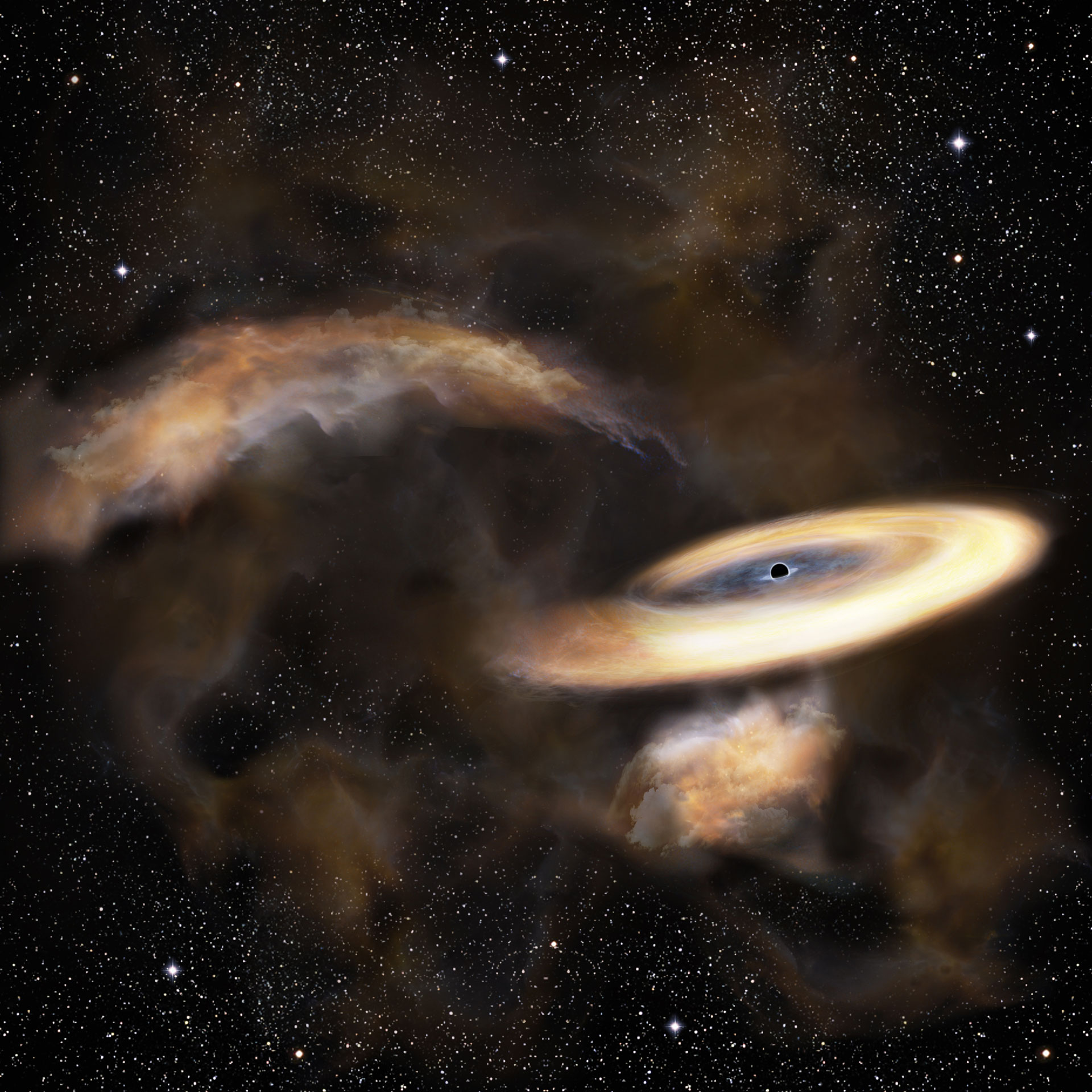
    Artist’s impression of a gas cloud swirling around a black hole.

    Astronomers have detected a stealthy black hole from its effects on an interstellar gas cloud. This intermediate-mass black hole is one of over 100 million quiet black holes expected to be lurking in our Galaxy. These results provide a new method to search for other hidden black holes and help us understand the growth and evolution of black holes.

    Black holes are objects with such strong gravity that everything, including light, is sucked in and cannot escape. Because black holes do not emit light, astronomers must infer their existence from the effects their gravity produces in other objects. Black holes range in mass from about 5 times the mass of the Sun to supermassive black holes millions of times the mass of the Sun. Astronomers think that small black holes merge and gradually grow into large ones, but no one had ever found an intermediate-mass black hole, hundreds or thousands of times the mass of the Sun.

    A research team led by Shunya Takekawa at the National Astronomical Observatory of Japan noticed HCN–0.009–0.044, a gas cloud moving strangely near the center of the Galaxy 25,000 light-years away from Earth in the constellation Sagittarius. They used ALMA (Atacama Large Millimeter/submillimeter Array) to perform high-resolution observations of the cloud and found that it is swirling around an invisible massive object.

    Takekawa explains, “Detailed kinematic analyses revealed that an enormous mass, 30,000 times that of the Sun, was concentrated in a region much smaller than our Solar System. This and the lack of any observed object at that location strongly suggests an intermediate-mass black hole. By analyzing other anomalous clouds, we hope to expose other quiet black holes.”

    Tomoharu Oka, a professor at Keio University and co-leader of the team, adds, “It is significant that this intermediate-mass black hole was found only 20 light-years from the supermassive black hole at the Galactic center. In the future, it will fall into the supermassive black hole; much like gas is currently falling into it. This supports the merger model of black hole growth.”

    Reference: “Indication of Another Intermediate-mass Black Hole in the Galactic Center”  by Shunya Takekawa, Tomoharu Oka, Yuhei Iwata, Shiho Tsujimoto and Mariko Nomura, 17 January 2019, The American Astronomical Society.
    DOI: 10.3847/2041-8213/aafb07in

    Never miss a breakthrough: Join the SciTechDaily newsletter.
    Follow us on Google and Google News.

    Astronomy Astrophysics Black Hole National Astronomical Observatory of Japan
    Share. Facebook Twitter Pinterest LinkedIn Email Reddit

    Related Articles

    M87’s Wobbling Jet: A Spin on Black Hole Mysteries

    Astrophysicists Surprised to Find Extreme Black Holes Have “Gravitational Hair” That Can Be Combed

    Earth 16,000 MPH Faster, 2000 Light-Years Closer to Supermassive Black Hole in the Center of the Milky Way

    Hungry Black Hole Among the Most Massive in the Universe – 34 Billion Times the Mass of Our Sun

    Astronomers Reveal Evidence for Higher Black Hole Spin in Radio-Loud Quasars

    Astronomers Detect Signs of an Invisible Black Hole at the Center of the Milky Way

    NASA Supercomputer Simulation Shows Neutron Stars Ripping Each Other Apart to Form a Black Hole

    Intermediate-Mass Black Hole Candidates Discovered at the Center of the Milky Way

    Scientists Convene to Take a Picture of the Supermassive Black Hole at the Center of the Milky Way

    2 Comments

    1. Scott Rodriguez on March 3, 2019 6:03 pm

      I didn’t know black holes could lurk, but well, ok.

      Reply
      • J A Jones on March 3, 2019 10:04 pm

        I too am tired of the media’s incessant science sensationalism and “kid-talk” as if we’re all in elementary school.

        Reply
    Leave A Reply Cancel Reply

    • Facebook
    • Twitter
    • Pinterest
    • YouTube

    Don't Miss a Discovery

    Subscribe for the Latest in Science & Tech!

    Trending News

    Scientists Say This Natural Hormone Reverses Obesity by Targeting the Brain

    35-Million-Year-Old Mystery: Strange Arachnid Discovered Preserved in Amber

    Is AI Really Just a Tool? It Could Be Altering How You See Reality

    JWST Reveals a “Forbidden” Planet With a Baffling Composition

    The Protein “Sabotaging” Aging Muscle Recovery Could Be Key to Surviving Aging

    This Diet–Gut Interaction Could Transform Fat Into a Calorie-Burning Machine

    Scientists Discover Hidden Virus Linked to Colorectal Cancer

    Scientists Discover 132-Million-Year-Old Dinosaur Tracks on South Africa’s Coast

    Follow SciTechDaily
    • Facebook
    • Twitter
    • YouTube
    • Pinterest
    • Newsletter
    • RSS
    SciTech News
    • Biology News
    • Chemistry News
    • Earth News
    • Health News
    • Physics News
    • Science News
    • Space News
    • Technology News
    Recent Posts
    • Beyond “Safe Levels”: Study Challenges What We Know About Pesticides and Cancer
    • Researchers Have Found a Dietary Compound That Increases Longevity
    • 5 Things Experts Say You’re Getting Wrong About Protein
    • Scientists Create “Optical Tornadoes” That Twist Light Into a Swirling Vortex
    • Scientists Uncover Hidden Superconductivity in Material Once Thought Only Magnetic
    Copyright © 1998 - 2026 SciTechDaily. All Rights Reserved.
    • Science News
    • About
    • Contact
    • Editorial Board
    • Privacy Policy
    • Terms of Use

    Type above and press Enter to search. Press Esc to cancel.