
Close Menu
    Facebook X (Twitter) Instagram
    SciTechDaily
    • Biology
    • Chemistry
    • Earth
    • Health
    • Physics
    • Science
    • Space
    • Technology
    Facebook X (Twitter) Pinterest YouTube RSS
    SciTechDaily
    Home»Space»Astronomers Detect Massive Clusters of Galaxies in the Early Universe
    Space

    Astronomers Detect Massive Clusters of Galaxies in the Early Universe

    By Megan Watzke, Harvard-Smithsonian Center for AstrophysicsMay 4, 2018No Comments3 Mins Read
    Facebook Twitter Pinterest Telegram LinkedIn WhatsApp Email Reddit
    Share
    Facebook Twitter LinkedIn Pinterest Telegram Email Reddit
    Massive Protocluster of Galaxies in the Early Universe
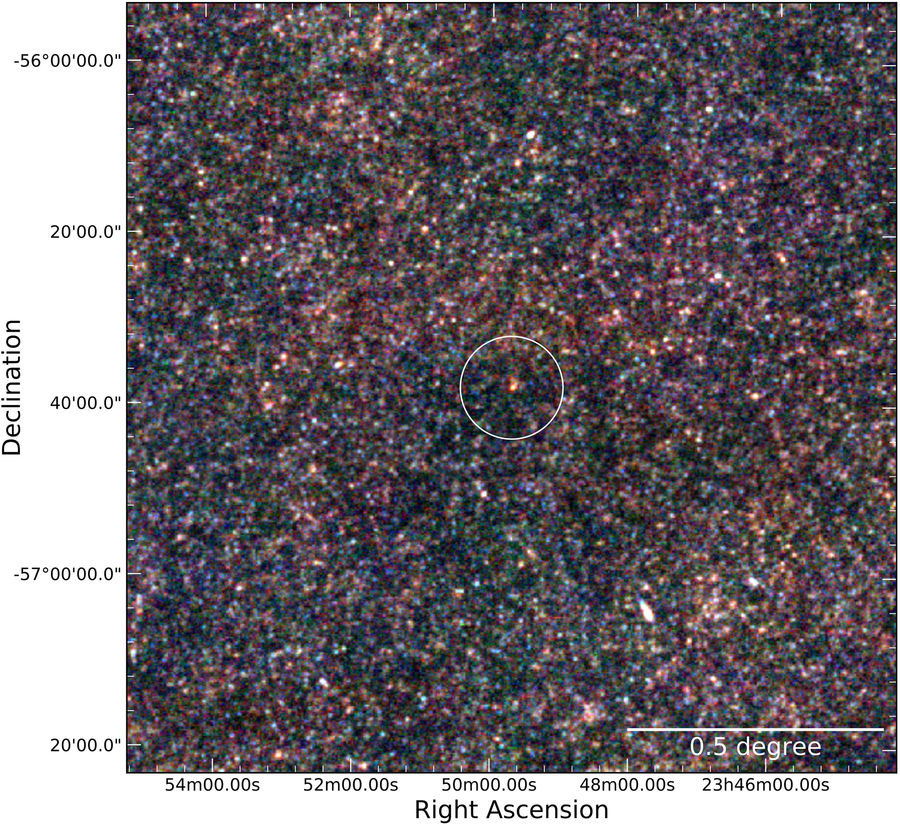
    A false-color image of the far-infrared emission from a massive protocluster of galaxies (in the circle) dating from the epoch about 1.4 billion years after the big bang. An RGB scale is used to represent sources selected at wavelengths of 500 μm (red), 350 μm (green) and 250 μm (blue), with the red SPT2349-56 extended complex clearly visible in a relative void in the foreground z ≈ 1 cosmic infrared background (blue to green colored galaxies). Credit: Nature, volume 556, pages 469–472 (2018) doi:10.1038/s41586-018-0025-2

    Astronomers have detected massive clusters of galaxies dating from as early as only about three billion years after the big bang. The stars in these clusters presumably had formed at an even earlier period and those progenitor systems, dubbed ‘protoclusters,’ are now the subject of intense searches. They have been identified in simulations of cosmological evolution, so they are expected to be present. Active star formation underway in them should be bright enough to allow their detection, but so far the evidence for any has been slight.

    In the new issue of Nature, CfA astronomers Matt Ashby, Chris Hayward, and Tony Stark join with thirty-five of their colleagues to report discovering a massive protocluster dating back to an epoch less than two billion years after the Simulations of the formation of a group of galaxies in an expanding universe, featuring no cosmological constant (left) and a very large cosmological constant (right). . The team has been using the South Pole Telescope to identify distant galaxy clusters at millimeter wavelengths. In that survey, which covers almost 6% of the sky, the brightest object discovered was one called SPT2349-56. The astronomers performed follow-up studies on this object using several other facilities including the ALMA array of telescopes and the APEX telescope. The source turned out to be a clump with multiple sources (in fact the team found evidence for fourteen components in the cluster), and spectral information showed the objects to be located in the epoch about 1.4 billion years after the big bang.

    The scientists compared their data with the results of simulations of galaxy clusters in the early universe. They conclude that most likely SPT2349-56 is a cluster with a mass about one thousand times larger than the Milky Way’s mass, and that each of its major component galaxies is forming stars at a rate of between fifty to one thousand times faster than our galaxy. Moreover, the cluster seems to be compact in scale, stretching across only about five hundred thousand light-years. The modest dimensions, large mass, and relatively modest velocities seen in the object suggest that many of the components are likely to coalesce as the system evolves. The paper concludes that this system represents the detection of a galaxy cluster core that is already at an advanced stage of formation when the Universe was only 1.4 billion years old.

    Reference: “A Massive Core for a Cluster of Galaxies at a Redshift of 4.3” by T. B. Miller, S. C. Chapman, M. Aravena, M. L. N. Ashby, C. C. Hayward, J. D. Vieira, A. Weiß, A. Babul, M. Béthermin, C. M. Bradford, M. Brodwin, J. E. Carlstrom, Chian-Chou Chen, D. J. M. Cunningham, C. De Breuck, A. H. Gonzalez, T. R. Greve, J. Harnett, Y. Hezaveh, K. Lacaille, K. C. Litke, J. Ma, M. Malkan, D. P. Marrone, W. Morningstar, E. J. Murphy, D. Narayanan, E. Pass, R. Perry, K. A. Phadke, D. Rennehan, K. M. Rotermund, J. Simpson, J. S. Spilker, J. Sreevani, A. A. Stark, M. L. Strandet and A. L. Strom, 25 April 2018, Nature.
    DOI: 10.1038/s41586-018-0025-2

    Never miss a breakthrough: Join the SciTechDaily newsletter.
    Follow us on Google and Google News.

    Astronomy Cosmology Harvard-Smithsonian Center for Astrophysics
    Share. Facebook Twitter Pinterest LinkedIn Email Reddit

    Related Articles

    Astronomers Just Reconstructed a Galaxy’s 12-Billion-Year History

    Webb’s Mysterious “Little Red Dots” May Be the Cradle of the First Black Holes

    Mysterious Radio Signals Reveal What’s Hiding Between Galaxies

    Cosmic Mystery Solved: Astronomers Have Discovered the Universe’s “Missing” Matter

    Invisible Storm Lights Up Galaxy Cluster With Record-Breaking Radio Glow

    Herschel Observations Help Identify the Physical Processes Underway in Cold, Dense Clouds

    CfA Scientists Measure the Rate of Expansion of the Universe

    New Study Challenges Planck Results

    Calculations Show the Ideal Time to Study the Cosmos

    Leave A Reply Cancel Reply

    • Facebook
    • Twitter
    • Pinterest
    • YouTube

    Don't Miss a Discovery

    Subscribe for the Latest in Science & Tech!

    Trending News

    Millions of People Have Osteopenia Without Realizing It – Here’s What You Need To Know

    Researchers Discover Boosting a Single Protein Helps the Brain Fight Alzheimer’s

    World-First Study Reveals Human Hearts Can Regenerate After a Heart Attack

    Why Your Dreams Feel So Real Sometimes and So Strange Other Times

    This Simple Home Device May Boost Brain Power in Adults Over 40

    Enormous Prehistoric Insects Puzzle Scientists

    Scientists Develop Bioengineered Chewing Gum That Could Help Fight Oral Cancer

    After 37 Years, the World’s Longest-Running Soil Warming Experiment Uncovers a Startling Climate Secret

    Follow SciTechDaily
    • Facebook
    • Twitter
    • YouTube
    • Pinterest
    • Newsletter
    • RSS
    SciTech News
    • Biology News
    • Chemistry News
    • Earth News
    • Health News
    • Physics News
    • Science News
    • Space News
    • Technology News
    Recent Posts
    • Researchers Identify the Most Common Recessive Neurodevelopmental Disorder Ever Discovered
    • This Is What Makes You Irresistible to Mosquitoes
    • Shockingly Powerful Giant Octopuses Ruled the Seas 100 Million Years Ago
    • After 100 Years, Scientists Uncover Hidden Rule Governing Cosmic Rays
    • The Milky Way Has a Hidden Edge and Scientists Finally Mapped It
    Copyright © 1998 - 2026 SciTechDaily. All Rights Reserved.
    • Science News
    • About
    • Contact
    • Editorial Board
    • Privacy Policy
    • Terms of Use

    Type above and press Enter to search. Press Esc to cancel.