
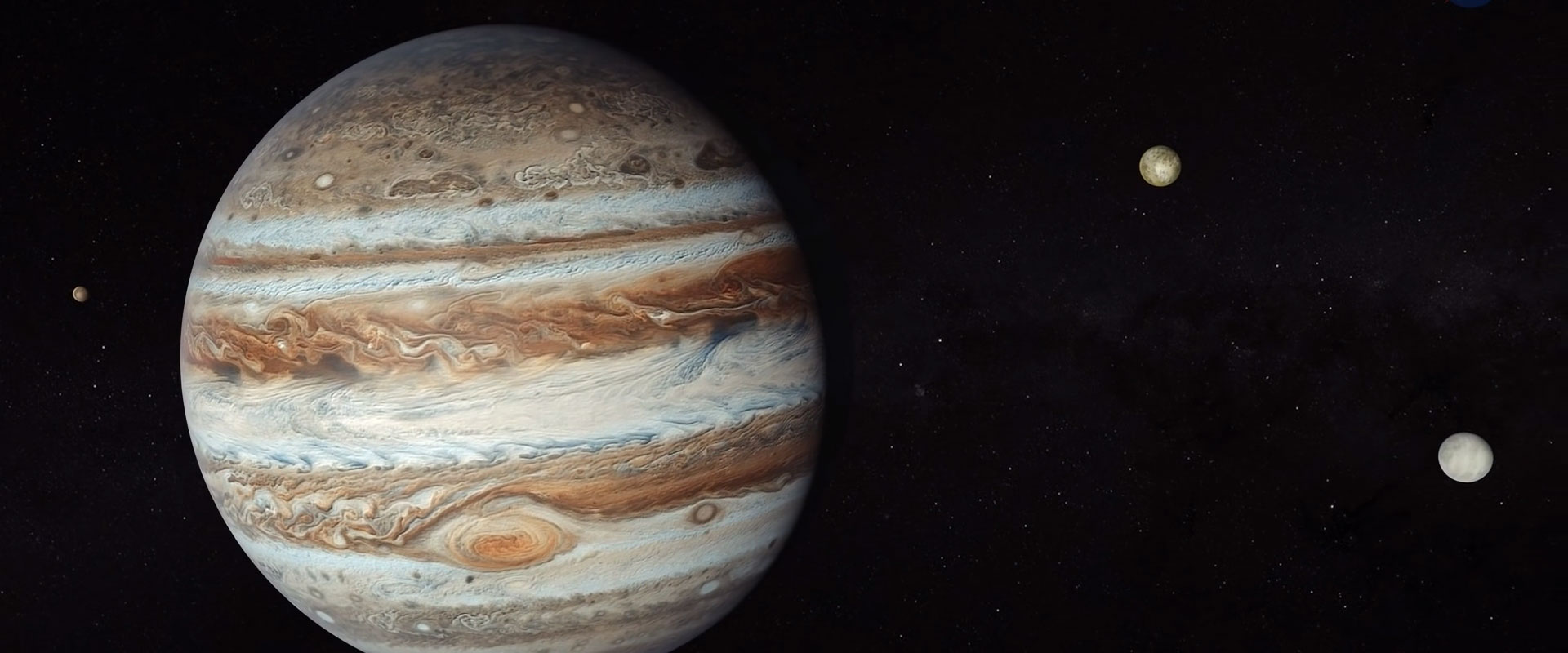
As the Juno spacecraft orbits Jupiter, new discoveries about the giant planet continue to be made.
When NASA’s Juno spacecraft recently flew over the poles of Jupiter, researchers were astonished, as if they had never seen a giant planet before. And in a sense they hadn’t. The pictures were unlike anything in the history of planetary exploration.
Juno entered orbit on the 4th of July 2016 and later found Jupiter’s poles covered in nearly continent-sized storms that are densely clustered and rubbing together in a mind-blowing swirl.
“It’s like a whole new Jupiter,” says Scott Bolton, Juno’s principal investigator from the Southwest Research Institute. “The clouds were amazing.”
What’s striking about Jupiter’s polar storms is that there are actually multiple cyclones at each pole. So instead of having one polar vortex like Earth, Jupiter was observed to have as many as eight giant swirls moving simultaneously on its north pole and as many as five on its south pole.
Even more amazing things are lurking below. Researchers have long wondered about the giant planet’s hidden interior. How far down do Jupiter’s continent-sized storms descend? And what is the exotic material near the planet’s core?
Deep inside Jupiter, high temperatures and crushing pressures transform Jupiter’s copious supplies of gaseous molecular hydrogen into an exotic form of matter known as liquid metallic hydrogen. Think of it as a mashup of atomic nuclei in a sea of electrons freely moving about. Jupiter’s powerful magnetic field almost certainly springs from dynamo action in Jupiter’s interior, the process by which the motion of this electrically-conducting fluid is converted into magnetic energy. The exact location within the interior is a mystery that researchers are still working to solve.
A planet’s magnetic field gets weaker as you get farther from its core. Jupiter’s magnetic field is 10,000 times stronger than that of Earth! However when measured at the cloudtops, Jupiter’s magnetic field is only 20 times greater than what we measure on Earth’s surface. This is due to Jupiter being so much larger than Earth.
Astronomers have long known that Jupiter has the most intense planetary magnetic field in the solar system. But according to Jack Connerney, Juno deputy principal investigator at NASA’s Goddard Space Flight Center, “Juno’s magnetometers indicate that Jupiter’s magnetic field is even stronger than we thought.”
“Moreover, the magnetic field looks lumpy,” he says. “It is stronger in some places and weaker in others. This uneven distribution suggests that the field might be generated by dynamo action closer to the surface, above the layer of metallic hydrogen.”
Jupiter’s magnetic field is home to the biggest and most powerful auroras in the solar system. Unlike Earth, which lights up in response to solar activity, Jupiter makes its own auroras. It does this by tapping into power generated by its own spinning magnetic field. Induced electric fields accelerate particles toward Jupiter’s poles where the aurora action takes place.
Another source of insight is Juno’s Microwave Radiometer which measures thermal microwaves radiating from the deep recesses of the planet, revealing structure hundreds of kilometers beneath Jupiter’s thick clouds.
Recent results from Juno’s Gravity experiment show that Jupiter’s iconic belts and zones rotate as a series of cylinders down to depths of about 3000-5000 km (1,900-3,100 mi). Beneath this depth, it appears that Jupiter may be rotating as a rigid body.
New discoveries about Jupiter continue to be made. Bolton says, “Every 53 days, Juno goes soaring by Jupiter and gets doused by a fire hose of data. There is always something new.”
Never miss a breakthrough: Join the SciTechDaily newsletter.
Follow us on Google and Google News.