
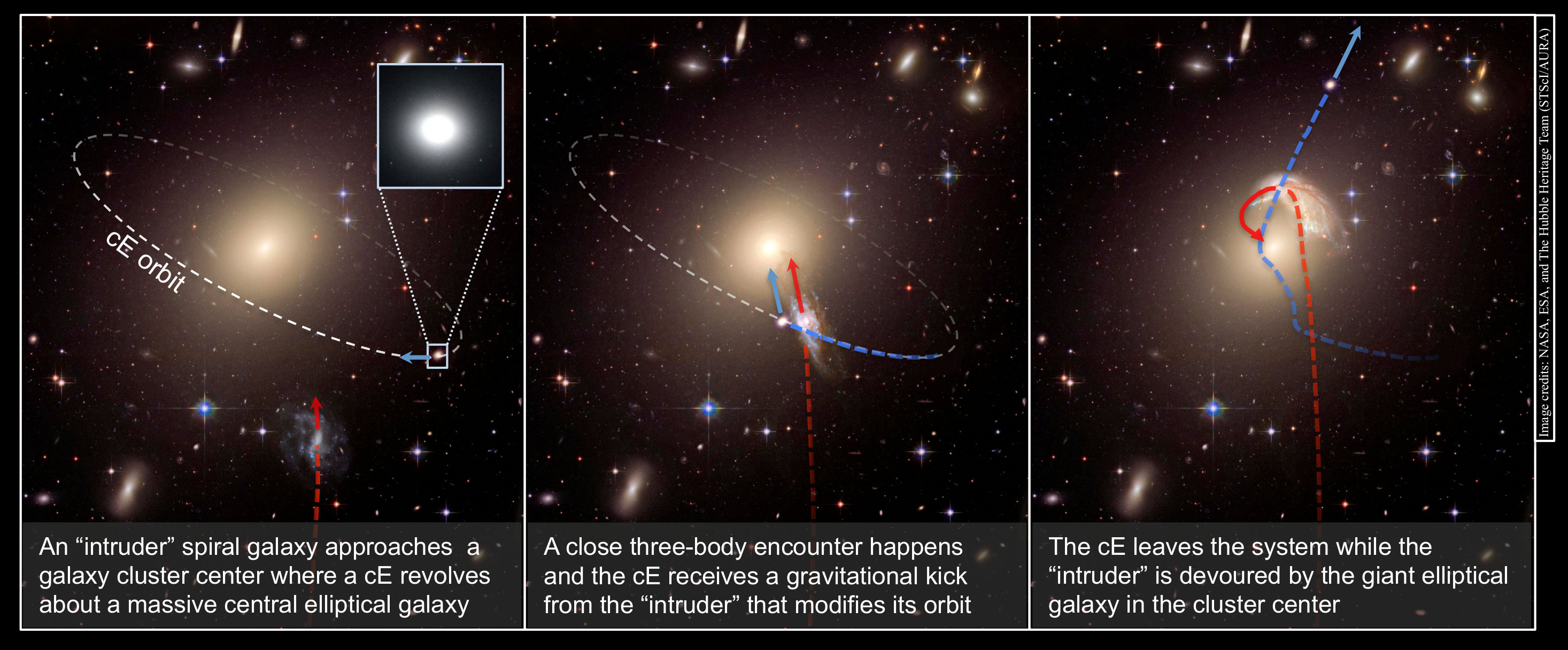
Astronomers from the Harvard-Smithsonian Center for Astrophysics and Moscow State University have discovered 11 isolated compact elliptical galaxies that have been flung out of their homes to wander the void of intergalactic space.
We know of about two dozen runaway stars, and have even found one runaway star cluster escaping its galaxy forever. Now, astronomers have spotted 11 runaway galaxies that have been flung out of their homes to wander the void of intergalactic space.
“These galaxies are facing a lonely future, exiled from the galaxy clusters they used to live in,” said astronomer Igor Chilingarian (Harvard-Smithsonian Center for Astrophysics/Moscow State University). Chilingarian is the lead author of the study, which is appearing in the journal Science.
An object is a runaway if it’s moving faster than escape velocity, which means it will depart its home never to return. In the case of a runaway star, that speed is more than a million miles per hour (500 km/s). A runaway galaxy has to race even faster, traveling at up to 6 million miles per hour (3,000 km/s).
Chilingarian and his co-author, Ivan Zolotukhin (L’Institut de Recherche en Astrophysique et Planetologie/Moscow State University), initially set out to identify new members of a class of galaxies called compact ellipticals. These tiny blobs of stars are bigger than star clusters but smaller than a typical galaxy, spanning only a few hundred light-years. In comparison, the Milky Way is 100,000 light-years across. Compact ellipticals also weigh 1000 times less than a galaxy like our Milky Way.
Prior to this study, only about 30 compact elliptical galaxies were known, all of them residing in galaxy clusters. To locate new examples Chilingarian and Zolotukhin sorted through public archives of data from the Sloan Digital Sky Survey and the GALEX satellite.
Their search identified almost 200 previously unknown compact ellipticals. Of those, 11 were completely isolated and found far from any large galaxy or galaxy cluster.
“The first compact ellipticals were all found in clusters because that’s where people were looking. We broadened our search, and found the unexpected,” said Zolotukhin.
These isolated compact galaxies were unexpected because theorists thought they originated from larger galaxies that had been stripped of most of their stars through interactions with an even bigger galaxy. So, compact galaxies should all be found near big galaxies.
Not only were the newfound compact ellipticals isolated, but also they were moving faster than their brethren in clusters.
“We asked ourselves, what else could explain them? The answer was a classic three-body interaction,” stated Chilingarian.
A hypervelocity star can be created if a binary star system wanders close to the black hole at the center of our galaxy. One star gets captured while the other is thrown away at tremendous speed.
Similarly, a compact elliptical could be paired with a big galaxy that stripped it of its stars. Then a third galaxy blunders into the dance and flings the compact elliptical away. As punishment, the intruder gets accreted by the remaining big galaxy.
This discovery represents a prominent success of the Virtual Observatory – a project to make data from large astronomical surveys easily available to researchers. So-called data mining can result in finds never anticipated when the original data was collected.
“We recognized we could use the power of the archives to potentially unearth something interesting, and we did,” added Chilingarian.
Headquartered in Cambridge, Massachusetts, the Harvard-Smithsonian Center for Astrophysics (CfA) is a joint collaboration between the Smithsonian Astrophysical Observatory and the Harvard College Observatory. CfA scientists, organized into six research divisions, study the origin, evolution, and ultimate fate of the universe.
Reference: “Isolated compact elliptical galaxies: Stellar systems that ran away” by Igor Chilingarian and Ivan Zolotukhin, 24 April 2015, Science.
DOI: 10.1126/science.aaa3344
Never miss a breakthrough: Join the SciTechDaily newsletter.
Follow us on Google and Google News.