
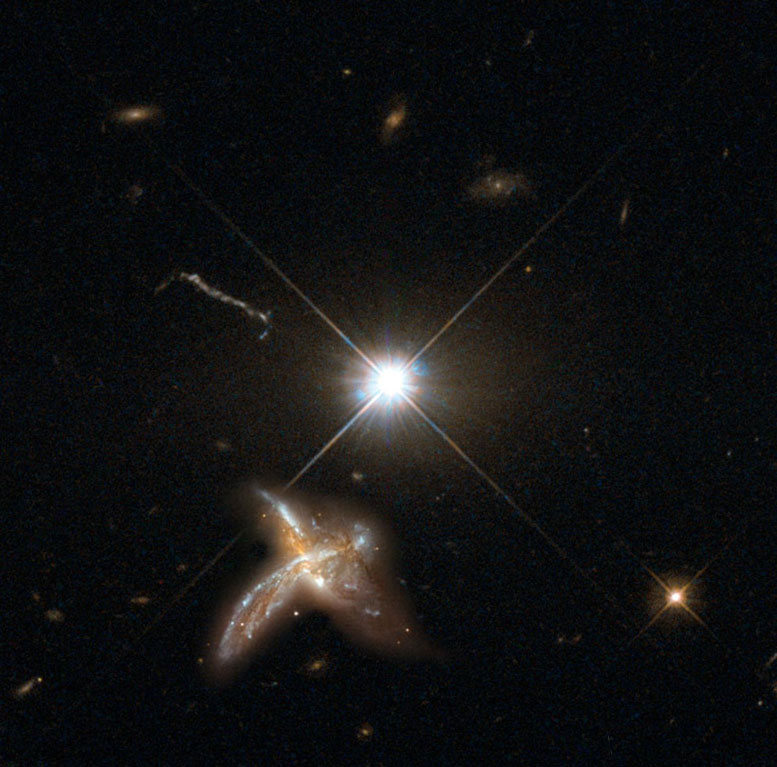
A team of astronomers has discovered a new kind of galaxy in the early universe, less than a billion years after the Big Bang. These galaxies are forming stars more than a hundred times faster than our own Milky Way. The discovery could explain an earlier finding: a population of surprisingly massive galaxies at a time 1.5 billion years after the Big Bang, which would require such hyper-productive precursors to grow their hundreds of billions of stars. The observations also show what appears to be the earliest image of galaxies merging.
When a group of astronomers discovered unusually massive galaxies in the early universe a few years ago, the sheer size of these galaxies, with hundreds of billions of stars, posed a puzzle. The galaxies are so distant, we see them as they were a mere 1.5 billion years after the Big Bang, when the universe was about 10% its present age. How were they able to form so many stars, in such a comparatively short time?
Now, this discovery led by Roberto Decarli from the Max Planck Institute for Astronomy is pointing to a possible solution to the mystery: a population of hyper-productive galaxies in the very early universe, at a time less than a billion years after the Big Bang.
Roberto Decarli says: “We were looking for something different: for star formation activity in the host galaxies of quasars. But what we found, in four separate cases, were neighboring galaxies that were forming stars at a furious pace, producing a hundred solar masses’ worth of new stars per year.” Quasars constitute a brief phase of galaxy evolution, powered by the infall of matter onto a supermassive black hole at the center of a galaxy.
Fabian Walter, leader of the observation program using the ALMA observatory in Chile that led to the discovery, says: “Very likely it is not a coincidence to find these productive galaxies close to bright quasars. Quasars are thought to form in regions of the universe where the large-scale density of matter is much higher than average. Those same conditions should also be conducive to galaxies forming new stars at a greatly increased rate.”
Whether or not these newly discovered galaxies can indeed be the precursors of their more massive, later kin, and thus solve the cosmic puzzle, will depend on how common they are in the universe. That is a question for follow-up observations planned by Decarli and his colleagues.
The ALMA observations also showed what appears to be the earliest known example of two galaxies undergoing a merger. In addition to forming new stars, mergers are another major mechanism of galaxy growth – and the new observations provide the first direct evidence that such mergers have been taking place even at the earliest stages of galaxy evolution, less than a billion years after the Big Bang.
The results, by a group of astronomers led by Roberto Decarli of the Max Planck Institute for Astronomy, have been published in the 25 May issue of the journal Nature.
Reference: “Rapidly star-forming galaxies adjacent to quasars at redshifts exceeding 6” by R. Decarli, F. Walter, B. P. Venemans, E. Bañados, F. Bertoldi, C. Carilli, X. Fan, E. P. Farina, C. Mazzucchelli, D. Riechers, H.-W. Rix, M. A. Strauss, R. Wang and Y. Yang, 25 May 2017, Nature.
DOI: 10.1038/nature22358
Never miss a breakthrough: Join the SciTechDaily newsletter.
Follow us on Google and Google News.
3 Comments
good reading
How do they know when the so called big bang occurred? And Hawkins said there was NOTHING before the big bang…so what created the bang then. And what created that and fo on and so on etc. etc. etc. Until you reach the fact something or Someone created it. (God)
The blog is very informative and outstanding. I would love to read your blog. Give me lots of useful information. I will often visit your blog.