
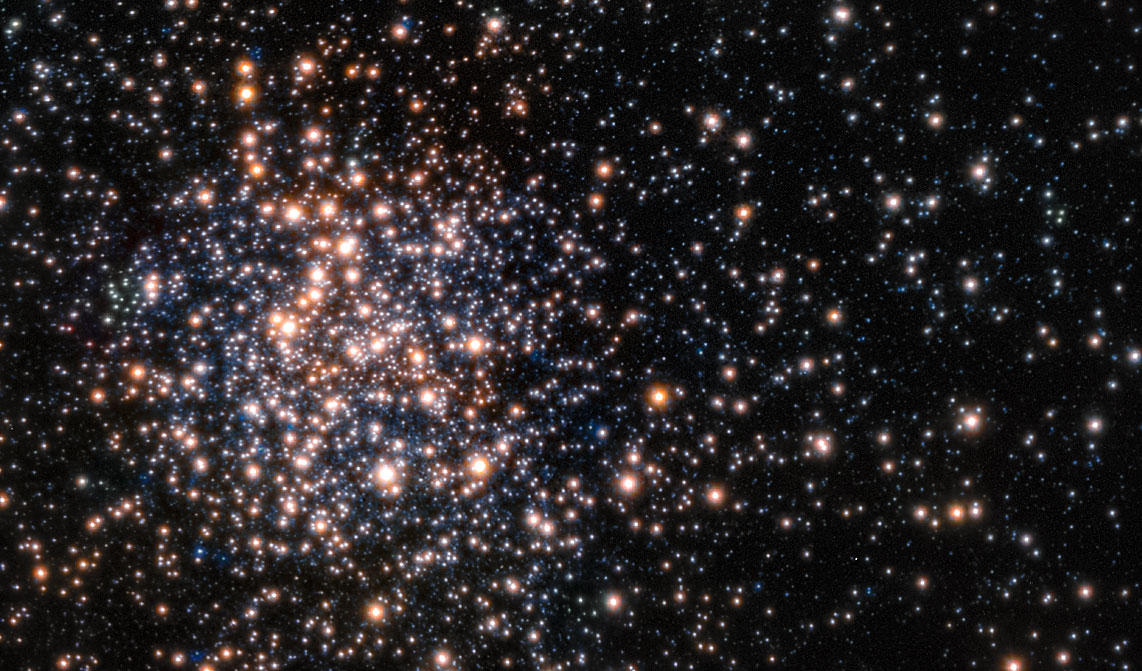
An international team of astronomers has revealed the unusual mix of stars in the stellar cluster known as Terzan 5. The new results indicate that Terzan 5 is in fact one of the bulge’s primordial building blocks, most likely the relic of the very early days of the Milky Way.
Using ESO’s Very Large Telescope and other telescopes a fossilized remnant of the early Milky Way harboring stars of hugely different ages has been revealed by an international team of astronomers. This stellar system resembles a globular cluster, but is like no other cluster known. It contains stars remarkably similar to the most ancient stars in the Milky Way and bridges the gap in understanding between our galaxy’s past and its present.
Terzan 5, 19,000 light-years from Earth in the constellation of Sagittarius (the Archer) and in the direction of the galactic center, has been classified as a globular cluster for the forty-odd years since its detection. Now, an Italian-led team of astronomers have discovered that Terzan 5 is like no other globular cluster known.
The team scoured data from the Multi-conjugate Adaptive Optics Demonstrator, installed at the Very Large Telescope, as well as from a suite of other ground-based and space telescopes. They found compelling evidence that there are two distinct kinds of stars in Terzan 5 which not only differ in the elements they contain, but have an age-gap of roughly 7 billion years.
The ages of the two populations indicate that the star formation process in Terzan 5 was not continuous, but was dominated by two distinct bursts of star formation. “This requires the Terzan 5 ancestor to have large amounts of gas for a second generation of stars and to be quite massive. At least 100 million times the mass of the Sun,” explains Davide Massari, co-author of the study, from INAF, Italy, and the University of Groningen, Netherlands.
Its unusual properties make Terzan 5 the ideal candidate for a living fossil from the early days of the Milky Way. Current theories on galaxy formation assume that vast clumps of gas and stars interacted to form the primordial bulge of the Milky Way, merging and dissolving in the process.
“We think that some remnants of these gaseous clumps could remain relatively undisrupted and keep existing embedded within the galaxy,” explains Francesco Ferraro from the University of Bologna, Italy, and lead author of the study. “Such galactic fossils allow astronomers to reconstruct an important piece of the history of our Milky Way.”
While the properties of Terzan 5 are uncommon for a globular cluster, they are very similar to the stellar population which can be found in the galactic bulge, the tightly packed central region of the Milky Way. These similarities could make Terzan 5 a fossilized relic of galaxy formation, representing one of the earliest building blocks of the Milky Way.
This sequence takes the viewer from a wide view of the Milky Way to the central regions, where many bright star forming regions and star clusters can be seen. The final view is a close-up of the sky around the star cluster Terzan 5 taken with the Hubble Space Telescope.
This assumption is strengthened by the original mass of Terzan 5 necessary to create two stellar populations: a mass similar to the huge clumps which are assumed to have formed the bulge during galaxy assembly around 12 billion years ago. Somehow Terzan 5 has managed to survive being disrupted for billions of years, and has been preserved as a remnant of the distant past of the Milky Way.
“Some characteristics of Terzan 5 resemble those detected in the giant clumps we see in star-forming galaxies at high-redshift, suggesting that similar assembling processes occurred in the local and in the distant Universe at the epoch of galaxy formation,“ continues Ferraro.
Hence, this discovery paves the way for a better and more complete understanding of galaxy assembly. “Terzan 5 could represent an intriguing link between the local and the distant Universe, a surviving witness of the Galactic bulge assembly process,” explains Ferraro while commenting on the importance of the discovery. The research presents a possible route for astronomers to unravel the mysteries of galaxy formation, and offers an unrivaled view into the complicated history of the Milky Way.
Reference: “The age of the young bulge-like population in the stellar system Terzan 5: linking the Galactic bulge to the high-z Universe” by F. R. Ferraro, D. Massari, E. Dalessandro, B. Lanzoni, L. Origlia, R. M. Rich and A. Mucciarelli, 6 September 2016, The Astrophysical Journal.
DOI: 10.3847/0004-637X/828/2/75
arXiv:1609.01515
PDF
Never miss a breakthrough: Join the SciTechDaily newsletter.
Follow us on Google and Google News.