
Close Menu
    Facebook X (Twitter) Instagram
    SciTechDaily
    • Biology
    • Chemistry
    • Earth
    • Health
    • Physics
    • Science
    • Space
    • Technology
    Facebook X (Twitter) Pinterest YouTube RSS
    SciTechDaily
    Home»Space»Astronomers Discover Clouds of Glowing Hydrogen Gas around a Red Supergiant Star
    Space

    Astronomers Discover Clouds of Glowing Hydrogen Gas around a Red Supergiant Star

    By European Southern ObservatoryOctober 15, 20132 Comments3 Mins Read
    Facebook Twitter Pinterest Telegram LinkedIn WhatsApp Email Reddit
    Share
    Facebook Twitter LinkedIn Pinterest Telegram Email Reddit
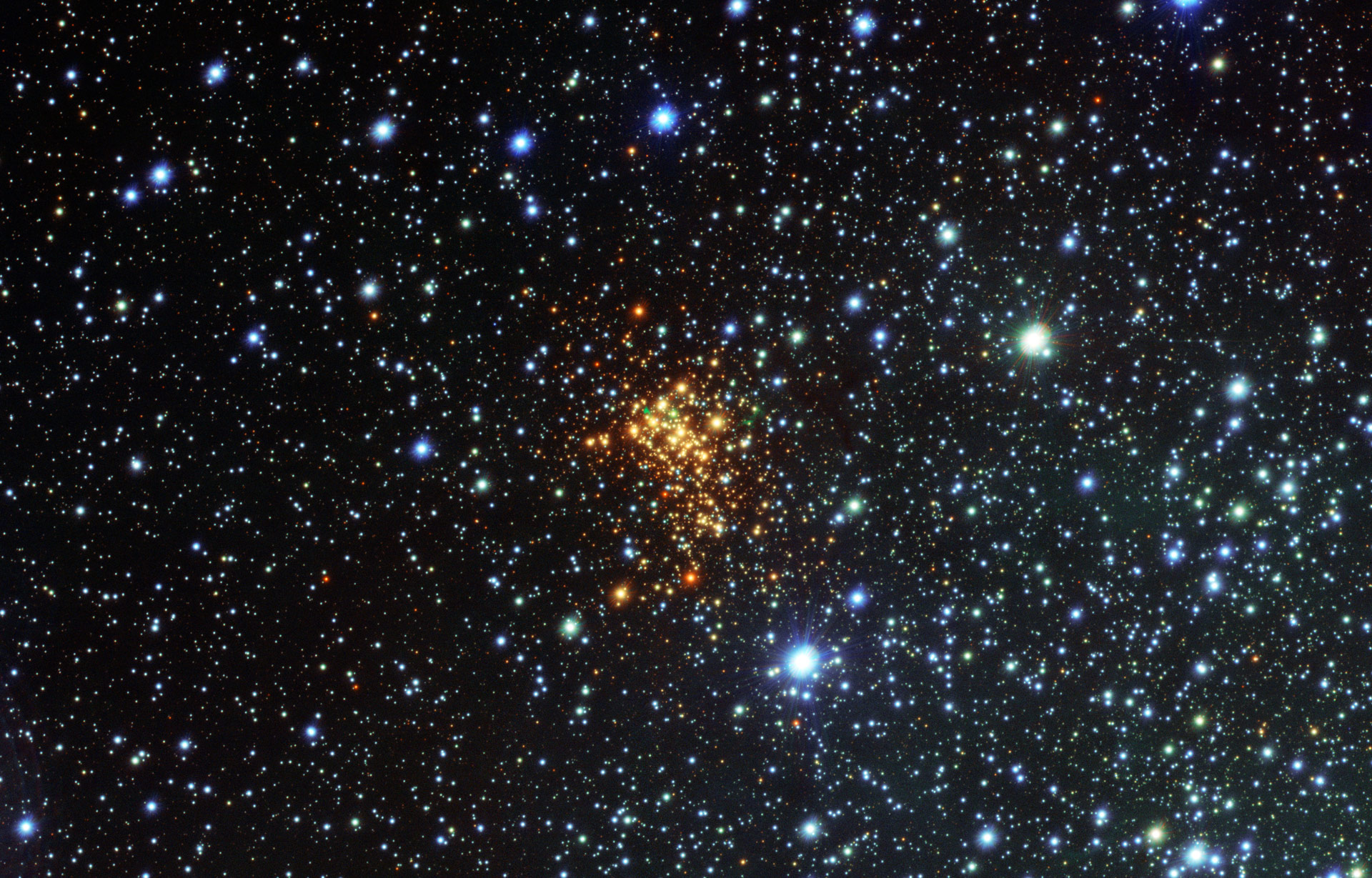
    ESO Views the Super Star Cluster Westerlund 1
    Westerlund 1, an exceptionally bright super star cluster, is located roughly 16,000 light-years away from Earth in the southern constellation Ara (The Altar). Credit: ESO/VPHAS+ Survey/N. Wright

    This newly released image from ESO’s Paranal Observatory shows the super star cluster Westerlund 1 and the newly discovered clouds of glowing hydrogen gas around supergiant star W26.

    This new picture from the VLT Survey Telescope (VST) at ESO’s Paranal Observatory shows the remarkable super star cluster Westerlund 1. This exceptionally bright cluster lies about 16,000 light-years from Earth in the southern constellation of Ara (The Altar). It contains hundreds of very massive and brilliant stars, all of which are just a few million years old — babies by stellar standards. But our view of this cluster is hampered by gas and dust that prevents most of the visible light from the cluster’s stars from getting to Earth.

    Now, astronomers studying images of Westerlund 1 from a new survey of the southern skies [1] have spotted something unexpected in this cluster. Around one of the stars — known as W26, a red supergiant and possibly the biggest star known— they have discovered clouds of glowing hydrogen gas, shown as green features in this new image.

    Such glowing clouds around massive stars are very rare, and are even rarer around a red supergiant— this is the first ionized nebula discovered around such a star. W26 itself would be too cool to make the gas glow; the astronomers speculate that the source of the ionizing radiation may be either hot blue stars elsewhere in the cluster, or possibly a fainter, but much hotter, companion star to W26.

    W26 will eventually explode as a supernova. The nebula that surrounds it is very similar to the nebula surrounding SN1987A, the remnants of a star that went supernova in 1987 [2]. SN1987A was the closest observed supernova to Earth since 1604, and as such it gave astronomers a chance to explore the properties of these explosions. Studying objects like this new nebula around W26 will help astronomers understand the mass loss processes around these massive stars, which eventually lead to their explosive demise.

    Notes

    1. This picture forms part of a detailed public survey of a large part of the Milky Way called VPHAS+ that is using the power of the VST to search for new objects such as young stars and planetary nebulae. A spectacular recent picture of the Prawn Nebula was made using observations from the same survey.
    2. This nebula is thought to have surrounded SN1987A’s progenitor star since before it went supernova.

    Reference: “The ionized nebula surrounding the red supergiant W26 in Westerlund 1” by Nicholas J. Wright, Roger Wesson, Janet E. Drew, Geert Barentsen, Michael J. Barlow, Jeremy R. Walsh, Albert Zijlstra, Jeremy J. Drake, Jochen Eislöffel and Hywel J. Farnhill, 16 October 2013, Monthly Notices of the Royal Astronomical Society: Letters.
    DOI: 10.1093/mnrasl/slt127
    arXiv:1309.4086

    Never miss a breakthrough: Join the SciTechDaily newsletter.
    Follow us on Google and Google News.

    Astronomy Astrophysics European Southern Observatory
    Share. Facebook Twitter Pinterest LinkedIn Email Reddit

    Related Articles

    Stunning Galactic Fireworks: New ESO Images Reveal Spectacular Features of Nearby Galaxies

    Astronomers Were Puzzled by “Great Dimming” of Betelgeuse – Now the Mystery Is Solved

    “Big Surprise!” – Heavy Metal Vapors Unexpectedly Found in Comets Throughout Our Solar System – and Beyond

    Mysterious Interstellar Visitor May Be the Most Pristine Comet Ever Found

    Event Horizon Telescope Images Magnetic Fields at the Edge of M87’s Supermassive Black Hole

    “Meteorological Beast in Our Solar System” – Powerful Stratospheric Winds Measured on Jupiter for the First Time

    Astronomers Have Discovered the Most Distant Source of Radio Emission Ever Known – 13 Billion Light-Years Away

    Distant Colliding Galaxy Dying Out As It Loses the Ability to Form Stars – Ejecting 10,000 Suns-Worth of Gas a Year

    Puzzling Six-Exoplanet System Discovered With Resonant Rhythmic Movement

    2 Comments

    1. Jes Lookin on October 16, 2013 2:02 pm

      Very nice picture and report… if only you had pointed out which star is W26.

      Reply
      • Staff on October 17, 2013 6:41 am

        ESO only released this photo, so we weren’t able to point W26 out. Sorry.

        Reply
    Leave A Reply Cancel Reply

    • Facebook
    • Twitter
    • Pinterest
    • YouTube

    Don't Miss a Discovery

    Subscribe for the Latest in Science & Tech!

    Trending News

    Scientists Discover Major Errors in Al Gore-Founded Climate Pollution Database

    New Vitamin B12-Based Therapy Could Change How Brain Cancer Is Treated

    This Common Fat Could Be Fueling Type 2 Diabetes, Researchers Warn

    Simple Fiber Supplement Cuts Knee Arthritis Pain in Just 6 Weeks, Study Finds

    Common Asthma Drug May Reverse Dangerous Fatty Liver Disease

    Extra Weight Could Age Your Brain Faster, Study Warns

    Scientists Warn: America’s Most Popular Cooking Oil May Be Harming Your Intestines

    Scientists Say a 59,000-Year-Old Neanderthal Tooth Shows Evidence of Surgery

    Follow SciTechDaily
    • Facebook
    • Twitter
    • YouTube
    • Pinterest
    • Newsletter
    • RSS
    SciTech News
    • Biology News
    • Chemistry News
    • Earth News
    • Health News
    • Physics News
    • Science News
    • Space News
    • Technology News
    Recent Posts
    • Physicists Have Measured “Negative Time” in Bizarre Quantum Experiment
    • Researchers Compare MS Models to Human Tissue in Search for Better Therapies
    • Scientists Discover Genetic “Off Switch” That Supercharges CAR T Cells Against Cancer
    • The Deadly Tapeworm Spreading Across America Has Reached the Pacific Northwest
    • Could Low Vitamin D Be Making Your Pain Worse?
    Copyright © 1998 - 2026 SciTechDaily. All Rights Reserved.
    • Science News
    • About
    • Contact
    • Editorial Board
    • Privacy Policy
    • Terms of Use

    Type above and press Enter to search. Press Esc to cancel.