
Until now, these flows of material had been detected only in other wavelength ranges, such as X-rays or the visible, depending on the phase in which the black hole is consuming its surrounding material. This study provides the first evidence that the winds are present throughout the evolution of the eruption, independently of the phase, and this is a step forward in our understanding of the mysterious processes of accretion onto stellar mass black holes. The article has just been published in Astronomy and Astrophysics and was chosen as an ‘outstanding article’ by the journal itself.
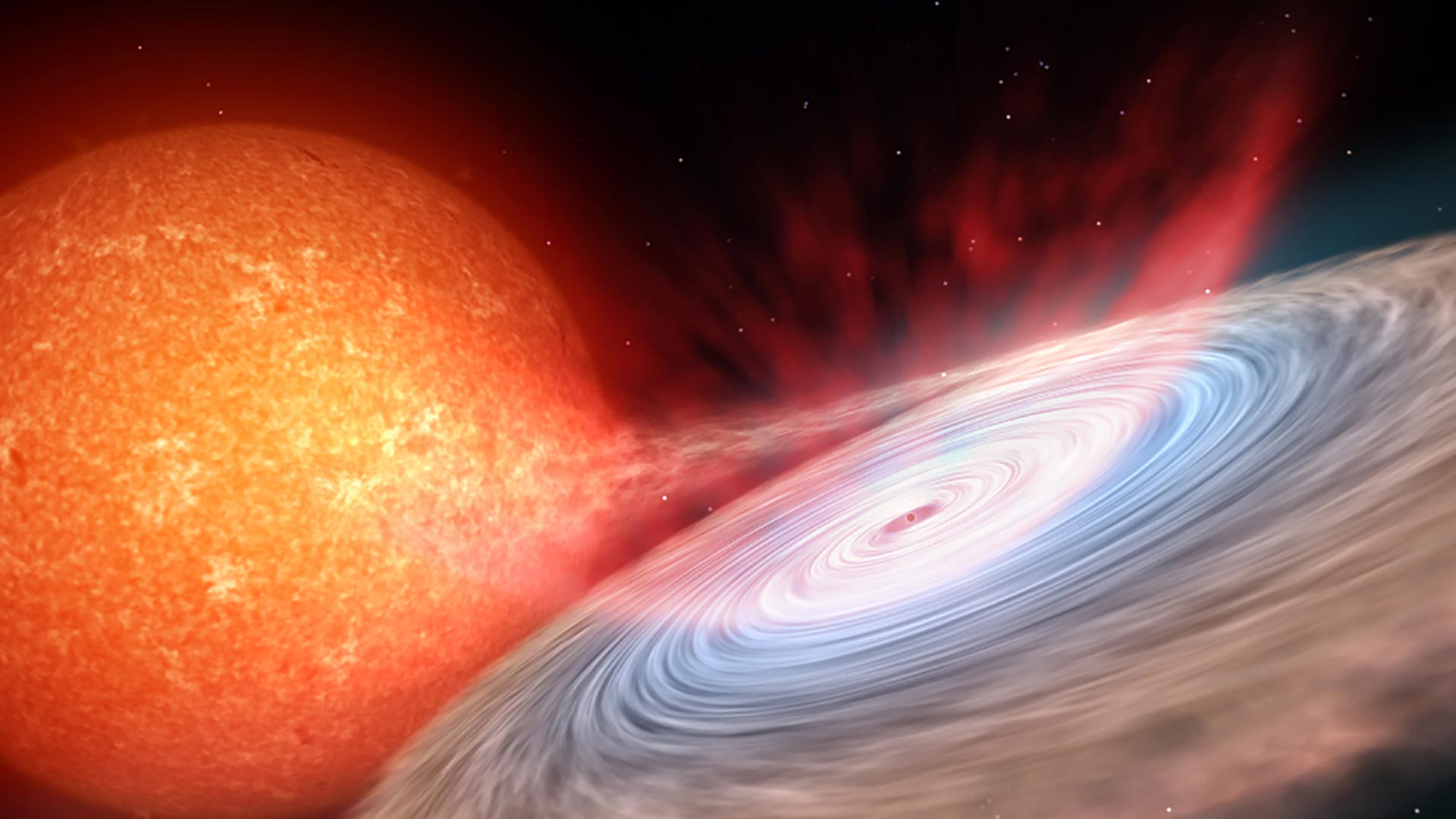
X-ray binaries, as their name implies, are binary stars that emit strong radiation in X-rays. They are formed by a compact object, normally a black hole, with a stellar companion. Low mass X-ray binaries (LMXB) have companions with masses equal to, or less than the mass of the Sun. In these systems the two stars orbit at a distance so small that some of the mass of the star falls into the gravitational well of the black hole, forming a flat disc of material around it. This process is called accretion, and the disc, is an accretion disc.
Some X-ray binaries, termed transitory, changed from quiescent states, in which the amount of mass accreting onto the black hole is small and its brightness is too low to detect from the Earth, to eruptive states in which the black hole has an augmented accretion rate, so that the material in the disc heats up, reaching values between one and ten million degrees Kelvin. During these eruptions, which can last from weeks to several months, the system emits a large flux of X-rays, and its brightness increases by several magnitudes.
We still don’t know exactly what the physical processes which occur during these accretion episodes are. “These systems are places where matter is subjected to gravitational fields which are among the strongest in the universe, so that X-ray binaries are physics laboratories which nature provides us for the study of compact objects, and the behavior of the matter surrounding them”, explains Javier Sánchez Sierras, a predoctoral researcher at the IAC and the first author of the article.
One of the most important physical processes which scientists need to understand is the ejection of material, or winds, during accretion episodes. According to Teo Muñoz Darias, an IAC researcher and coauthor of the article, “the study of winds in those systems is a key to understand accretion processes, because the winds can get to expel even more matter than is accreted by the black hole”.
Same wind, different states
The article which has just been published in Astronomy and Astrophysics Letters, and which has been chosen by the journal as a “highlight article”, presents the discovery of winds from the black hole MAXI J1820+070 in the infrared, during the eruption which took place during 2018-2019. In the past two decades, winds have been observed in X-rays during the eruption, termed soft in which the radiation emitted by the accretion disc is dominant, showing high luminosity. More recently, the same group at the IAC has discovered at visible wavelengths winds in the hard state of accretion which is characterized by the appearance of a jet, which comes out essentially perpendicular to the accretion disc, and which emits strongly at radio wavelengths.
“In the present study -stressed Sánchez Sierras-, we have shown the discovery of infrared winds which are present during both the hard and soft accretion states, during the full evolution of the eruption, so that their presence does not depend on the accretion state, and this is the first time that this type of winds has been observed”. The researchers have also been able to show that the kinematic properties of the wind are very similar to those observed in 2019 in the visible range, reaching velocities of up to 1,800 km/s (1,100 mi/s).
“These data suggest that the wind is the same for both cases, but its visibility changes wavelength during the evolution of the eruption, which would indicate that the system is losing mass and also angular momentum during the process of the eruption”, explains Muñoz Darias. These results are very important to the scientists, because they add a new element to the global picture of the winds in these systems, and represent a step forward towards the goal of completing our understanding of the processes of accretion onto stellar mass black holes.
Reference: “Near-infrared emission lines trace the state-independent accretion disc wind of the black hole transient MAXI J1820+070” by J. Sánchez-Sierras and T. Muñoz-Darias, 28 July 2020, Astronomy & Astrophysics.
DOI: 10.1051/0004-6361/202038406
Never miss a breakthrough: Join the SciTechDaily newsletter.
Follow us on Google and Google News.
1 Comment
Sure thing nothing can escape unescapable but something does constantly