
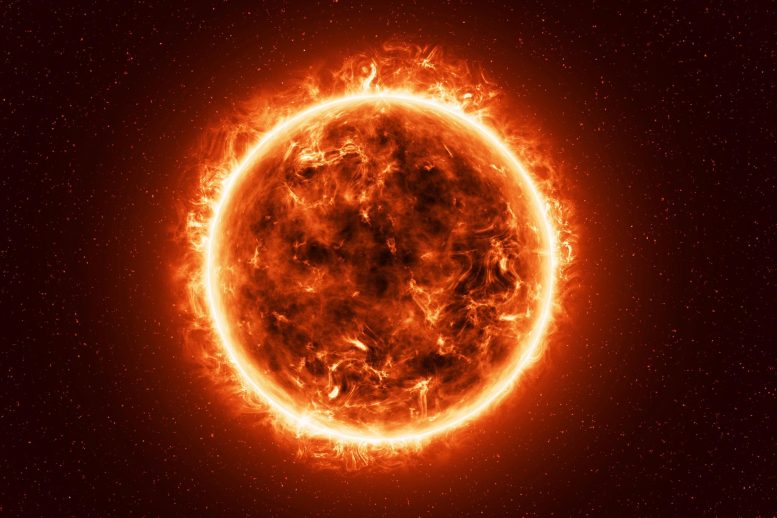
Recent Findings Indicate That a Significant Number of Stars Exhibit Irregularities in Their Cores
Scientists have discovered a method to examine the internal workings of some of the brightest stars in the sky.
An international team of researchers, utilizing data from NASA’s Kepler space telescope, has uncovered new evidence that red giants – stars that have reached the end of their lifecycle and have depleted their hydrogen supply – frequently experience significant structural variations, or “glitches,” deep within their inner core.
The stellar glitches popularized in the media have to do with a star’s rotation, but lead author Mathieu Vrard studies a different kind of defect. The glitches in this study can affect a star’s oscillations or the frequencies and paths that sound waves travel when passing through a star.
Oscillations and Red Clump Stars as Cosmic Probes
Red clump stars, helium-core burning objects, are often used in astrophysical studies as probes of distance to measure aspects like galaxy density and to learn more about the physical processes behind stellar chemical evolution. So it’s vital that scientists understand why these discontinuities happen, said Vrard, a postdoctoral research associate in astronomy at the Ohio State University.
“By analyzing these variations, we can use them to obtain not only the global parameters of the star but also information on the precise structure of those objects,” he said.
The study, recently published in the journal Nature Communications is the first to perform detailed observational characterizations on the deepest layers of these red giants.
In order to determine if these glitches were becoming more prevalent across certain star groups, the team selected a sample of 359 red giants that were below a certain stellar mass, and measured various properties and individual frequencies of each star.
The team found proof that 24 of the red giants surveyed (about 7% of those in the sample) had experienced intermittent structural discontinuities at one point or another during their lifetime. While 7% may not seem like much, if applied to all of the known stars in our universe, the number of stars that have these irregularities would be enormous.
Theories Behind Red-Giant Irregularities
There are two main theories that explain how these disturbances might work. The first scenario posits that glitches are present throughout the star’s evolution, but are generally very weak and below the threshold for what astronomers would categorize as a true discontinuity.
The second suggests that irregularities are “smoothed out” by some unknown physical process that later leads to changes in the structure of the star’s core.
As it turns out, the first scenario is not supported by this study’s model, which predicts that glitches observed are actually a common occurrence, but more precise data is needed before scientists can confidently subscribe to the second.
“What we think is that the second theory might hold up better because the first one didn’t make sense with our observations,” Vrard said.
As the study offers a better characterization of the physical processes taking place inside red-giant stars, Vrard’s work could potentially have large implications for the field of asteroseismology – a branch of astronomy that studies the internal composition of stars using the oscillations of sound waves – and for galactic archaeology, a field that uses detailed stellar fossil records to uncover the history of the universe.
And though Vrard’s current analysis has come to an end, he aims to build on the scientific community’s knowledge of red-giant stars by examining more precise data that could help cultivate even more refined stellar models.
Reference: “Evidence of structural discontinuities in the inner core of red-giant stars” by Mathieu Vrard, Margarida S. Cunha, Diego Bossini, Pedro P. Avelino, Enrico Corsaro and Benoît Mosser, 16 December 2022, Nature Communications.
DOI: 10.1038/s41467-022-34986-z
The study was funded by NASA and the European Regional Development Fund.
Never miss a breakthrough: Join the SciTechDaily newsletter.
Follow us on Google and Google News.