
Close Menu
    Facebook X (Twitter) Instagram
    SciTechDaily
    • Biology
    • Chemistry
    • Earth
    • Health
    • Physics
    • Science
    • Space
    • Technology
    Facebook X (Twitter) Pinterest YouTube RSS
    SciTechDaily
    Home»Space»Astronomers Discover Planets Building Each Other in Space
    Space

    Astronomers Discover Planets Building Each Other in Space

    By National Institutes of Natural SciencesDecember 21, 2024No Comments3 Mins Read
    Facebook Twitter Pinterest Telegram LinkedIn WhatsApp Email Reddit
    Share
    Facebook Twitter LinkedIn Pinterest Telegram Email Reddit
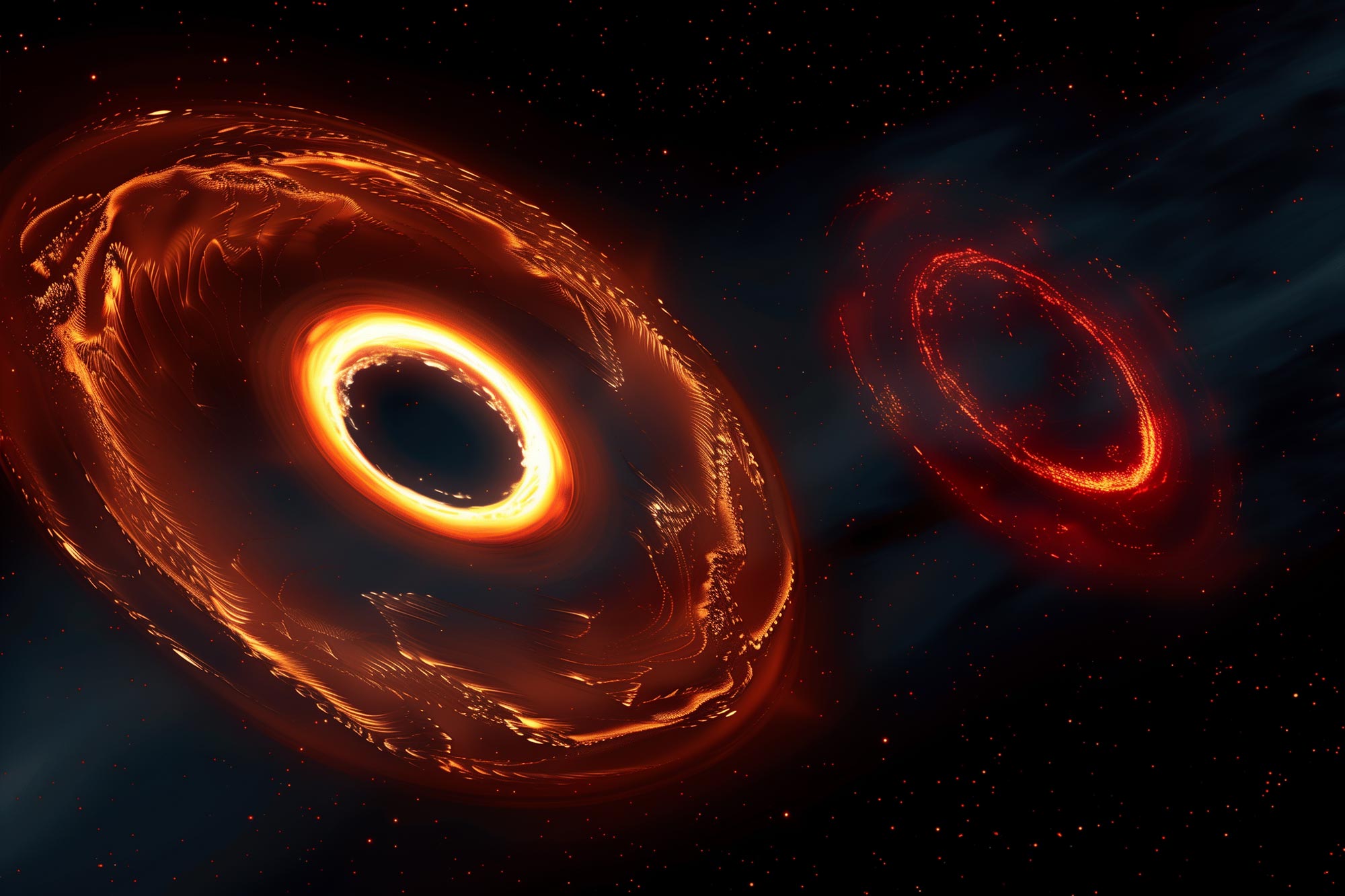
    Two Protoplanetary Disks Art Concept
    Radio astronomy has revealed that early-formed planets within a protoplanetary disk can influence the creation of additional planets, acting like a cascade where each planet aids in forming the next. Credit: SciTechDaily.com

    New observations show that planets forming in protoplanetary disks like that around PDS 70 can trigger the formation of subsequent planets.

    This finding, based on high-resolution images from ALMA, supports the domino effect in the sequential formation of planetary systems.

    Discoveries in Multi-Planet Systems

    New radio astronomy observations of a forming planetary system reveal that once the first planets emerge near a star, they can influence the surrounding material, guiding it to form additional planets farther out. In this process, each planet plays a role in creating the next, much like falling dominos triggering one another.

    So far, astronomers have identified over 5,500 planetary systems, with more than 1,000 confirmed to have multiple planets. Planets form in protoplanetary disks — massive clouds of gas and dust surrounding young stars. Despite this knowledge, the exact process of how multi-planet systems like our Solar System develop remains unclear.

    Case Study: PDS 70

    A key system for studying planet formation is PDS 70, a young star located 367 light-years away in the constellation Centaurus. It’s the only known star where fully formed planets have been directly observed within a protoplanetary disk using optical and infrared imaging. (First Confirmed Image of Newborn Planet Caught with ESO’s VLT.)

    Earlier radio wave observations from the Atacama Large Millimeter/submillimeter Array (ALMA) detected a ring of dust grains beyond the orbits of PDS 70’s two known planets. However, these initial observations lacked the resolution needed to explore the ring’s detailed structure.

    Planets Form Through Domino Effect Annotated
    Compared to the previous observations (left), the new ALMA observations (right) at longer wavelengths can better see into the dust ring and reveal a concentration of dust to the north-west (upper right) where a new planet is forming. Credit: ALMA (ESO/NAOJ/NRAO), W. M. Keck Observatory, VLT (ESO), K. Doi (MPIA)

    Advancements in Observation Techniques

    In this research, an international team led by Kiyoaki Doi, formerly a Ph.D. student at the National Astronomical Observatory of Japan (NAOJ)/the Graduate University for Advanced Studies, SOKENDAI and currently a postdoctoral fellow at the Max Planck Institute for Astronomy, performed high-resolution observations of the protoplanetary disk around PDS 70. The team again used ALMA, but observed at a longer wavelength of radio waves. This is because longer wavelengths are better for peering into the dusty cloud of the protoplanetary disk.

    Findings from ALMA’s Latest Observations

    The new ALMA observations clearly show a concentration of dust grains to the northwest (upper right) in the ring outside the orbits of the two existing planets. The location of this dust clump suggests that the already-formed planets interact with the surrounding disk, concentrating dust grains into a narrow region at the outer edge of their orbits. These clumped dust grains are thought to grow into a new planet.

    This work observationally shows that the formation of planetary systems, like the Solar System, can be explained by the sequential formation of the planets from inside to outside by the repetition of this process; like a line of falling dominos, each one triggering the next.

    Reference: “Asymmetric Dust Accumulation of the PDS 70 Disk Revealed by ALMA Band 3 Observations” by Kiyoaki Doi, Akimasa Kataoka, Hauyu Baobab Liu, Tomohiro C. Yoshida, Myriam Benisty, Ruobing Dong, Yoshihide Yamato and Jun Hashimoto, 14 October 2024, The Astrophysical Journal Letters.
    DOI: 10.3847/2041-8213/ad7f51

    Never miss a breakthrough: Join the SciTechDaily newsletter.
    Follow us on Google and Google News.

    ALMA Astronomy Astrophysics National Astronomical Observatory of Japan Planets
    Share. Facebook Twitter Pinterest LinkedIn Email Reddit

    Related Articles

    Newborn Star’s Jet Ignites a Cosmic Blast. Then Gets Slammed by Its Shockwave

    Interplay Between Magnetic Force and Gravity in Massive Star Formation

    Untangling the Formation of Planetary Systems With Heavy Hydrogen

    Extensive Chemical Composition Mapping Reveals Carbon-Rich, Organic Birth Environments of Planets

    Astrophysicists Identify “Significant Reservoirs” of Organic Molecules Necessary To Form the Basis of Life

    Spinning Disks, Oddball Stars, and Strange Planets Help Astronomers Test Theories About Planetary System Formation

    Incredibly Powerful 900+ Mph Winds in Jupiter’s Atmosphere Measured for the First Time

    “Meteorological Beast in Our Solar System” – Powerful Stratospheric Winds Measured on Jupiter for the First Time

    Growing up Stardust: Astronomers Discover That Stars and Planets May Be Siblings

    Leave A Reply Cancel Reply

    • Facebook
    • Twitter
    • Pinterest
    • YouTube

    Don't Miss a Discovery

    Subscribe for the Latest in Science & Tech!

    Trending News

    Breakthrough Parkinson’s Drug Targets Disease at Its Genetic Roots

    Just 4 Weeks of Simple Diet Changes Reversed Signs of Aging in Older Adults

    Scientists May Have Finally Solved Why Humans Are Right-Handed

    NASA’s Hubble Accidentally Witnesses a Comet Shattering in Space

    Researchers Discover the Body’s Hidden “Off Switch” for Inflammation

    Scientists Discover Metformin Doesn’t Work the Way We Thought

    Tea or Coffee? Your Daily Choice Could Affect Osteoporosis Risk

    Vitamin C May Fight Cancer in a Surprising Way

    Follow SciTechDaily
    • Facebook
    • Twitter
    • YouTube
    • Pinterest
    • Newsletter
    • RSS
    SciTech News
    • Biology News
    • Chemistry News
    • Earth News
    • Health News
    • Physics News
    • Science News
    • Space News
    • Technology News
    Recent Posts
    • Extra Weight Could Age Your Brain Faster, Study Warns
    • Scientists Warn: America’s Most Popular Cooking Oil May Be Harming Your Intestines
    • Scientists Unravel the Mystery of Angola’s Giant “Ghost Elephants”
    • Ancient DNA Shatters the Simple Story of Europe’s Origins
    • Scientists Say a 59,000-Year-Old Neanderthal Tooth Shows Evidence of Surgery
    Copyright © 1998 - 2026 SciTechDaily. All Rights Reserved.
    • Science News
    • About
    • Contact
    • Editorial Board
    • Privacy Policy
    • Terms of Use

    Type above and press Enter to search. Press Esc to cancel.