
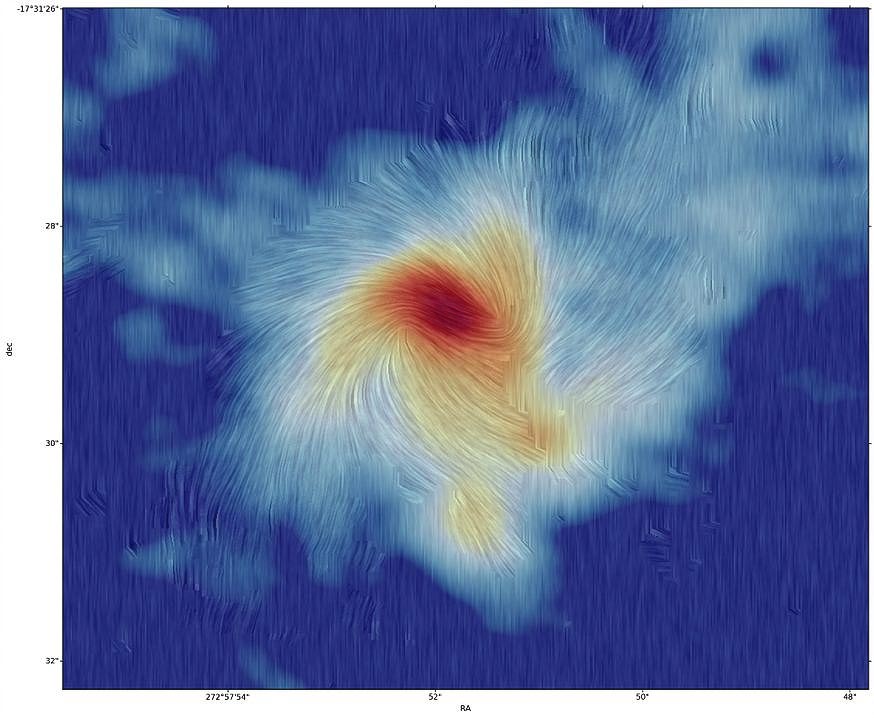
ALMA observations of a distant star-forming region revealed that, contrary to expectations, gravity overwhelms the magnetic field in shaping massive star birth.
The magnetic field is part of one of the four fundamental forces in nature. It plays a vital role in everyday life, from producing electricity in hydroelectric power plants to diagnosing diseases in medicine. Historically, the Earth’s magnetic field served as a compass for travelers before modern technology was available. Crucially for life, the Earth’s magnetic field acts as a shield protecting us from charged particles emanating from the Sun, which are accelerated by the Sun’s magnetic field. Removing this shield would very likely extinguish life on Earth. So it may not be a surprise that magnetic fields also play an outstanding role far away from us, outside the solar system.
The Sun was born in a cloud of dust and gas about 5 billion years ago, and magnetic fields may have controlled its birth. Indeed, scientists still debate how magnetic fields affect the process of star formation. Among all of the stars, the formation of the most massive ones is still shrouded in uncertainty. For years, scientists believed that the magnetic field plays an essential role in the high-mass star formation process. But they only had a limited number of observational evidence to prove or disprove this theory.
A team led by Patricio Sanhueza of the National Astronomical Observatory of Japan used ALMA to tackle this long-standing problem. They observed a source called IRAS 18089-1732, a high-mass star-forming region 7600 light-years away, finding a well-organized magnetic field that resembles a spiral “whirlpool.” Contrary to their predictions, however, the magnetic field appears overwhelmed by another of the four fundamental forces in nature, gravity.
“In these extreme environments, gravity can shape the gas morphology and dominate the energy budget,” says Sanhueza. They further discovered that the magnetic field lines are twisted from the immense gravitational infall of gas.
The minor contribution of the magnetic field has caught them by surprise since they have previously found evidence of strong magnetic fields in a similar star-forming environment. This ALMA discovery reveals the diversity in which high-mass stars form, concluding, somewhat unexpectedly, that high-mass stars can be born in either strongly or weakly magnetized environments, “feeling” the interplay between different forces as we experience here on Earth.
These observation results were presented as Patricio Sanhueza et al. “Gravity-driven Magnetic Field at ∼1000 au Scales in High-mass Star Formation” in the Astrophysical Journal Letters on June 30, 2021.
Reference: “Gravity-driven Magnetic Field at ∼1000 au Scales in High-mass Star Formation” by Patricio Sanhueza, Josep Miquel Girart, Marco Padovani, Daniele Galli, Charles L. H. Hull, Qizhou Zhang, Paulo Cortes, Ian W. Stephens, Manuel Fernández-López, James M. Jackson, Pau Frau, Patrick M. Koch, Benjamin Wu, Luis A. Zapata, Fernando Olguin, Xing Lu, Andrea Silva, Ya-Wen Tang, Takeshi Sakai, Andrés E. Guzmán, Ken’ichi Tatematsu, Fumitaka Nakamura and Huei-Ru Vivien Chen, 30 June 2021, Astrophysical Journal Letters.
DOI: 10.3847/2041-8213/ac081c
Never miss a breakthrough: Join the SciTechDaily newsletter.
Follow us on Google and Google News.
2 Comments
Gravitý driven magnetic field is proportional to the mass of the star or to the brightness of light for a complete time period of rotation following the inverse square law.
Gravitý driven magnetic field is proportional to the mass of the star or to the brightness of light for a complete time period of rotation following the inverse square law.Iñdigeneously magnetìsm is resulted from the gravity bearig a constant of proportionality,which varies with mass and temperature from star to star in a gaĺaxy.