
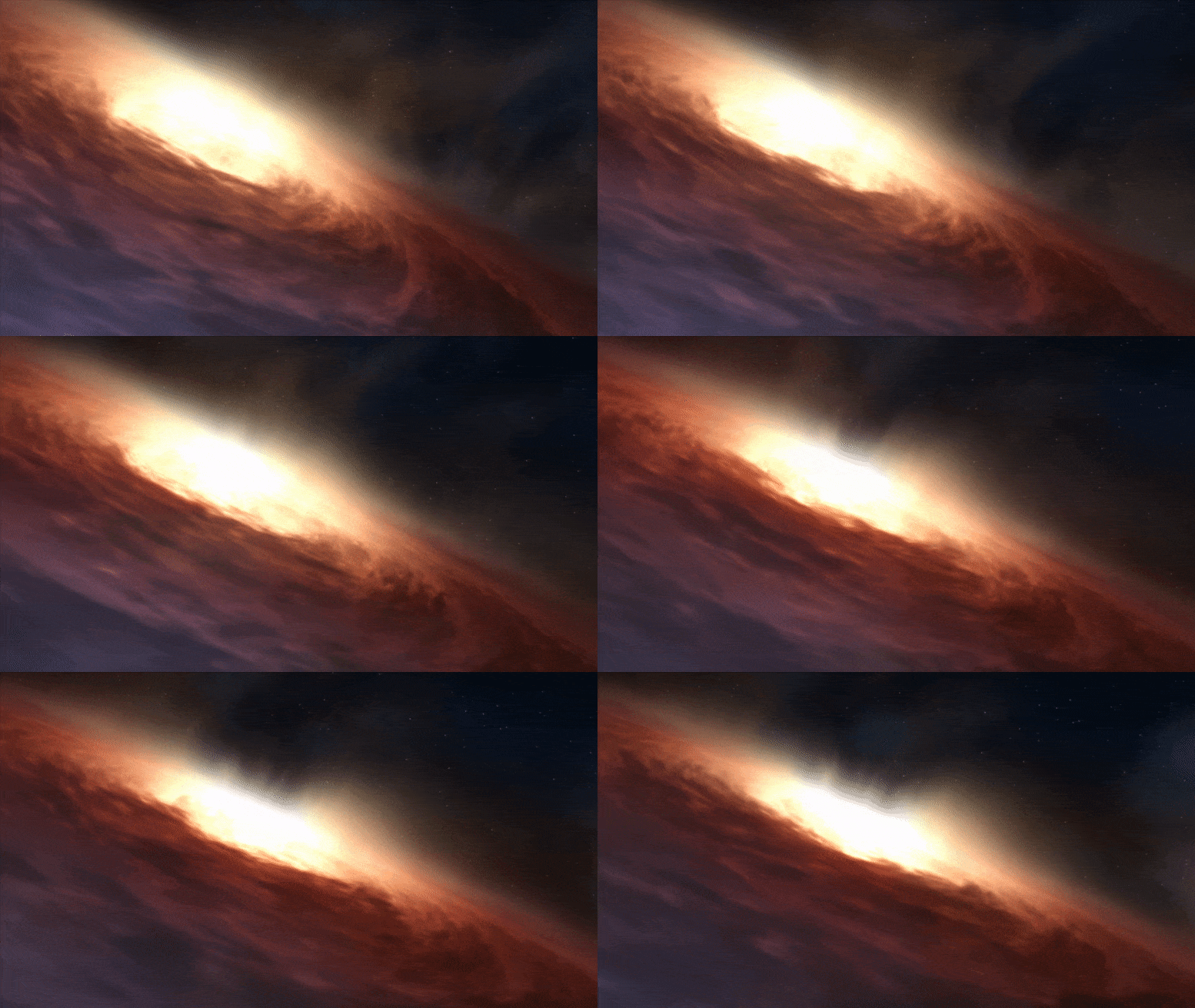
Our telescopes have never detected a black hole more massive than twenty times the mass of the Sun. Nevertheless, we now know of their existence as dozens of those black holes have recently been “heard” to merge via gravitational wave radiation. A team of astronomers led by Peter Jonker (SRON/Radboud University) has now discovered that these seemingly disparate results can be explained by biases against massive black holes in conventional telescope observations.
In 2015 the LIGO facilities detected gravitational waves for the first time. They were emitted by two massive black holes of several tens of the mass of the Sun in the process of merging. This discovery shook the Universe, and also the astronomical community, because few astronomers had predicted that such massive black holes would exist, let alone that they could merge. Before the gravitational wave detections, our conventional telescopes had found proof for the existence of stellar-mass black holes in about 20 cases. However, none had ever been found that were as massive as those now observed through gravitational wave radiation emitted during the merger. By now about 50 of such merging black hole pairs have been detected, including by the European Virgo detector, again in most cases involving massive black holes. Telescopes still have not found such black holes.
This disparity can be partially explained by the larger volume of the Universe that is being probed by the gravitational wave detectors. LIGO-Virgo can find much more massive black holes more easily because their waves are stronger relative to those from lighter black holes, implying that these could be rare, but loud events. But zero detections of such black holes using telescopes? Black holes, or at least their close environment, light up when they slowly devour a companion star. Through measurements of the orbital motion of the hapless star, the mass of the black hole can be determined.
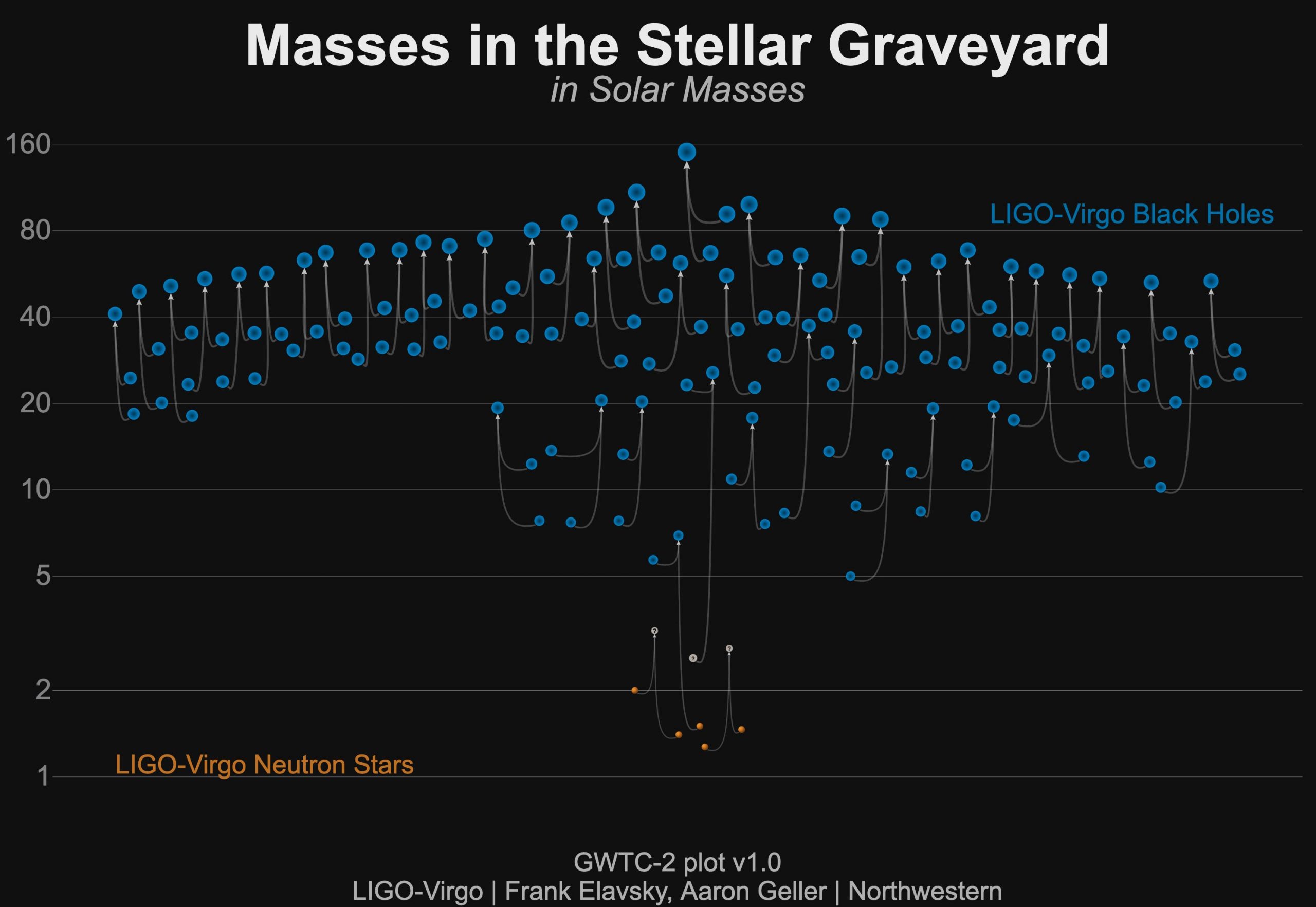
LIGO/Virgo measurements of gravitational wave radiation emitted when two black holes merge have allowed the masses of several tens of black holes to be measured since 2015 (blue circles). These black holes are generally more massive than those found through EM radiation. We know now that the lack of massive black holes studied through EM techniques can be caused by a bias against finding and studying the massive black holes. Incidentally, the LIGO/Virgo measurements favor the detection of massive black holes because the signal of their mergers is louder and thus can be detected from systems further out in the Universe compared with the signal of merging lower-mass black holes. Nevertheless, LIGO/Virgo is also detecting lower-mass merging black holes. In the near future, the JWST telescope will enable to remove the EM bias. Due to its sensitivity astronomers will be able to measure the mass of black hole candidate systems located at places where the most massive black holes are thought to reside.
Credit: Aaron M. Geller, Northwestern University and Frank Elavsky, LIGO-Virgo
A team of astronomers led by Peter Jonker (Radboud University/SRON) realized that telescope observations are biased against detecting massive black holes. Such massive black holes can, in principle, be observed if they eat mass from a companion star. However, the circumstances for those observations have been too difficult in practice, explaining the lack of detections of massive black holes through telescope observations. The largest black holes are formed through imploding massive stars, instead of exploding massive stars (“supernova”). Formed through an implosion, these massive black holes stay put in the same place where their predecessor (the massive star) was born, the plane of the Milky Way galaxy. However, that means that they remain shrouded in dust and gas. Their lighter black hole sisters and brothers, born out of massive stars through supernova explosions, experience a kick ejecting them out of the plane of the Milky Way, making them more readily observable for our telescopes measuring their mass.
Aggravating this bias, as realized by Jonker and colleagues, is that any companion star of a massive black hole must orbit at a relatively large distance, making it rarer for a companion star to be devoured in an observable frenzy. Such episodes are what give away the existence and location of black holes. Thus, the more massive black holes will more rarely give away their location.
The imminent launch of the James Webb space telescope (JWST) on December 18 will allow astronomers to test these ideas. JWST will for the first time allow the measurement of the mass of several systems of candidate black holes in the plane of the Milky Way. JWST will be sensitive to infrared light, and such light is much less affected by dust and gas than is the optical light typically used by ground-based telescopes. Furthermore, the large size of JWST, and its advantageous position in space, allows JWST to pick out the right star to study among the millions of stars in the plane of the Milky Way. Finally, being above the Earth’s atmosphere, JWST will not be hindered by the infrared light emitted by the atmosphere.
Reference: “The Observed Mass Distribution of Galactic Black Hole LMXBs Is Biased against Massive Black Holes” by Peter G. Jonker, Karamveer Kaur, Nicholas Stone and Manuel A. P. Torres, 9 November 2021, The Astrophysical Journal.
DOI: 10.3847/1538-4357/ac2839
Never miss a breakthrough: Join the SciTechDaily newsletter.
Follow us on Google and Google News.