
Close Menu
    Facebook X (Twitter) Instagram
    SciTechDaily
    • Biology
    • Chemistry
    • Earth
    • Health
    • Physics
    • Science
    • Space
    • Technology
    Facebook X (Twitter) Pinterest YouTube RSS
    SciTechDaily
    Home»Space»Astronomers Investigate Gravitational Wave-Inducing Black Holes
    Space

    Astronomers Investigate Gravitational Wave-Inducing Black Holes

    By Kyoto UniversityDecember 19, 2017No Comments3 Mins Read
    Facebook Twitter Pinterest Telegram LinkedIn WhatsApp Email Reddit
    Share
    Facebook Twitter LinkedIn Pinterest Telegram Email Reddit
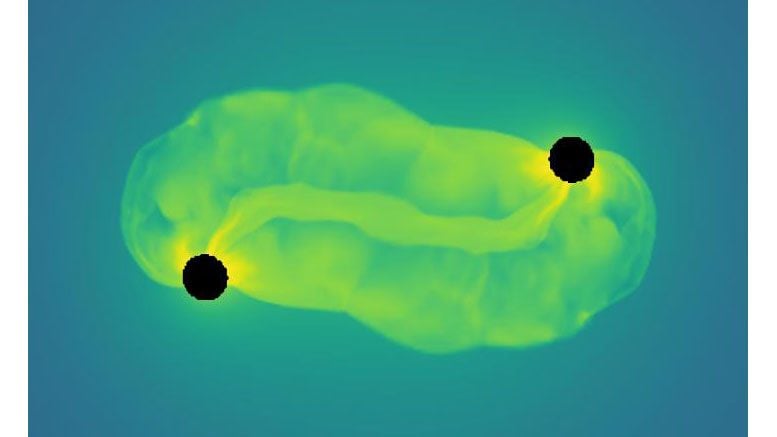
    Astronomers Detect Gravitational Waves from Binary Black Hole Mergers inside Stars
    Snapshot of gravitational waves propagating from binary black holes merging inside of a star. Kyoto University, Joseph M. Fedrow

    Far from earth, two black holes orbit around each other propagating waves that bend time and space.

    The existence of such waves — gravitational waves — was first predicted by Albert Einstein over a century ago on the basis of his theory of general relativity. And as always: Einstein was right. But it took until 2015 for the Laser Interferometer Gravitational-Wave Observatory to detect gravitational waves for the first time: findings which earned the LIGO team the Nobel Prize in physics two years later.

    In addition to the shockwave this discovery sent across the scientific community, it also gave researchers the new field of gravitational wave astronomy. But as with many discoveries, for every mystery solved, new questions have arisen.

    One such new puzzle: how did those gravitational wave-inducing black holes originate?

    Writing in the journal Physical Review Letters, Joseph Fedrow of Kyoto University’s Yukawa Institute for Theoretical Physics — in collaboration with the International Research Unit for Advanced Future Studies — has determined what gravitational waves might look like if two black holes formed inside a massive, collapsing star.

    “Although gravitational waves have allowed us to directly detect black holes for the first time, we still don’t know the exact origins of these particular black holes,” explains Fedrow.

    “One idea is that these black holes formed during dynamical fragmentation of the inner core of a dying star undergoing gravitational collapse.” This, according to Fedrow, could have resulted in two of the fragments becoming black holes and orbiting around each other in the remains of the stellar environment.

    To test this proposal, the team used supercomputers and the tools of numerical relativity to create a model of two black holes in such surroundings. And after many long hours of computation, the output was compared against LIGO’s observational data.

    “Our results were measurably different,” continues Fedrow, “showing that if black holes formed in a high-density, stellar environment, then the time it takes for them to merge shortens. If the density is lowered to levels more similar to vacuum, then the resulting gravitational waves match those of the event observed.”

    In addition to shedding light on the dynamics of binary black holes, these results reaffirm that the first waves detected by LIGO came from black holes in an empty region of space.

    “In this exciting, new era of gravitational wave astronomy, we don’t know what we’ll find, or where it will lead us,” concludes Fedrow. “But our work here will help to illuminate untrodden paths, and shine a light upon the darkest of objects in the universe.”

    Reference: “Gravitational Waves from Binary Black Hole Mergers inside Stars” by Joseph M. Fedrow, Christian D. Ott, Ulrich Sperhake, Jonathan Blackman, Roland Haas, Christian Reisswig and Antonio De Felice, 24 October 2017, Physical Review Letters.
    DOI: 10.1103/PhysRevLett.119.171103

    Never miss a breakthrough: Join the SciTechDaily newsletter.
    Follow us on Google and Google News.

    Astronomy Astrophysics Black Hole Cosmology Kyoto University LIGO
    Share. Facebook Twitter Pinterest LinkedIn Email Reddit

    Related Articles

    Dense Stellar Clusters Are Home to Black Hole ‘Megamergers’

    Gravitational Waves From Merging Supermassive Black Holes Will Be Detected Within 10 years

    LIGO Detects Merging Ripples in Space and Time

    Advanced LIGO Looks to Reveal the Mystery of Merging Black Holes

    New Research Shows LIGO’s Twin Black Holes Might Have Been Born Inside a Single Star

    New Model Shows How a Collapsing Star Results in Two Black Holes that Form and Fuse

    NASA Data Suggests Black Holes Abundant Among the Earliest Stars

    Supercomputer Simulations Present a New View of Black Hole Jets and Accretion Disks

    The Brightest Flare Ever Observed From Sagittarius A*

    Leave A Reply Cancel Reply

    • Facebook
    • Twitter
    • Pinterest
    • YouTube

    Don't Miss a Discovery

    Subscribe for the Latest in Science & Tech!

    Trending News

    Invisible Black Holes Could Be Triggering Supernovae

    Scientists Discover the First Contagious Cancer in a Freshwater Animal

    THC-CBD Treatment Dramatically Reduces Agitation in Dementia Trial

    Scientists Say Love Follows Mathematical Patterns

    “Zombie Cells” Reveal a Hidden Weakness That Could Help Fight Aging

    Alien Signals May Be Hiding in a Radio Band SETI Has Barely Explored

    Earth’s Hidden Thermostat Has Regulated Climate for 60 Million Years

    This 518-Million-Year-Old Creature Reveals How Spiders Got Their Bite

    Follow SciTechDaily
    • Facebook
    • Twitter
    • YouTube
    • Pinterest
    • Newsletter
    • RSS
    SciTech News
    • Biology News
    • Chemistry News
    • Earth News
    • Health News
    • Physics News
    • Science News
    • Space News
    • Technology News
    Recent Posts
    • Shape-Shifting Drug Supercharges Cancer Treatment in Mice
    • Skin Damage May Begin Long Before You Can See It
    • Scientists Reversed Autism-Like Symptoms in Adult Mice Within Two Hours
    • Thousands of Years of Human History Unearthed in the Trent Valley
    • A Simple Twist Could Unlock a New Generation of Electronics
    Copyright © 1998 - 2026 SciTechDaily. All Rights Reserved.
    • Science News
    • About
    • Contact
    • Editorial Board
    • Privacy Policy
    • Terms of Use

    Type above and press Enter to search. Press Esc to cancel.