
Close Menu
    Facebook X (Twitter) Instagram
    SciTechDaily
    • Biology
    • Chemistry
    • Earth
    • Health
    • Physics
    • Science
    • Space
    • Technology
    Facebook X (Twitter) Pinterest YouTube RSS
    SciTechDaily
    Home»Space»Astronomers Map Vigorous Atmospheric Motion in the Red Supergiant Star Antares
    Space

    Astronomers Map Vigorous Atmospheric Motion in the Red Supergiant Star Antares

    By European Southern ObservatoryAugust 25, 2017No Comments4 Mins Read
    Facebook Twitter Pinterest Telegram LinkedIn WhatsApp Email Reddit
    Share
    Facebook Twitter LinkedIn Pinterest Telegram Email Reddit
    ESO Captures Best Ever Image of a Star’s Surface and Atmosphere
    VLTI reconstructed view of the surface of Antares. Credit: ESO/K. Ohnaka

    A team of astronomers has constructed the most detailed image ever of a star — the red supergiant star Antares. They have also made the first map of the velocities of material in the atmosphere of a star other than the Sun, revealing unexpected turbulence in Antares’s huge extended atmosphere.

    To the unaided eye, the famous, bright star Antares shines with a strong red tint in the heart of the constellation of Scorpius (The Scorpion). It is a huge and comparatively cool red supergiant star in the late stages of its life, on the way to becoming a supernova.

    A team of astronomers, led by Keiichi Ohnaka, of the Universidad Católica del Norte in Chile, has now used ESO’s Very Large Telescope Interferometer (VLTI) at the Paranal Observatory in Chile to map Antares’s surface and to measure the motions of the surface material. This is the best image of the surface and atmosphere of any star other than the Sun.
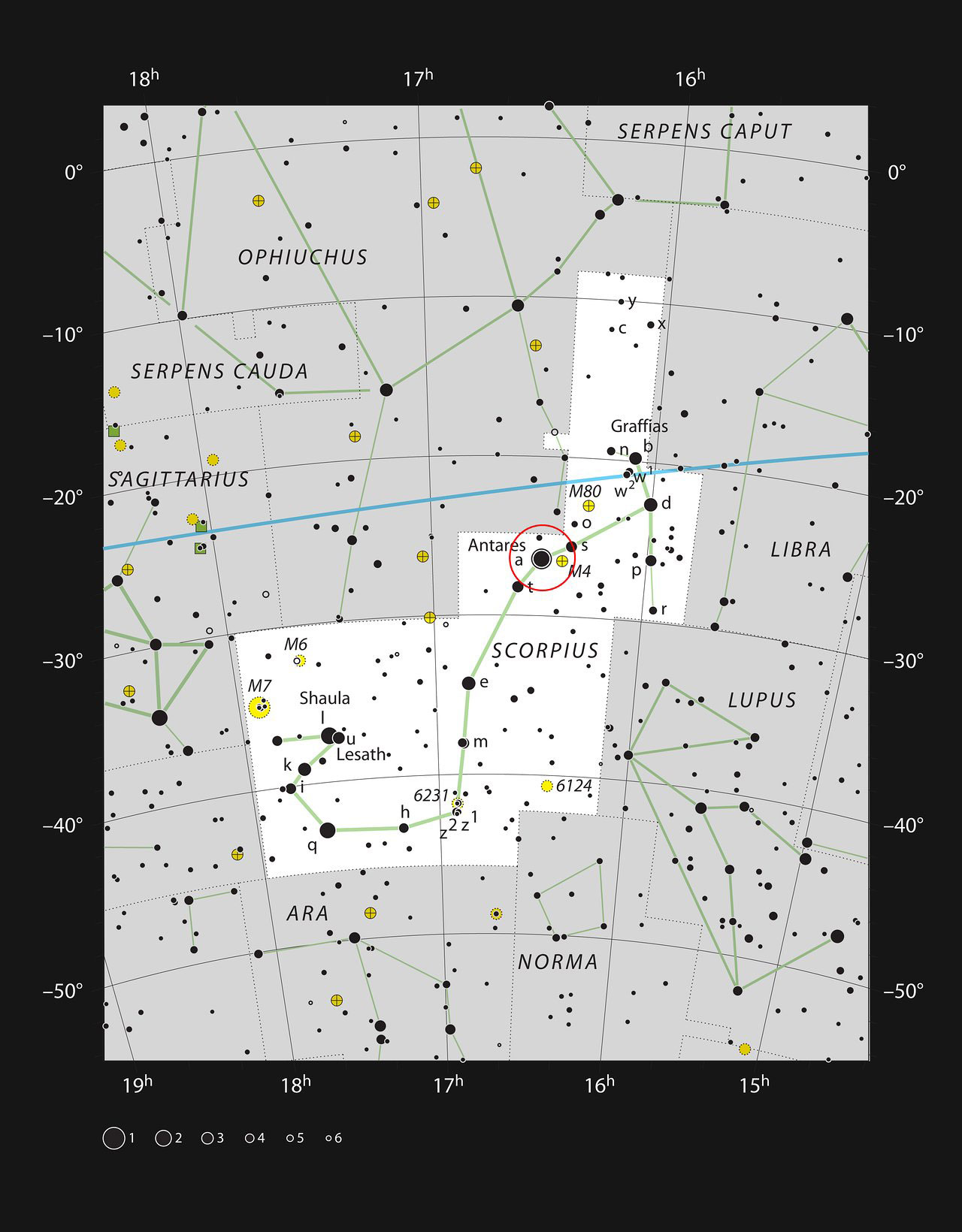
    Antares in the Constellation of Scorpius
    This chart shows the prominent constellation of Scorpius (The Scorpion). At the heart of this very striking grouping of stars lies the bright red supergiant star Antares.
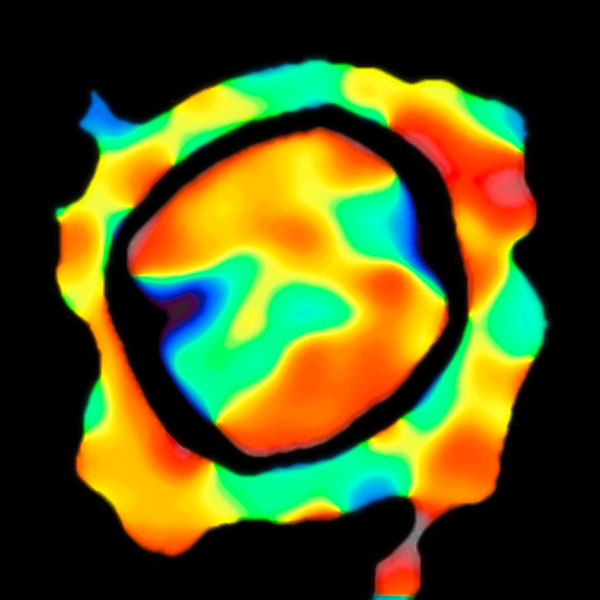
    Using ESO’s Very Large Telescope Interferometer astronomers have constructed this remarkable map of the motions of material on the surface of the red supergiant star Antares. This is the first such velocity map of any star other than the Sun. In red regions the material is moving away from us and in the blue areas the material is approaching. The empty region around the star is not a real feature, but shows where velocity measurements were not possible.

    The VLTI is a unique facility that can combine the light from up to four telescopes, either the 8.2-meter Unit Telescopes, or the smaller Auxiliary Telescopes, to create a virtual telescope equivalent to a single mirror up to 200 meters across. This allows it to resolve fine details far beyond what can be seen with a single telescope alone.

    “How stars like Antares lose mass so quickly in the final phase of their evolution has been a problem for over half a century,” said Keiichi Ohnaka, who is also the lead author of the paper. “The VLTI is the only facility that can directly measure the gas motions in the extended atmosphere of Antares — a crucial step towards clarifying this problem. The next challenge is to identify what’s driving the turbulent motions.”


    Using ESO’s Very Large Telescope Interferometer astronomers have constructed the most detailed image ever of a star — the red supergiant star Antares. They have also made the first map of the velocities of material the atmosphere of a star other than the Sun, revealing unexpected turbulence in Antares’s huge extended atmosphere.

    Using the new results the team has created the first two-dimensional velocity map of the atmosphere of a star other than the Sun. They did this using the VLTI with three of the Auxiliary Telescopes and an instrument called AMBER to make separate images of the surface of Antares over a small range of infrared wavelengths. The team then used these data to calculate the difference between the speed of the atmospheric gas at different positions on the star and the average speed over the entire star. This resulted in a map of the relative speed of the atmospheric gas across the entire disc of Antares — the first ever created for a star other than the Sun..

    The astronomers found turbulent, low-density gas much further from the star than predicted, and concluded that the movement could not result from convection, that is, from large-scale movement of matter which transfers energy from the core to the outer atmosphere of many stars. They reason that a new, currently unknown, process may be needed to explain these movements in the extended atmospheres of red supergiants like Antares.

    “In the future, this observing technique can be applied to different types of stars to study their surfaces and atmospheres in unprecedented detail. This has been limited to just the Sun up to now,” concludes Ohnaka. “Our work brings stellar astrophysics to a new dimension and opens an entirely new window to observe stars.”


    This is an artist’s impression showing the surface and atmosphere of the supergiant star Antares, located in the constellation of Scorpius. It was made using data obtained by ESO’s Very Large Telescope Interferometer.

    Reference: “Vigorous atmospheric motion in the red supergiant star Antares” by K. Ohnaka, G. Weigelt and K.-H. Hofmann, 17 August 2017, Nature.
    DOI: 10.1038/nature23445

    Never miss a breakthrough: Join the SciTechDaily newsletter.
    Follow us on Google and Google News.

    Astronomy Astrophysics Cosmology European Southern Observatory Popular VLTI
    Share. Facebook Twitter Pinterest LinkedIn Email Reddit

    Related Articles

    ALMA Detects Water Snowline Around Young Star V883 Orionis

    Astronomers Discover Unexpectedly Cold Grains in a Planet-Forming Disc

    Detailed Images of the Hypergiant Star VY Canis Majoris

    VISTA Survey Telescope Discovers Massive Galaxies in the Early Universe

    VISTA Telescope Discovers a New Component of Milky Way

    Astronomers Discover VFTS 352 – The Hottest and Most Massive Touching Double Star System to Date

    ESO Image of the Week: A Microlensing Mystery

    GAMA Survey Reveals the Slow Death of the Universe

    VLT/SPHERE Reveal a Star Giving Birth to a Butterfly-Like Planetary Nebula

    Leave A Reply Cancel Reply

    • Facebook
    • Twitter
    • Pinterest
    • YouTube

    Don't Miss a Discovery

    Subscribe for the Latest in Science & Tech!

    Trending News

    Massive Study Warns Marijuana Use in Teens Is Linked to Serious Mental Illness

    Scientists Discover a Completely Unexpected Way T Cells Kill Cancer

    Scientists Just Found the Solar System’s Original “Planet Factory”

    Study Warns Widely Used Food Preservatives Linked to High Blood Pressure and Heart Disease

    New Treatment Could Reverse Osteoarthritis Within Weeks

    Physicists Have Measured “Negative Time” in Bizarre Quantum Experiment

    The Deadly Tapeworm Spreading Across America Has Reached the Pacific Northwest

    Could Low Vitamin D Be Making Your Pain Worse?

    Follow SciTechDaily
    • Facebook
    • Twitter
    • YouTube
    • Pinterest
    • Newsletter
    • RSS
    SciTech News
    • Biology News
    • Chemistry News
    • Earth News
    • Health News
    • Physics News
    • Science News
    • Space News
    • Technology News
    Recent Posts
    • Streetlights Are Trapping Thousands of Isopods in Mysterious “Death Spirals”
    • Scientists Have Discovered These Deadly Parasites Are Secretly Swapping DNA
    • What Scientists Found Inside a 117-Year-Old Woman Reveals New Clues to Long Life
    • Breakthrough Technique Reveals Atomic Secrets of Record-Breaking Superconductors
    • The Future of Work Belongs to People Who Master AI
    Copyright © 1998 - 2026 SciTechDaily. All Rights Reserved.
    • Science News
    • About
    • Contact
    • Editorial Board
    • Privacy Policy
    • Terms of Use

    Type above and press Enter to search. Press Esc to cancel.