
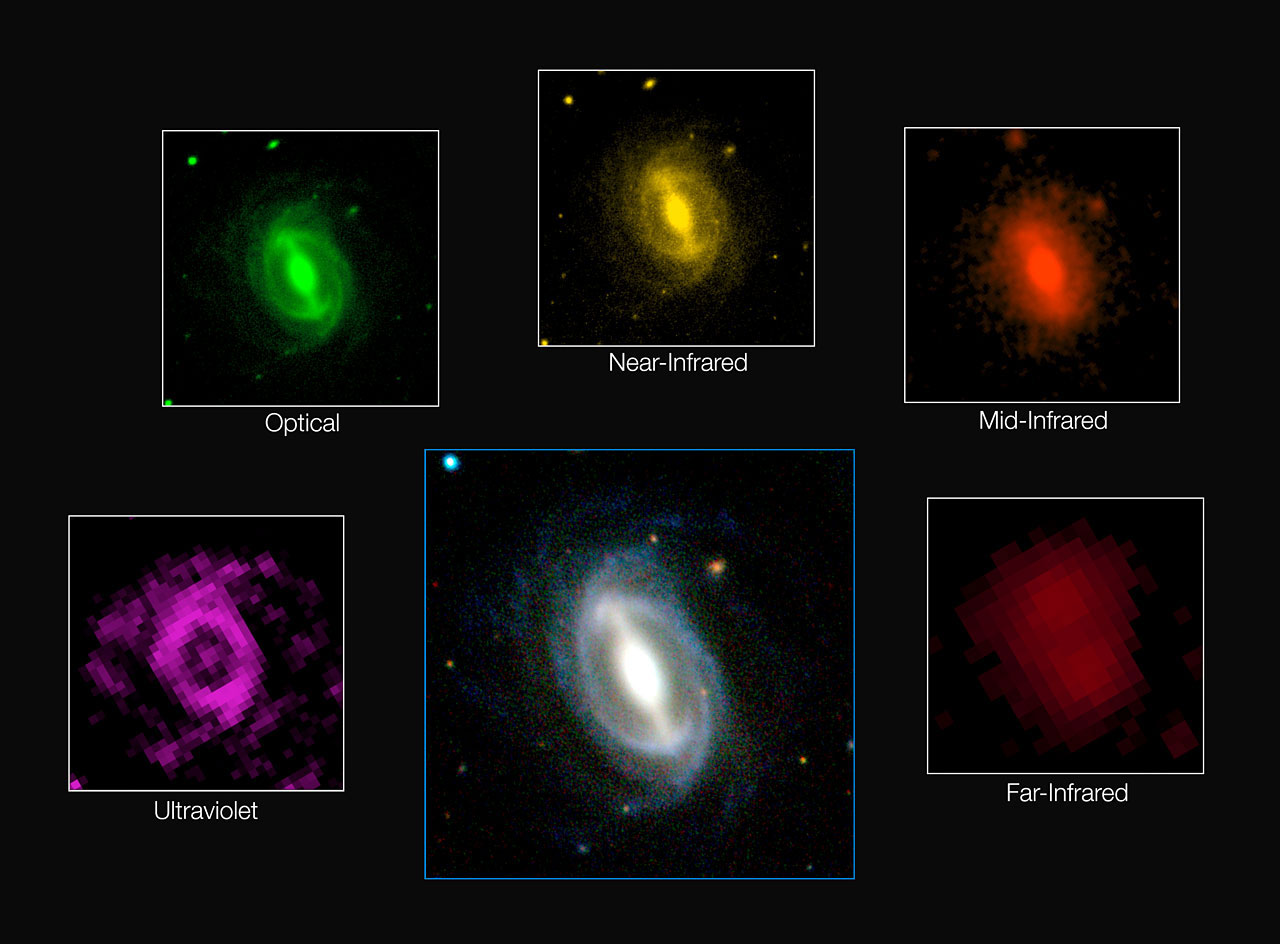
The Galaxy And Mass Assembly project released its first data at the International Astronomical Union XXIX General Assembly in Hawaii, revealing that the Universe is slowly dying.
An international team of astronomers studying more than 200,000 galaxies has measured the energy generated within a large portion of space more precisely than ever before. This represents the most comprehensive assessment of the energy output of the nearby Universe. They confirm that the energy produced in a section of the Universe today is only about half what it was two billion years ago and find that this fading is occurring across all wavelengths from the ultraviolet to the far infrared. The Universe is slowly dying.
The study involves many of the world’s most powerful telescopes, including ESO’s VISTA and VST survey telescopes at the Paranal Observatory in Chile. Supporting observations were made by two orbiting space telescopes operated by NASA (GALEX and WISE) and another belonging to the European Space Agency (Herschel).
The research is part of the Galaxy And Mass Assembly (GAMA) project, the largest multi-wavelength survey ever put together.
“We used as many space and ground-based telescopes as we could get our hands on to measure the energy output of over 200,000 galaxies across as broad a wavelength range as possible,” says Simon Driver (ICRAR, The University of Western Australia), who heads the large GAMA team.
The survey data, released to astronomers around the world today, includes measurements of the energy output of each galaxy at 21 wavelengths, from the ultraviolet to the far infrared. This dataset will help scientists to better understand how different types of galaxies form and evolve.
All the energy in the Universe was created in the Big Bang, with some portion locked up as mass. Stars shine by converting mass back into energy, as described by Einstein’s famous equation E=mc2. The GAMA study sets out to map and model all of the energy generated within a large volume of space today and at different times in the past.
“While most of the energy sloshing around in the Universe arose in the aftermath of the Big Bang, additional energy is constantly being generated by stars as they fuse elements like hydrogen and helium together,” Simon Driver says. “This new energy is either absorbed by dust as it travels through the host galaxy, or escapes into intergalactic space and travels until it hits something, such as another star, a planet, or, very occasionally, a telescope mirror.”
The fact that the Universe is slowly fading has been known since the late 1990s, but this work shows that it is happening across all wavelengths from the ultraviolet to the infrared, representing the most comprehensive assessment of the energy output of the nearby Universe.
“The Universe will decline from here on in, sliding gently into old age. The Universe has basically sat down on the sofa, pulled up a blanket, and is about to nod off for an eternal doze,” concludes Simon Driver.
The team of researchers hope to expand the work to map energy production over the entire history of the Universe, using a swathe of new facilities, including the world’s largest radio telescope, the Square Kilometer Array, which is due to be built in Australia and South Africa over the next decade.
Reference: “Galaxy And Mass Assembly (GAMA): Panchromatic Data Release (far-UV — far-IR) and the low-z energy budget” by Simon P. Driver, Angus H. Wright, Stephen K. Andrews, Luke J. Davies, Prajwal R. Kafle, Rebecca Lange, Amanda J. Moffett, Elizabeth Mannering, Aaron S. G. Robotham, Kevin Vinsen, Mehmet Alpaslan, Ellen Andrae, Ivan K. Baldry, Amanda E. Bauer, Steven P. Bamford, Joss Bland-Hawthorn, Nathan Bourne, Sarah Brough, Michael J. I. Brown, Michelle E. Cluver, Scott Croom, Matthew Colless, Christopher J. Conselice, Elisabete da Cunha, Roberto De Propris, Michael Drinkwater, Loretta Dunne, Steve Eales, Alastair Edge, Carlos Frenk, Alister W. Graham, Meiert Grootes, Benne W. Holwerda, Andrew M. Hopkins, Edo Ibar, Eelco van Kampen, Lee S. Kelvin, Tom Jarrett, D. Heath Jones, Maritza A. Lara-Lopez, Angel R. Lopez-Sanchez, Jochen Liske, Jon Loveday, Steve J. Maddox, Barry Madore, Martin Meyer, Peder Norberg, Samantha J. Penny, Stephen Phillipps, Cristina Popescu, Richard J. Tuffs, John A. Peacock, Kevin A.Pimbblet, Kate Rowlands, Anne E. Sansom, Mark Seibert, Matthew W.L. Smith, Will J. Sutherland, Edward N. Taylor, Elisabetta Valiante, Lingyu Wang, Stephen M. Wilkins and Richard Williams, 2 December 2015, MNRAS.
DOI: 10.1093/mnras/stv2505
arXiv: 1508.02076
Never miss a breakthrough: Join the SciTechDaily newsletter.
Follow us on Google and Google News.
1 Comment
Anyone in this study predicting how long this “death” will take?