
Close Menu
    Facebook X (Twitter) Instagram
    SciTechDaily
    • Biology
    • Chemistry
    • Earth
    • Health
    • Physics
    • Science
    • Space
    • Technology
    Facebook X (Twitter) Pinterest YouTube RSS
    SciTechDaily
    Home»Space»Astronomers Observe Unprecedented Detail in Pulsar PSR B1957+20
    Space

    Astronomers Observe Unprecedented Detail in Pulsar PSR B1957+20

    By Chris Sasaki, University of TorontoMay 24, 2018No Comments3 Mins Read
    Facebook Twitter Pinterest Telegram LinkedIn WhatsApp Email Reddit
    Share
    Facebook Twitter LinkedIn Pinterest Telegram Email Reddit
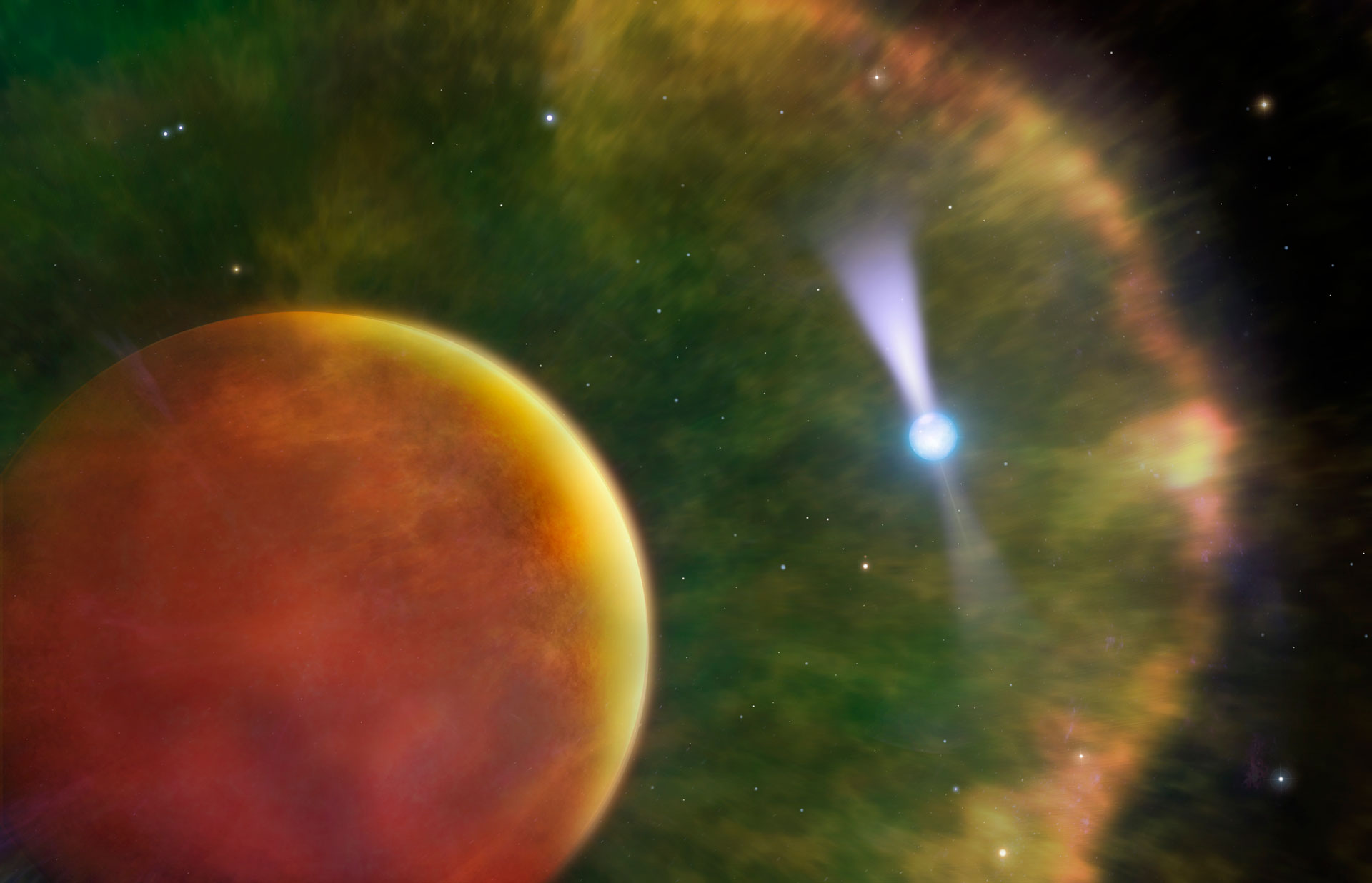
    Pulsar PSR B1957+20
    The pulsar PSR B1957+20 is seen in the background through the cloud of gas enveloping its brown dwarf star companion. Credit: Dr. Mark A. Garlick; Dunlap Institute for Astronomy & Astrophysics, University of Toronto

    A team of astronomers has performed one of the highest resolution observations in astronomical history by observing two intense regions of radiation, 20 kilometers (12 miles) apart, around a star 6500 light-years away.

    The observation is equivalent to using a telescope on Earth to see a flea on the surface of Pluto.

    The extraordinary observation was made possible by the rare geometry and characteristics of a pair of stars orbiting each other. One is a cool, lightweight star called a brown dwarf, which features a “wake” or comet-like tail of gas. The other is an exotic, rapidly spinning star called a pulsar.

    “The gas is acting like a magnifying glass right in front of the pulsar,” says Robert Main, lead author of the paper describing the observation being published May 24 in the journal Nature. “We are essentially looking at the pulsar through a naturally occurring magnifier which periodically allows us to see the two regions separately.”

    Main is a Ph.D. astronomy student in the Department of Astronomy & Astrophysics at the University of Toronto, working with colleagues at the University of Toronto’s Dunlap Institute for Astronomy & Astrophysics and Canadian Institute for Theoretical Astrophysics, and the Perimeter Institute.

    The pulsar is a neutron star that rotates rapidly—over 600 times a second. As the pulsar spins, it emits beams of radiation from the two hotspots on its surface. The intense regions of radiation being observed are associated with the beams.

    The brown dwarf star is about a third the diameter of the Sun. It is roughly two million kilometers from the pulsar—or five times the distance between the Earth and the moon—and orbits around it in just over 9 hours. The dwarf companion star is tidally locked to the pulsar so that one side always faces its pulsating companion, the way the moon is tidally locked to the Earth.

    Because it is so close to the pulsar, the brown dwarf star is blasted by the strong radiation coming from its smaller companion. The intense radiation from the pulsar heats one side of the relatively cool dwarf star to the temperature of our Sun, or some 6000°C (11,000°F).

    The blast from the pulsar could ultimately spell its companion’s demise. Pulsars in these types of binary systems are called “black widow” pulsars. Just as a black widow spider eats its mate, it is thought the pulsar, given the right conditions, could gradually erode gas from the dwarf star until the latter is consumed.

    In addition to being an observation of incredibly high resolution, the result could be a clue to the nature of mysterious phenomena known as Fast Radio Bursts, or FRBs.

    “Many observed properties of FRBs could be explained if they are being amplified by plasma lenses,” said Main. “The properties of the amplified pulses we detected in our study show a remarkable similarity to the bursts from the repeating FRB, suggesting that the repeating FRB may be lensed by plasma in its host galaxy.”

    Reference: “Pulsar emission amplified and resolved by plasma lensing in an eclipsing binary” by Robert Main, I-Sheng Yang, Victor Chan, Dongzi Li, Fang Xi Lin, Nikhil Mahajan, Ue-Li Pen, Keith Vanderlinde and Marten H. van Kerkwijk, 23 May 2018, Nature.
    DOI: 10.1038/s41586-018-0133-z

    Never miss a breakthrough: Join the SciTechDaily newsletter.
    Follow us on Google and Google News.

    Astronomy Cosmology Pulsars University of Toronto
    Share. Facebook Twitter Pinterest LinkedIn Email Reddit

    Related Articles

    Mysterious Gamma-Ray Glow at the Center of the Milky Way Most Likely Caused by Pulsars, Not Dark Matter

    NuSTAR Helps Solve Forty-Year-Old Neutron Star Mystery

    Astronomers Study the Pulsar Wind Nebula Created by PSR B0355+54

    Astronomers Identify a Signature of Dark Matter Annihilation

    Chandra Reveals a Pulsar on the Southern Edge the Jellyfish Nebula

    Fermi Satellite Detects Gamma-Ray Pulsar in the Tarantula Nebula

    Scientists Develop a New Method for Measuring the Mass of Pulsars

    Astrophysicists Examine the Possibility of Planets Forming around HL Tauri

    Astronomers Take a Closer Look at Black Widow and Redback Binary Systems

    Leave A Reply Cancel Reply

    • Facebook
    • Twitter
    • Pinterest
    • YouTube

    Don't Miss a Discovery

    Subscribe for the Latest in Science & Tech!

    Trending News

    Why Popular Diabetes Drugs Like Ozempic Don’t Work for Everyone: The “Genetic Glitch”

    Scientists Stunned After Finding Plant Thought Extinct for 60 Years

    Scientists Discover Tiny New Spider That Hunts Prey 6x Its Size

    Natural Component From Licorice Shows Promise for Treating Inflammatory Bowel Disease

    Scientists Warn: Popular Sweetener Linked to Dangerous Metabolic Effects

    Monster Storms on Jupiter Unleash Lightning Beyond Anything on Earth

    Scientists Create “Liquid Gears” That Spin Without Touching

    The Simple Habit That Could Help Prevent Cancer

    Follow SciTechDaily
    • Facebook
    • Twitter
    • YouTube
    • Pinterest
    • Newsletter
    • RSS
    SciTech News
    • Biology News
    • Chemistry News
    • Earth News
    • Health News
    • Physics News
    • Science News
    • Space News
    • Technology News
    Recent Posts
    • 100,000-Year-Old Neanderthal Fossils in Poland Reveal Unexpected Genetic Connections
    • Unexpected Hormone Discovery Could Change How We Treat Arthritis
    • Scientists Supercharge “Natural Killer” Cells To Break Through Cancer’s Defenses
    • Simple “Gut Reset” May Prevent Weight Gain After Ozempic or Wegovy
    • 2.8 Days to Disaster: Scientists Warn Low Earth Orbit Could Suddenly Collapse
    Copyright © 1998 - 2026 SciTechDaily. All Rights Reserved.
    • Science News
    • About
    • Contact
    • Editorial Board
    • Privacy Policy
    • Terms of Use

    Type above and press Enter to search. Press Esc to cancel.