
Close Menu
    Facebook X (Twitter) Instagram
    SciTechDaily
    • Biology
    • Chemistry
    • Earth
    • Health
    • Physics
    • Science
    • Space
    • Technology
    Facebook X (Twitter) Pinterest YouTube RSS
    SciTechDaily
    Home»Space»Astronomers Solve 900-Year-Old Cosmic Mystery Surrounding Famous Chinese Supernova of 1181AD
    Space

    Astronomers Solve 900-Year-Old Cosmic Mystery Surrounding Famous Chinese Supernova of 1181AD

    By University of ManchesterSeptember 18, 2021No Comments4 Mins Read
    Facebook Twitter Pinterest Telegram LinkedIn WhatsApp Email Reddit
    Share
    Facebook Twitter LinkedIn Pinterest Telegram Email Reddit

    Pa 30
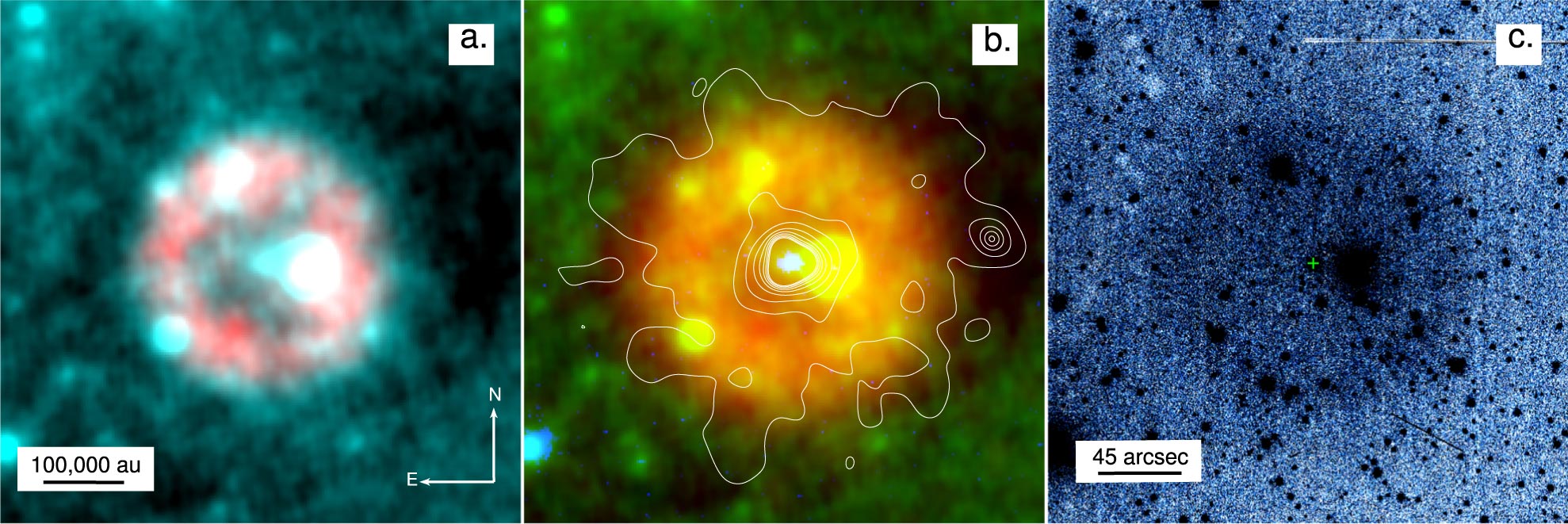
    Figure 1. (a) WISE false color image of Pa 30 where blue and green stand for 11 μm emission, and red for 22 μm. Here, the levels of the 22 μm component have been adjusted to enhance the ring-like feature. (b) In this false color image, where green stands for WISE 11 μm (as in the left panel) and red for WISE 22 μm (adjusted to show extended emission), the emission from the central star is highlighted in blue from the GALEX near-UV data, while the XMM-Newton contours (10 levels, linear scale) show that the majority of the X-ray emission originates from the core of the nebula. A background point source is seen westward of the CS in the XMM-Newton contour map. (c) The 2.1 m KPNO [O iii] image, which we have stacked and rebinned from individual frames to enhance the low surface brightness, diffuse shell. The green cross in the center of the image marks the location of the CS. Panels (a)–(c) are reproduced at the same angular scale and orientation. At the Gaia distance of Pa 30 of 2.30 ± 0.14 kpc, an angular scale of 45” translates to about 100,000 au.
    Pa30 and Parker’s Star have been confirmed as remnants of SN 1181, solving a 900-year-old mystery and revealing a rare Type Iax supernova.

    A 900-year-old cosmic mystery surrounding the origins of a famous supernova first spotted over China in 1181AD has finally been solved, according to an international team of astronomers.

    New research published today (September 15, 2021) says that a faint, fast expanding cloud (or nebula), called Pa30, surrounding one of the hottest stars in the Milky Way, known as Parker’s Star, fits the profile, location, and age of the historic supernova.

    There have only been five bright supernovae in the Milky Way in the last millennium (starting in 1006). Of these, the Chinese supernova, which is also known as the ‘Chinese Guest Star’ of 1181AD has remained a mystery. It was originally seen and documented by Chinese and Japanese astronomers in the 12th century who said it was as bright as the planet Saturn and remained visible for six months. They also recorded an approximate location in the sky of the sighting, but no confirmed remnant of the explosion has even been identified by modern astronomers. The other four supernovae are all now well known to modern day science and include the famous Crab nebula.

    The source of this 12th century explosion remained a mystery until this latest discovery made by a team of international astronomers from Hong Kong, the UK, Spain, Hungary, and France, including Professor Albert Zijlstra from The University of Manchester. In the new paper, the astronomers found that the Pa 30 nebula is expanding at an extreme velocity of more than 1,100 km (680 mi) per second (at this speed, traveling from the Earth to the Moon would take only 5 minutes). They use this velocity to derive an age at around 1,000 years, which would coincide with the events of 1181AD.

    Prof Zijlstra (Professor in Astrophysics at the University of Manchester) explains: “The historical reports place the guest star between two Chinese constellations, Chuanshe and Huagai. Parker’s Star fits the position well. That means both the age and location fit with the events of 1181.”

    A Rare Type Iax Supernova Unveiled  

    Pa 30 and Parker’s Star have previously been proposed as the result of a merger of two White Dwarfs. Such events are thought to lead to a rare and relatively faint type of supernova, called a ‘Type Iax supernova’.

    Prof Zijlstra added: “Only around 10% of supernovae are of this type and they are not well understood. The fact that SN1181 was faint but faded very slowly fits this type. It is the only such event where we can study both the remnant nebula and the merged star, and also have a description of the explosion itself.”

    The merging of remnant stars, white dwarfs and neutron stars, gives rise to extreme nuclear reactions and forms heavy, highly neutron-rich elements such as gold and platinum. Prof.  Zijlstra said: “Combining all this information such as the age, location, event brightness and historically recorded 185-day duration, indicates that Parker’s star and Pa30 are the counterparts of SN 1181. This is the only Type Iax supernova where detailed studies of the remnant star and nebula are possible. It is nice to be able to solve both a historical and an astronomical mystery.”

    Reference: “The Remnant and Origin of the Historical Supernova 1181 AD” by Andreas Ritter, Quentin A. Parker, Foteini Lykou, Albert A. Zijlstra, Martín A. Guerrero and Pascal Le Du, 15 September 2021, The Astrophysical Journal.
    DOI: 10.3847/2041-8213/ac2253

    Never miss a breakthrough: Join the SciTechDaily newsletter.
    Follow us on Google and Google News.

    Astronomy Astrophysics Popular Supernova University of Manchester
    Share. Facebook Twitter Pinterest LinkedIn Email Reddit

    Related Articles

    Astronomers Captured a Star’s Final Explosion in Stunning Detail

    Webb Telescope Captures the Final Moments of a Doomed Star Cloaked in Dust

    “Like Nothing Anyone Has Ever Seen Before” – Bizarre Supernova Stuns Scientists

    Scientists Think This Star Could Be the Next Supernova

    Rare Supernova Defies Textbooks and Reveals Inner Layers of a Dying Star

    Exploding Star Could Shed New Light on the Nature of Dark Energy

    12 Billion-Year Old Supernova Discovered by Astronomers

    Cloud of Hydrogen and Helium Plunging Toward the Galactic Center

    Astronomers Detect X-rays From the Remains of Supernova SN 1957D

    Leave A Reply Cancel Reply

    • Facebook
    • Twitter
    • Pinterest
    • YouTube

    Don't Miss a Discovery

    Subscribe for the Latest in Science & Tech!

    Trending News

    289-Million-Year-Old Reptile Mummy Reveals Origin of Human Breathing System

    New Brain Discovery Challenges Long-Held Theory of Teenage Brain Development

    Scientists Discover Plants “Scream” – We Just Couldn’t Hear Them Until Now

    Scientists Discover a Surprising Reason Intermittent Fasting Extends Life

    This Simple Fruit Wash Could Make Produce Safer and Last Days Longer

    Scientists Say Adding This Unusual Seafood to Your Diet Could Reverse Signs of Aging

    Scientists Say a Hidden Structure May Exist Inside Earth’s Core

    Doctors Surprised by the Power of a Simple Drug Against Colon Cancer

    Follow SciTechDaily
    • Facebook
    • Twitter
    • YouTube
    • Pinterest
    • Newsletter
    • RSS
    SciTech News
    • Biology News
    • Chemistry News
    • Earth News
    • Health News
    • Physics News
    • Science News
    • Space News
    • Technology News
    Recent Posts
    • Nearly 1 in 5 Gray Whales That Enter San Francisco Bay Die There
    • The Ozone Layer Is Healing, But There’s a Hidden Catch
    • Earth’s Crust Is Tearing Open in Africa, and It Could Form a New Ocean
    • Breakthrough Bowel Cancer Trial Leaves Patients Cancer-Free for Nearly 3 Years
    • New Immune Pathway Could Supercharge mRNA Cancer Vaccines
    Copyright © 1998 - 2026 SciTechDaily. All Rights Reserved.
    • Science News
    • About
    • Contact
    • Editorial Board
    • Privacy Policy
    • Terms of Use

    Type above and press Enter to search. Press Esc to cancel.